
Apache HTTP Server 2.4.71 fixes a critical HTTP/2 vulnerability that could allow remote code execution on affected web servers. Released on November 11, 2026, the update addresses CVE-2026-119618, a synchronization failure in the mod_http2 module. The Apache Software Foundation credits independent findings by Anthropic’s OSS Scanner and Google Cloud Vulnerability Research. Administrators running affected HTTP/2 deployments should prioritize the vendor’s security release instead of assuming a firewall alone eliminates the application-level exposure.

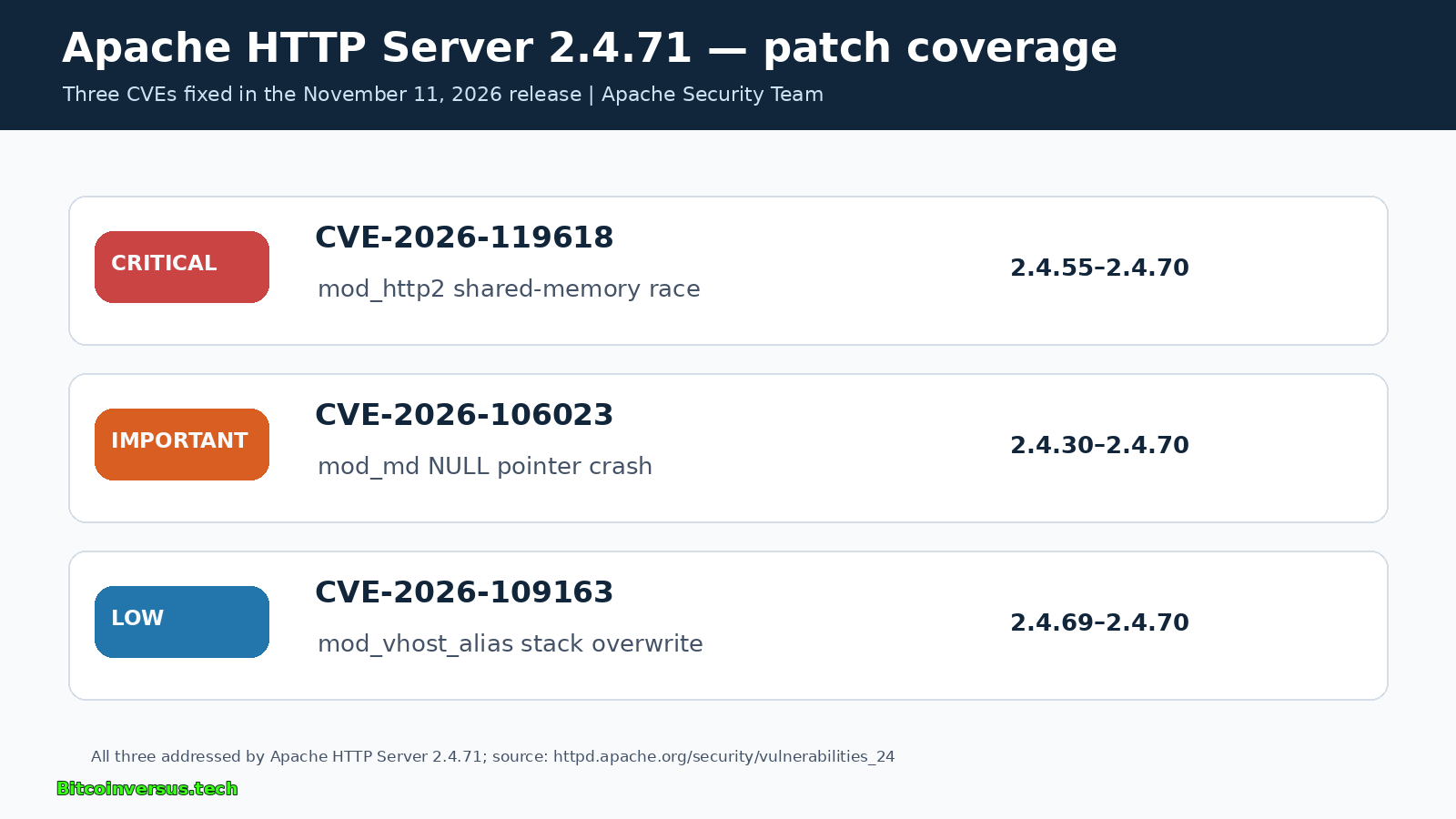
Apache’s official vulnerability bulletin identifies affected server versions 2.4.55 through 2.4.70, along with standalone mod_h2 versions 2.0.8 through 2.0.42. The fixed Apache HTTP Server version is 2.4.71. The release also includes two additional vulnerability fixes with lower severity ratings.
What failed inside the HTTP/2 module
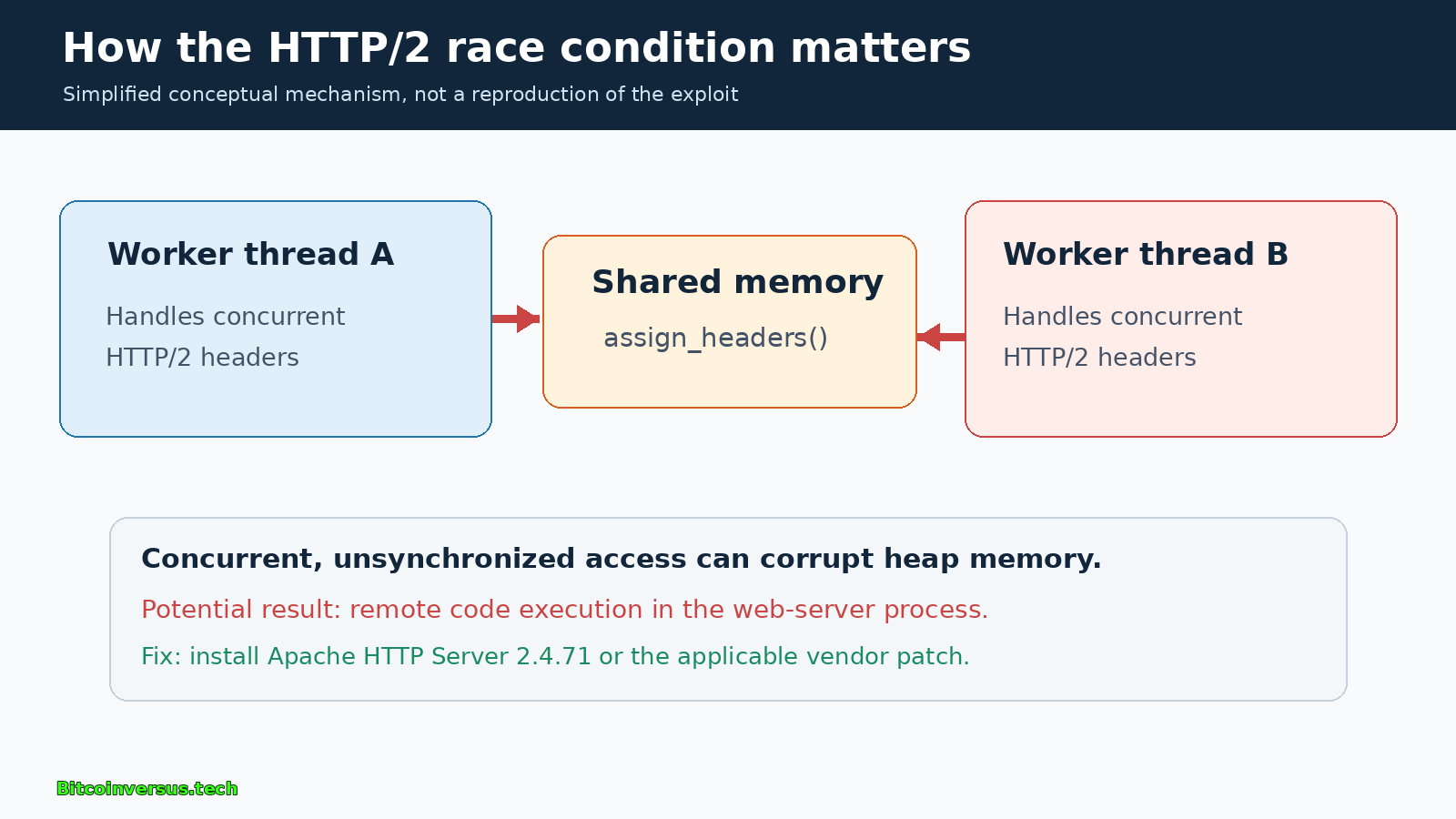
HTTP/2 permits multiple requests and responses to share a connection through multiplexed streams. It can improve efficiency compared with repeated independent HTTP/1.1 connections, but concurrent processing requires careful coordination when threads share memory. The defect affects assign_headers(), where competing execution paths may access a shared resource without proper synchronization.
Apache rates the flaw critical because the resulting heap corruption can potentially permit code execution in the web-server process. The security bulletin does not claim a universal, reliable exploit or document confirmed widespread exploitation. Actual exposure depends on the installed software, whether the affected module is used and platform-specific runtime conditions. The underlying protocol is not itself declared broken.
Understanding TCP transport and how browsers reach web servers helps separate the network connection from the vulnerable HTTP/2 server implementation. Blocking traffic at the perimeter may reduce exposure, but a confirmed fixed build addresses the underlying software defect.
The same release resolves two more vulnerabilities
The project lists CVE-2026-106023, rated important, as a NULL-pointer dereference in mod_md that can crash a child process during request processing. Affected versions run from 2.4.30 through 2.4.70. A third issue, CVE-2026-109163, is a low-severity one-byte stack overwrite affecting mod_vhost_alias in versions 2.4.69 and 2.4.70.
A server running HTTP/1.1 without mod_http2 may not expose the critical HTTP/2 bug, while remaining affected by another issue in a loaded component. Administrators should inspect the actual module configuration, installed packages and vendor advisories rather than treating every Apache installation as equally vulnerable.
What administrators should verify now
Apache recommends upgrading to 2.4.71. On managed Linux distributions, the applicable fix may arrive as a backported security patch without changing the upstream version string to 2.4.71. Operators should confirm the distribution’s security advisory, package build and installed remediation instead of relying solely on httpd -v.
Before rollout, inventory internet-facing HTTP/2 endpoints and their reverse proxies, test site behavior on a staging host, and schedule a restart or reload using approved change procedures. Verify the new package, review error logs, and watch for HTTP/2 handshake or request failures after deployment. The Apache download page also provides cryptographic signatures for release-integrity verification.
Related BitcoinVersus.Tech reporting covers PHP application vulnerabilities, OpenSSH security updates, and AI-assisted vulnerability discovery. The technologies differ, but dependency inventories and timely verified patches are recurring operational requirements.
Anthropic reported the Apache issue on October 26, followed by Google researchers on November 3; Apache published the fix November 11. The independently credited discoveries demonstrate how different research methods can converge on the same vulnerability. They do not establish that an AI system autonomously deployed the patch or that exploitation has been observed in the wild.
Bottom line: Apache HTTP Server 2.4.71 is a concrete security update for vulnerable web-server configurations. Operators should confirm their software’s patch status, affected modules and distribution-specific fixes, then monitor the upgraded service for regressions.
Primary sources: Apache HTTP Server official vulnerability disclosures; Apache 2.4.71 release announcement, November 11, 2026; Apache security-list announcement for CVE-2026-119618; official signed downloads; and SecurityWeek independent reporting, November 12. Severity labels, version ranges and researcher attributions follow the Apache Security Team’s advisory.
Editor’s Note: Apache rates CVE-2026-119618 critical because a race condition in mod_http2 can permit remote code execution, but the project’s advisory does not establish confirmed exploitation or guaranteed exploit reliability. The affected upstream versions are 2.4.55 through 2.4.70; distribution-specific backported patches should be checked with package maintainers. The original 1200 × 630 colored-pencil cover and two in-story diagrams are conceptual editorial illustrations, not attack captures or official memory-layout drawings. The Apache HTTP Server logo is an authentic project asset. No directly relevant official YouTube or independently verified social player was available, so none is represented as functional. The post’s rendered content and responsive limitations are reported separately.

BitcoinVersus.Tech is volunteer-run and publishes independent educational technology reporting. An optional 5,000-satoshi donation supports ongoing research. Scan the original QR from a second screen with a compatible Bitcoin wallet; on mobile, use a wallet that supports scanning a saved image. Independently verify the recipient address 3C9o19EH5HSiwEPyCTmEKzxhNCbo2X6TTb and the payment amount before sending. Bitcoin transfers are generally irreversible.
We volunteer daily to ensure information on the BitcoinVersus.Tech platform is Verifiably True. Coverage is educational and informational and does not constitute financial or investment advice.


Leave a Reply