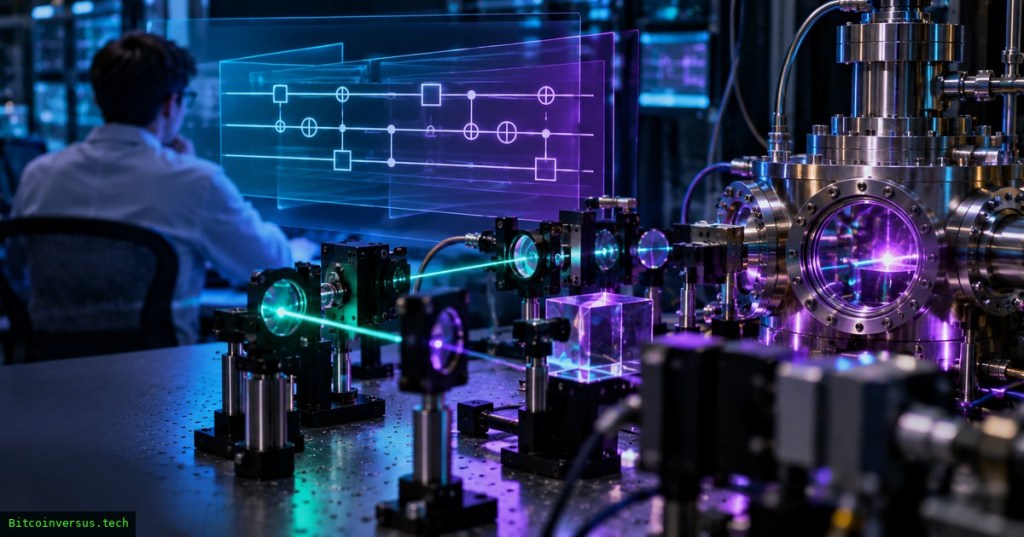
Researchers working with Harvard University, Anthropic and QuEra Computing have used an AI-assisted search system to design quantum circuits requiring fewer operations and fewer logical qubits than previous designs. A November 10, 2026 QuEra announcement highlighted a 39-fold improvement in the largest reported benchmark. Crucially, the result measures a product of gate count and qubit demand for a mathematical subroutine—not a 39-fold increase in the speed of an operating quantum computer.
Making the algorithm smaller, not the chip bigger
The October 15 research preprint, by Andi Gu, Alek H. Kemeny, Susanne F. Yelin and Mikhail D. Lukin, tested eight computational building blocks used in chemistry, optimization, simulation and number theory. In seven tasks, the newly designed circuits reduced both gate and qubit requirements against reported baselines. In the eighth, the search produced a new reversible modular-inversion architecture with different trade-offs between operations and memory.
Quantum algorithms must operate coherently over superposed inputs and reverse temporary computations rather than simply deleting intermediate values. Storage consumes scarce logical qubits, while repeatedly reconstructing information consumes gates. A Toffoli gate is a three-qubit reversible operation that becomes especially costly in fault-tolerant designs. Previous IBM quantum processor coverage describes the separate hardware challenge of building large, accurate systems.
What the 39-fold number actually measures
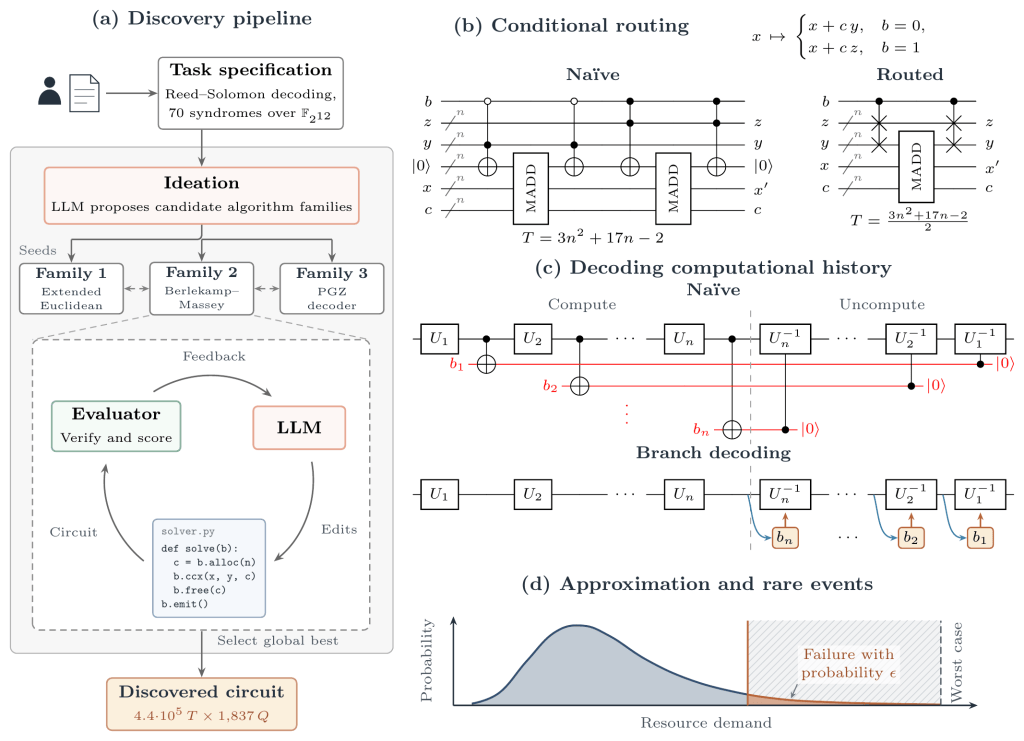
The researchers used Claude Mythos 5 to propose circuit-generating Python programs. An independent evaluator checked candidate behavior and ranked designs by T × Q, where T counts Toffoli operations and Q counts peak logical qubits. Several algorithm families were explored in parallel, with promising ideas carried between them. Evaluation included computational tests and, for a key modular-inversion result, formal verification in Lean; computational checks alone do not establish that every large circuit is mathematically proven for all inputs.
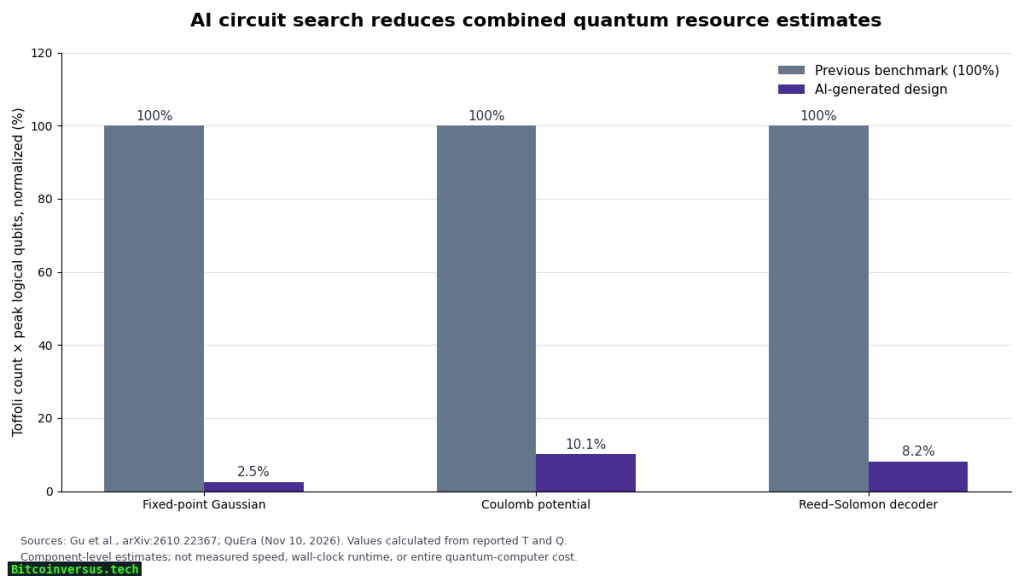
For a fixed-point Gaussian function, the published comparison drops from approximately 24,000 Toffoli gates and 362 qubits to 1,583 gates and 139 qubits. Multiplying the pairs gives about 8.69 million versus 220,037 gate-qubit units: a 39.5× smaller product. Coulomb-potential calculation improves about 9.9× on the same measure; Reed–Solomon decoding improves about 12.2× using the paper’s benchmark pairs. Each task has a different baseline and cannot be averaged into a claimed universal speedup.
Why quantum software matters
A particularly significant result converts the classical divsteps method for modular inversion into a reversible quantum procedure by recovering much of its branch history from the numbers already held in registers. The redesigned elliptic-curve point-addition circuit offers roughly 17 times fewer Toffoli gates than a previous compact-qubit comparison, at the price of roughly 12% more qubits. Such arithmetic is relevant to future cryptanalysis, but Bitcoin’s quantum-security risk cannot be inferred from an individual subroutine benchmark. No cryptocurrency security was broken in the reported experiment.
Another improvement replaces a costly Reed–Solomon decoding architecture with a reversible Berlekamp–Massey design. The researchers describe a controlled failure budget for rare inputs instead of reserving worst-case workspace for every possible run. Like AI-assisted formal verification of Signal’s code, the broader lesson is that automated generation becomes more useful when accompanied by independent validation.
Research result, not commercial quantum advantage
None of the reported benchmark circuits was executed as an end-to-end application on a fault-tolerant quantum processor. Physical error correction, connectivity, compilation overhead and runtime scheduling may alter eventual savings. The preprint is research evidence, not a commercial deployment or proof that useful quantum computers will arrive by a specified date. DARPA’s hardware-validation program tracks another necessary piece of the challenge. Improved algorithms and improved hardware could be complementary, but both must be measured together before application-level benefits can be claimed.
Primary research: Gu et al., “Discovering state-of-the-art quantum circuits with large language models,” October 15, 2026; Anthropic, October 16, 2026; QuEra technical commentary, October 16, 2026; QuEra announcement, November 10, 2026.
BitcoinVersus.Tech Editor’s Note: We volunteer daily to ensure the credibility of the information on this platform is Verifiably True. If you would like to support to help further secure the integrity of our research initiatives, please donate using the QR code provided.

Optional donation: 5,000 satoshis (0.00005 BTC). On mobile, display the original QR code on a second screen and scan it with a Bitcoin wallet, or use a wallet offering QR scanning from a saved image. Confirm the destination and amount in the wallet before sending.
BitcoinVersus.Tech is maintained by volunteers. BitcoinVersus.Tech is not a financial adviser. Reporting on financial and technology subjects is informational, not investment advice.


Leave a Reply