
A quantum processor is a scarce and specialized machine. Researchers generally cannot treat one like another CPU in a shared supercomputer. Pasqal says a new integration with Slurm 26.11, the widely used high-performance computing scheduler, is changing how quantum work can enter an ordinary cluster job queue. Announced November 19, 2026, the work builds on NVIDIA’s new Hierarchical Resources (HRES) interface and open-source Quantum Resource Management Interface (QRMI) software developed with IBM. The integration has been tested, but the new scheduler release was still slated for later in November.
Pasqal’s official May 2025 video shows its neutral-atom quantum processor. It explains the hardware, not the November 2026 scheduling integration. Open the video on YouTube if the embedded player cannot load.
A quantum computer can wait in the same queue as GPUs
Slurm decides which scientific computing jobs should run and which servers, GPUs and other resources they may occupy. A quantum processing unit, or QPU, is different: a machine might be shared by multiple compute nodes, accessed remotely, or temporarily unavailable for calibration. Older methods used site-specific workarounds, including software licenses and SPANK plugins. The new HRES model gives administrators a native cluster-level resource tied to whichever nodes can access the QPU.
Under the model described by NVIDIA’s technical team, a lightweight Lua plugin checks availability and manages job admission, while QRMI handles device access. The scheduler can hold jobs until a QPU becomes ready, establish access before execution and release the resource after completion or cancellation. Operators retain control of sharing limits and which nodes can connect.
Tests on emulators and a physical quantum processor
Pasqal published a technical account of its validation. Engineers submitted a small two-atom Rydberg-blockade experiment through Slurm, checking that a pair of nearby neutral atoms rarely entered an excluded simultaneous state. Their test covered Pasqal Cloud emulation and a simulated on-premises QPU connection, both using Pulser and NVIDIA CUDA-Q. They also report running the workflow on a physical FRESNEL_CAN1 processor in Canada through Pasqal Cloud.
The distinction matters: Italy’s CINECA center already runs quantum jobs on Pasqal’s Sol machine using the older QRMI SPANK route. Pasqal identifies that earlier integration as the production approach today, while its HRES implementation is the newer path to evaluate as centers adopt Slurm 26.11. Likewise, IQM describes demonstration work using the alternative QDMI interface, with broader staging validation still planned.
Pasqal’s official January 2026 example explores neutral-atom optimization of 5G/6G antenna placement. The application video is not a benchmark for Slurm HRES. Open the video on YouTube if the embedded player cannot load.
Why shared infrastructure matters more than a speed claim
A useful workflow can first run a quantum program in GPU emulation, then launch a dependent QPU job only if the emulator succeeds, and finally compare outcomes on classical processors. One scheduler can track those steps without reserving costly quantum time while a GPU performs preparatory computation. The approach may also simplify cluster operations, access control and failure recovery.
None of the announcements proves a quantum speed advantage, error-corrected fault tolerance or lower energy consumption. Queueing integration improves resource coordination, not quantum gate fidelity. The hardware’s actual value will depend on useful algorithms, device reliability, throughput and the expense of maintaining optical and control equipment. Earlier BitcoinVersus.Tech reporting covered IBM, NVIDIA and Fermilab’s quantum-classical research, quantum computing fundamentals, AI-assisted quantum circuit research and next-generation supercomputer CPU infrastructure.
What operators need to verify next
Before treating QPUs as routine cluster resources, operators should test Slurm version compatibility, QRMI plugin behavior, job cancellation, credentials, scheduling fairness, device maintenance windows and reproducible measurements against classical baselines. Pasqal’s November results establish a tested integration path. They do not establish universal deployment or quantum advantage.
Primary documentation: Pasqal’s November 19 announcement; Pasqal’s reproducible workflow notes; NVIDIA HRES technical guide; IQM independent integration announcement.
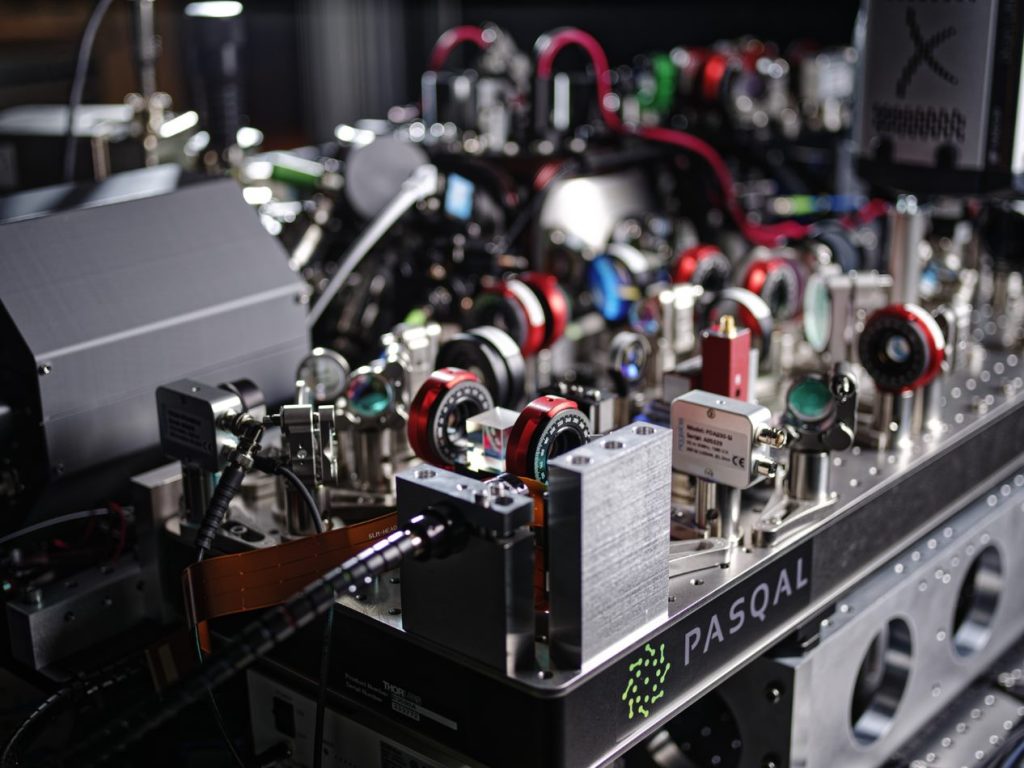
Media note: The featured 1200 × 630 colored-pencil cover is an original editorial illustration, not a photograph of Pasqal’s equipment. The interior photograph is an authentic Pasqal asset. Both YouTube videos are official Pasqal background material; neither depicts the November HRES tests.
We volunteer daily to ensure the credibility of the information on this platform is Verifiably True. If you would like to support to help further secure the integrity of our research initiative, please scan the QR code below.



Leave a Reply