
CHICAGO, November 21, 2026 — NVIDIA has introduced a liquid-cooled rack for scientific computing built around 192 Vera CPUs, expanding the processor’s role beyond AI-agent servers. Unveiled November 16 at SC26, the system targets weather simulation, computational fluid dynamics and molecular research where moving data quickly can be as important as executing instructions. NVIDIA claims substantial improvements over selected x86 configurations, but the measurements require careful interpretation.
NVIDIA’s June 2026 Vera CPU overview explains the underlying processor; the video predates the November HPC rack announcement. Open directly on YouTube if the video player does not load.
What is inside the new rack?
The company’s announcement specifies 24 one-unit trays, each containing eight Vera CPUs. At 88 Olympus cores and 176 threads per processor, the configuration totals 16,896 CPU cores and 33,792 hardware threads. It combines approximately 300 TB of system memory, 1 PB of storage, and more than 200 TB/s of aggregate peak memory bandwidth. These are manufacturer specifications, not independently audited delivered application throughput.
Vera uses high-bandwidth LPDDR5X memory, while NVIDIA Quantum-X800 InfiniBand connects the rack’s compute components. The SHARP in-network computing capability can offload collective operations, reducing synchronization delays during distributed simulations. Such tasks differ from conventional AI inference: scientific codes often exchange large arrays repeatedly, making bandwidth and communication overhead decisive. For context, our RoCEv2 congestion lesson explains why distributed workloads depend on disciplined network engineering.
What the efficiency figures actually measure
In NVIDIA-run tests of the OpenFOAM motorBike Large airflow model, Vera achieved 1.9× application performance and 2.4× performance per watt relative to the particular x86 systems selected for comparison. Neither multiplier means every simulation will run at the same advantage. The company separately projects 1.6× performance and 2× energy efficiency for the Weather Research and Forecasting model, with projected results carrying greater uncertainty than completed measurements.
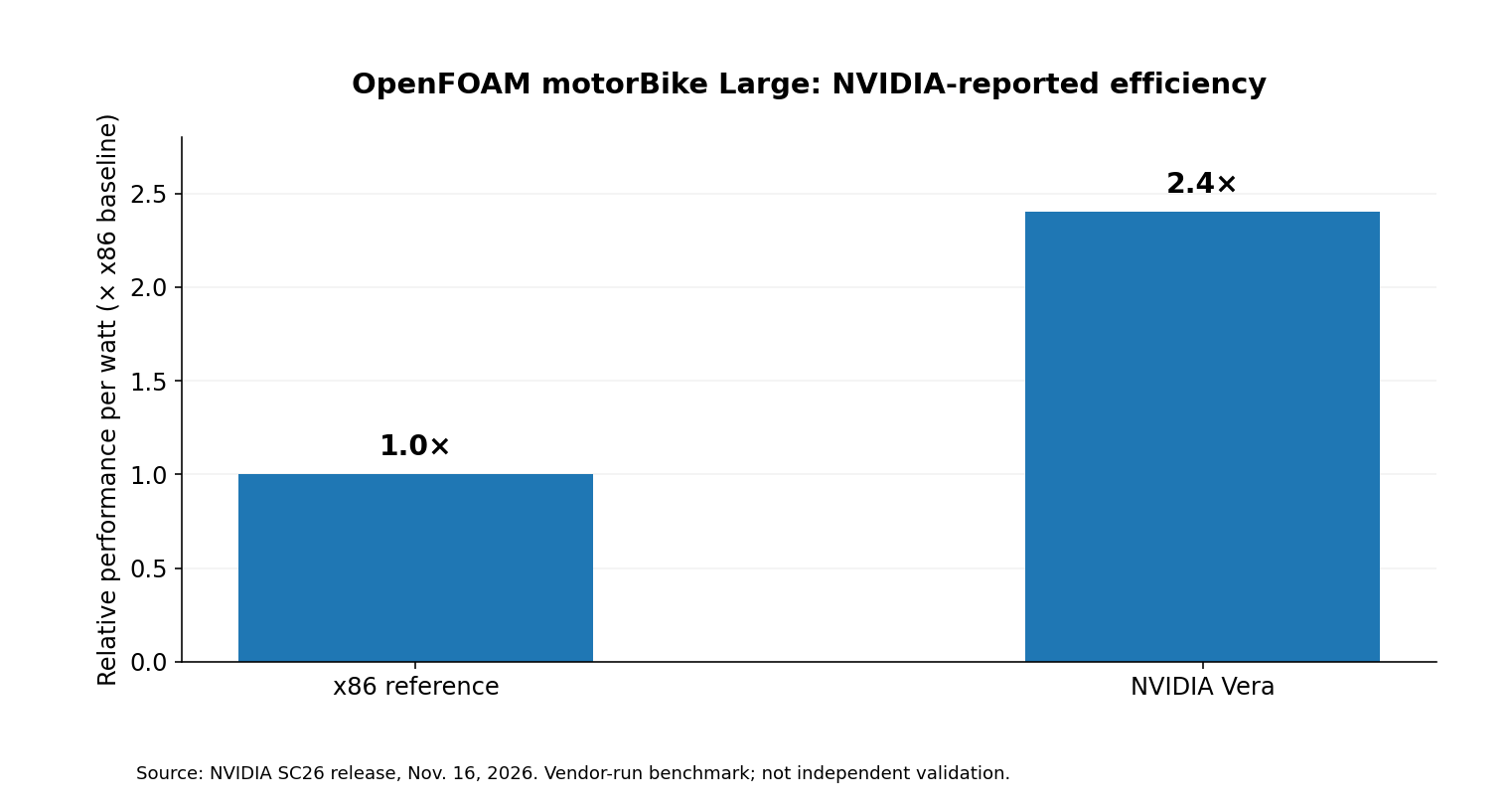
Workload, compiler versions, processor counts and the electricity measured at chip versus rack level influence performance-per-watt results. A 2.4× efficiency ratio is not a claim that the rack consumes 2.4× less electrical power at all utilization levels. Our prior SC26 TOP500 and Green500 report examines different standardized supercomputing metrics, and our 5,120-core liquid-cooled server coverage provides another approach to compute density.
Compiler support and deployment timeline
NVIDIA also released HPC SDK 26.11 and announced a public beta of its next-generation Fortran compiler. Backward compatibility with established Fortran codes matters because scientific institutions depend on simulation software maintained over decades. A new processor alone is insufficient if applications require expensive rewrites. Developers still need to validate numerical accuracy and reproducibility.
NVIDIA Newsroom’s November 16 SC26 announcement describes the Vera HPC platform and the company’s energy-efficiency claim. See the original X post.
Independent June 2026 Vera architecture explainer from MaxonShire; background video, not footage of the announced 192-CPU rack. Open directly on YouTube if the video player does not load.
The German Climate Computing Center plans to use Vera CPUs in its HLRE-5 machine, expected in early 2028. Vendors Dell, HPE, Lenovo and Supermicro are expected to offer the HPC rack starting in early 2027. The announcement should therefore be read as a product specification with selective performance evidence and a future deployment schedule—not a claim that the complete rack has already been installed at research centers.
The distinction between 192-CPU scientific racks and NVIDIA’s separate 256-CPU agentic server racks matters for capacity planning. CPU count, memory bandwidth, storage, networking and cooling topology are workload-specific choices. Our Azure Cobalt 200 infrastructure story offers a further example of custom CPUs challenging traditional data-center design.
Primary references: NVIDIA’s SC26 release (November 16); Vera CPU technical documentation; StorageReview conference coverage.
We volunteer daily to ensure the credibility of the information on this platform is Verifiably True. If you would like to support to help further secure the integrity of our research initiatives, please scan the QR code below



Leave a Reply