Just 27 new supercomputers entered the November 2026 TOP500, the lowest turnover ever recorded by the longstanding global ranking. Announced November 16 at SC26 in Chicago, the list kept all ten leading systems in their June positions. The separate Green500 energy-efficiency ranking also retained its entire top ten, led by France’s KAIROS at 73.28 gigaflops per second per watt.
The results illustrate a divide between the fastest individual research installations and the wider expansion of computing for artificial intelligence. Fewer new machines appearing in one performance ranking do not establish that global semiconductor or AI infrastructure investment has declined.
Forschungszentrum Jülich, May 28, 2026: an official explanation of JUPITER, Europe’s first exascale supercomputer. Original institutional footage provides context for the system ranked fifth in November, not coverage of the SC26 announcement.
The same five exascale machines lead again
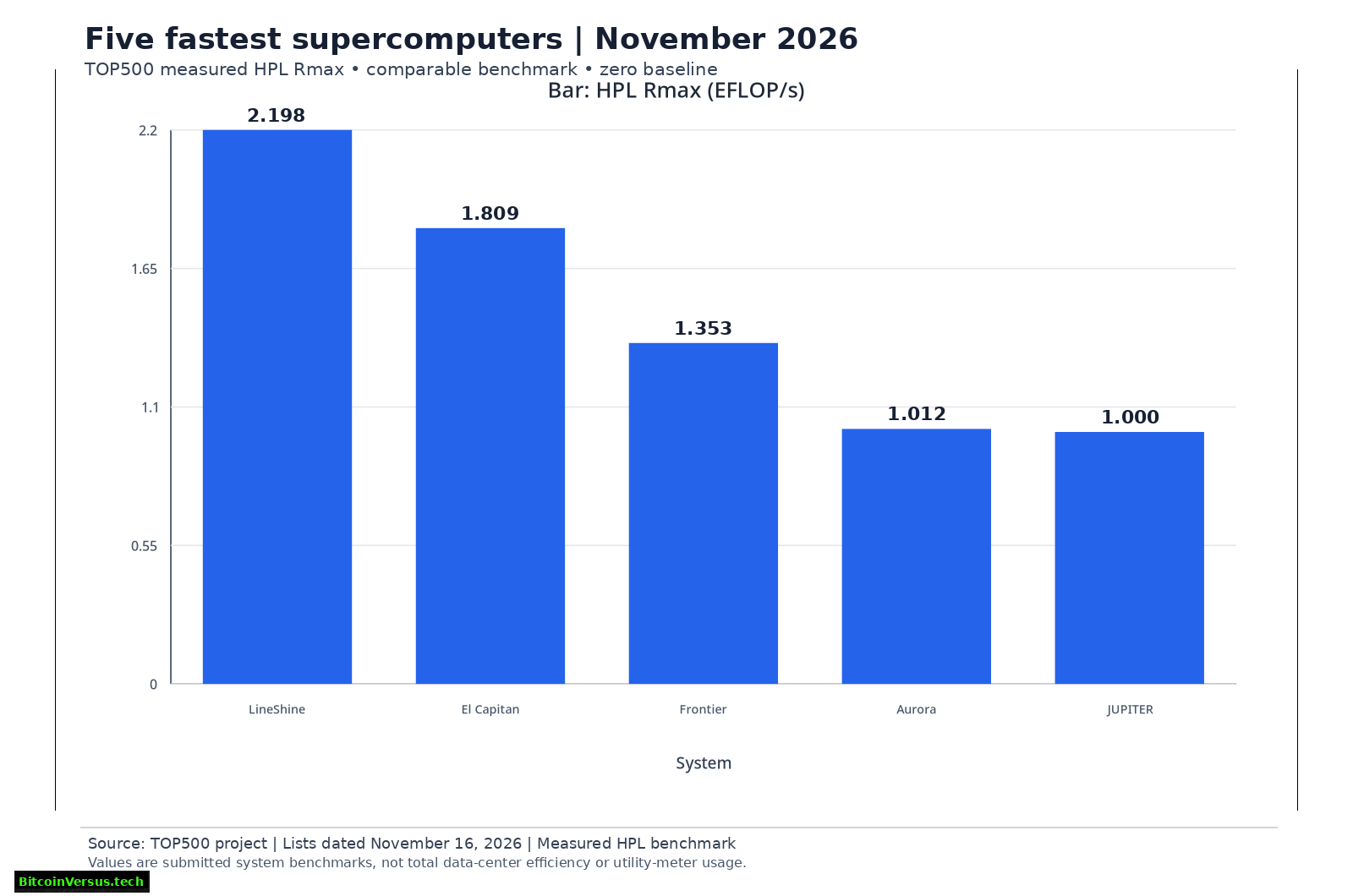
China’s LineShine remains first at 2.198 exaflops on High Performance Linpack (HPL), the standardized dense-matrix benchmark. The United States follows with El Capitan at 1.809, Frontier at 1.353 and Aurora at 1.012 exaflops. Germany’s JUPITER Booster completes the exascale group at exactly 1.000 exaflop. The other five systems also retained their places.
The new list nevertheless contains measurable progress. The No. 500 machine now achieves 2.857 petaflops, up from 2.662 in June, a 7.3% increase. Aggregate measured performance across the list climbed 4.4% to 19.57 exaflops. South Korea’s HANGANG was the highest-ranked new system, entering at No. 12 with 342.6 petaflops. The count of accelerator-equipped machines increased from 275 to 291.
The Green500 winner is not the fastest supercomputer
The November Green500 data rank France’s KAIROS first at 73.28 GFLOPS/W, followed by ROMEO-2025 at 70.91 and Germany’s Levante GPU extension at 69.43. All three use BullSequana XH3000 systems with NVIDIA Grace Hopper GH200 superchips. Their positions did not change from June.
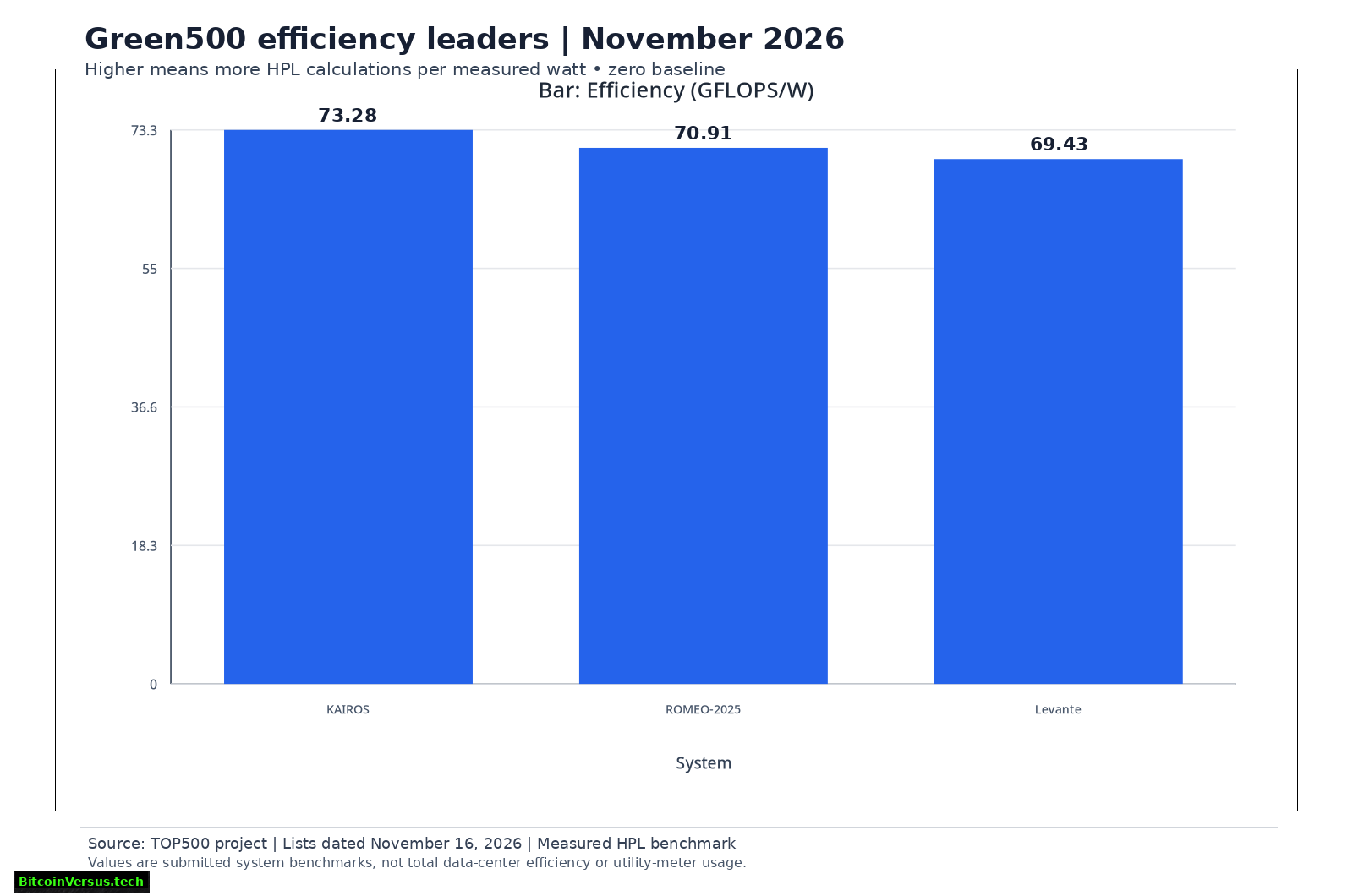
KAIROS ranks only 472nd on TOP500 for absolute performance, delivering about 3.05 petaflops. Energy efficiency is a ratio: the measured HPL calculation rate divided by the electrical power assessed under benchmark rules. It is not the machine’s annual electricity consumption, total building power usage effectiveness, or a guarantee that every workload reaches the reported efficiency.
Lawrence Livermore National Laboratory, January 9, 2025: its original El Capitan supercomputer documentary. Historical footage of the November 2026 No. 2 machine, not a recording of the latest ranking.
Why performance per watt matters
LineShine’s TOP500 entry lists approximately 42.22 megawatts of benchmark power at 2.198 exaflops, while El Capitan lists about 29.69 megawatts at 1.809 exaflops. Those are benchmark-associated values; actual facility electricity bills also depend on cooling, distribution losses, utilization and operating schedules. Comparing the electricity spent per floating-point operation matters alongside peak throughput when evaluating new hardware.
The difference is relevant to our compute-per-joule analysis, but it cannot be converted directly into Bitcoin-mining joules per terahash. Floating-point calculations and SHA-256 hashes are different operations, with different algorithms and specialized circuits.
What the quiet ranking does and does not mean
TOP500’s organizers suggest some investment is moving toward large AI service clusters that prioritize total useful computing capacity rather than a single published HPL result. Such infrastructure may not be submitted to the ranking, so the 27-newcomer figure is not a census of all new data centers. The measurement covers reporting systems, not every GPU installed worldwide.
For background, BitcoinVersus.Tech has examined the chips and cooling systems of the largest machines, the rise of exascale computing and industrial data-center cooling options. The next ranking will show whether the current pause in leadership turnover continues as new processors and installations are benchmarked.
Sources and verification
- TOP500 official November 16, 2026 release: new entries, performance thresholds and unchanged leaders
- TOP500 November 2026 system-level HPL and power measurements
- Green500 November 2026 measured efficiency table
- Forschungszentrum Jülich: JUPITER Facts & Figures, May 2026
- Lawrence Livermore National Laboratory: El Capitan, January 2025
Editor’s Note: Rankings reflect systems submitted to the November 2026 HPL and Green500 lists, not all AI installations. Efficiency figures refer to published benchmark methodologies, not comparable end-to-end utility-meter costs. The cover is original fine-art editorial illustration featuring a fictional researcher; historical institutional videos document actual supercomputers but predate SC26.
Editor’s Note: We volunteer daily to ensure the credibility of the information on this platform is Verifiably True. If you would like to support to help further secure the integrity of our research initiatives, please scan the QR code below

For mobile scanning, open the article on another display and scan the QR code with a Bitcoin wallet. The voluntary donation amount is 5,000 sats. Verify the receiving address 3C9o19EH5HSiwEPyCTmEKzxhNCbo2X6TTb before sending.
BitcoinVersus.Tech publishes technology and financial journalism for informational purposes and does not provide financial, investment, or legal advice.


Leave a Reply