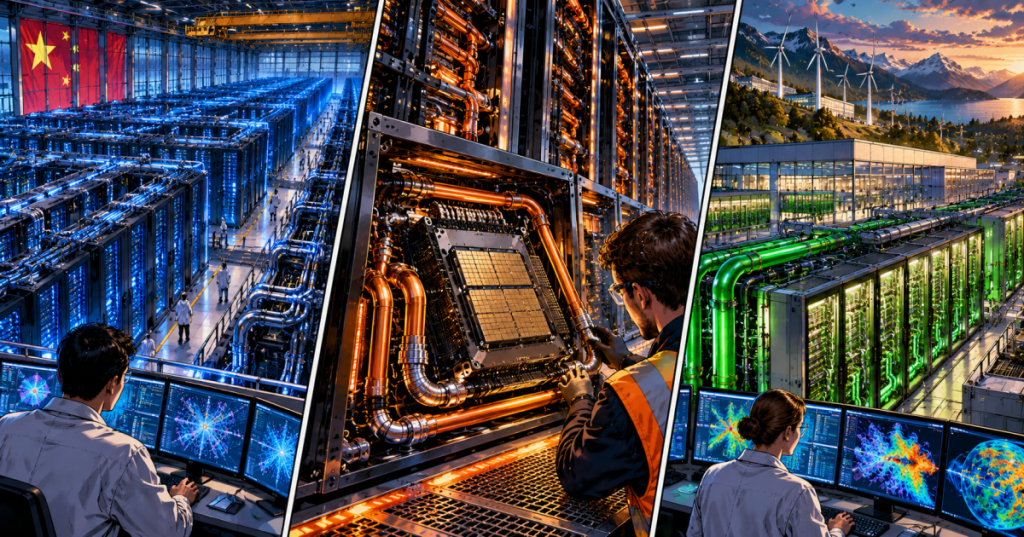
The fastest supercomputers now sustain more than two quintillion floating-point operations each second—but their electricity requirements are just as striking. China’s CPU-only LineShine leads the June 2026 TOP500 at 2.1984 exaflops, while the next six systems combine AMD, Intel and NVIDIA technologies. This October 27 technical countdown looks beyond the already established performance leaderboard to examine what the seven machines actually use: processors, networks, cooling, benchmark electricity, and the trade-offs between scientific performance and AI throughput.
The ranking follows sustained FP64 HPL Rmax, not theoretical Rpeak, GPU marketing FLOPS, or AI inference tokens per second. Power readings are from the same TOP500 submission, not invented facility electricity estimates. Each ranked entry receives a distinct relevant media item, favoring laboratory and operator video.
| TOP500 rank | System | HPL Rmax (EFLOPS) | Benchmark power | GFLOPS/watt |
|---|---|---|---|---|
| 1 | LineShine · China | 2.1984 | 42.220 MW | 52.07 |
| 2 | El Capitan · USA | 1.8090 | 29.685 MW | 60.94 |
| 3 | Frontier · USA | 1.3530 | 24.607 MW | 54.99 |
| 4 | Aurora · USA | 1.0120 | 38.698 MW | 26.15 |
| 5 | JUPITER Booster · Germany | 1.0000 | 15.794 MW | 63.31 |
| 6 | HPC7 · Italy | 0.5715 | 8.735 MW | 65.43 |
| 7 | Eagle · USA | 0.5612 | Not listed | Not verifiable |
7. Eagle — Microsoft Azure, United States
561.2 petaflops HPL. Eagle uses Microsoft’s NDv5 cloud infrastructure with NVIDIA H100 accelerators, Xeon Platinum 8480C CPUs and NVIDIA NDR InfiniBand networking. The machine represents a different operational model from national-laboratory supercomputers: customers rent accelerated infrastructure rather than owning a single government-funded science system. H100 hardware is also a pivotal generation in the broader FP8 accelerator race. TOP500 does not publish Eagle’s system test power, so calculating a comparable GFLOPS-per-watt figure would be guesswork.
A cloud supercomputer still needs local interconnect bandwidth, resilient checkpointing and thermal engineering. General cloud-scale discussions help explain the infrastructure, but they do not establish Eagle’s rack count or a specific energy measurement.
6. HPC7 — Eni, Italy
571.5 petaflops HPL; 8.735 MW test power; about 65.43 GFLOPS/W. HPC7 is a new 2026 entrant inside Eni’s Green Data Center at Ferrera Erbognone. It uses HPE Cray EX255a, AMD EPYC processors and nearly 14,000 MI300A accelerator devices interconnected by HPE Slingshot. It accelerates subsurface models, carbon-storage studies and fusion research. Eni’s June engineering disclosure cites direct-liquid cooling and distinguishes a 9.4 MW maximum facility-inclusive figure from TOP500’s lower benchmark-system power.
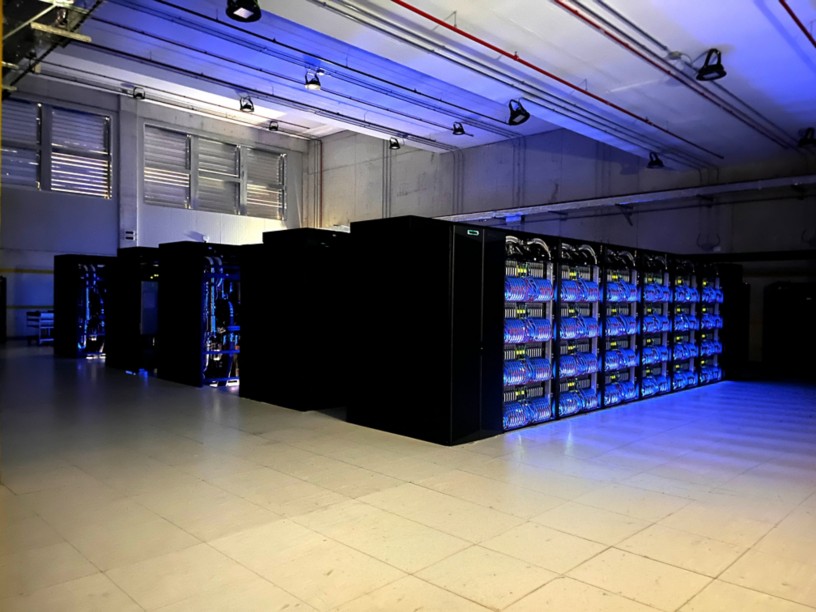
Eni also operates HPC6. Together they exceed one exaflop of reported aggregate HPL performance, but two independent machines should not be misrepresented as one TOP500 entry. HPC7 remains No. 6 by itself.
5. JUPITER Booster — Forschungszentrum Jülich, Germany
1.000 exaflop HPL; 15.794 MW; roughly 63.31 GFLOPS/W. Germany’s EuroHPC JUPITER Booster is Europe’s first exascale-class computer. It combines NVIDIA Grace Hopper GH200 superchips with Eviden’s BullSequana XH3000 liquid-cooled architecture and quad-rail NDR InfiniBand. JUPITER supports climate modeling, neuroscience, materials research and AI. NVIDIA describes FP8 AI processing in the tens of exaflops, but those exascale milestones cannot be ranked alongside double-precision HPL without disclosing the precision change.
The liquid-cooled design matters because memory bandwidth, interconnect traffic and thermal limits can constrain a massive science job even when accelerator silicon can theoretically perform more arithmetic.
4. Aurora — Argonne National Laboratory, United States
1.012 exaflops HPL; 38.698 MW; roughly 26.15 GFLOPS/W. Argonne’s Aurora is based on Intel Xeon CPU Max processors and Intel Data Center GPU Max accelerators on an HPE Cray EX fabric. It ranks fourth by HPL but is a formidable mixed-precision machine, with TOP500’s June highlights reporting 11.6 exaflops on HPL-MxP. That is not equivalent to 11.6 exaflops FP64 HPL performance. Aurora illustrates the gap between sustained scientific workloads, peak chip arithmetic, and facility-scale operating costs.
Aurora’s reported HPL system power is larger than El Capitan’s, despite a lower HPL score. That is why the semiconductor architecture, electrical infrastructure and cooling system must be considered together when comparing HPC clusters.
3. Frontier — Oak Ridge National Laboratory, United States
1.353 exaflops HPL; 24.607 MW; roughly 54.99 GFLOPS/W. Frontier was the first publicly verified exascale supercomputer and remains a scientific workhorse. Its HPE Cray EX235a nodes pair AMD EPYC CPUs with AMD Instinct MI250X GPUs over Slingshot-11, delivering simulation at enormous scale. Its role in scientific computation is fundamentally different from a Bitcoin network measured in hashes per second, although both ecosystems make electrical efficiency central to physical infrastructure planning.
Frontier remains third, despite the appearance of newer accelerators, because a single benchmark record reflects system-level engineering, software, network, available uptime and completed performance testing—not just a GPU model number.
2. El Capitan — Lawrence Livermore National Laboratory, United States
1.809 exaflops HPL; 29.685 MW; approximately 60.94 GFLOPS/W. El Capitan combines AMD MI300A APUs with HPE Cray EX255a cabinets, EPYC CPU cores and Slingshot networking. Built for the U.S. National Nuclear Security Administration, it supports high-fidelity simulations as well as scientific research. El Capitan ranks second on FP64 HPL, but first in the June 2026 HPL-MxP comparison at about 16.7 exaflops, demonstrating why a single definition of “fastest” always needs a benchmark qualifier.
Its roughly 29.7 MW test load also helps put enormous AI data-center megaprojects into context: one multi-exaflop machine and a planned gigawatt campus operate at very different electrical scales.
1. LineShine — Shenzhen, China
2.1984 exaflops HPL; 42.220 MW; approximately 52.07 GFLOPS/W. China returned to No. 1 in June 2026 with LineShine at the National Supercomputing Centre in Shenzhen. Instead of NVIDIA or AMD GPU accelerators, LineShine uses 304-core LingKun LX2 Arm-based processors, LingQi networking and Kylin OS, totaling about 13.79 million cores. It also leads the HPCG scientific benchmark at 22 petaflops. Its CPU-only architecture shows that accelerator-based clusters are not the only path to exascale, though El Capitan outperforms it on HPL-MxP and achieves better HPL GFLOPS/W.
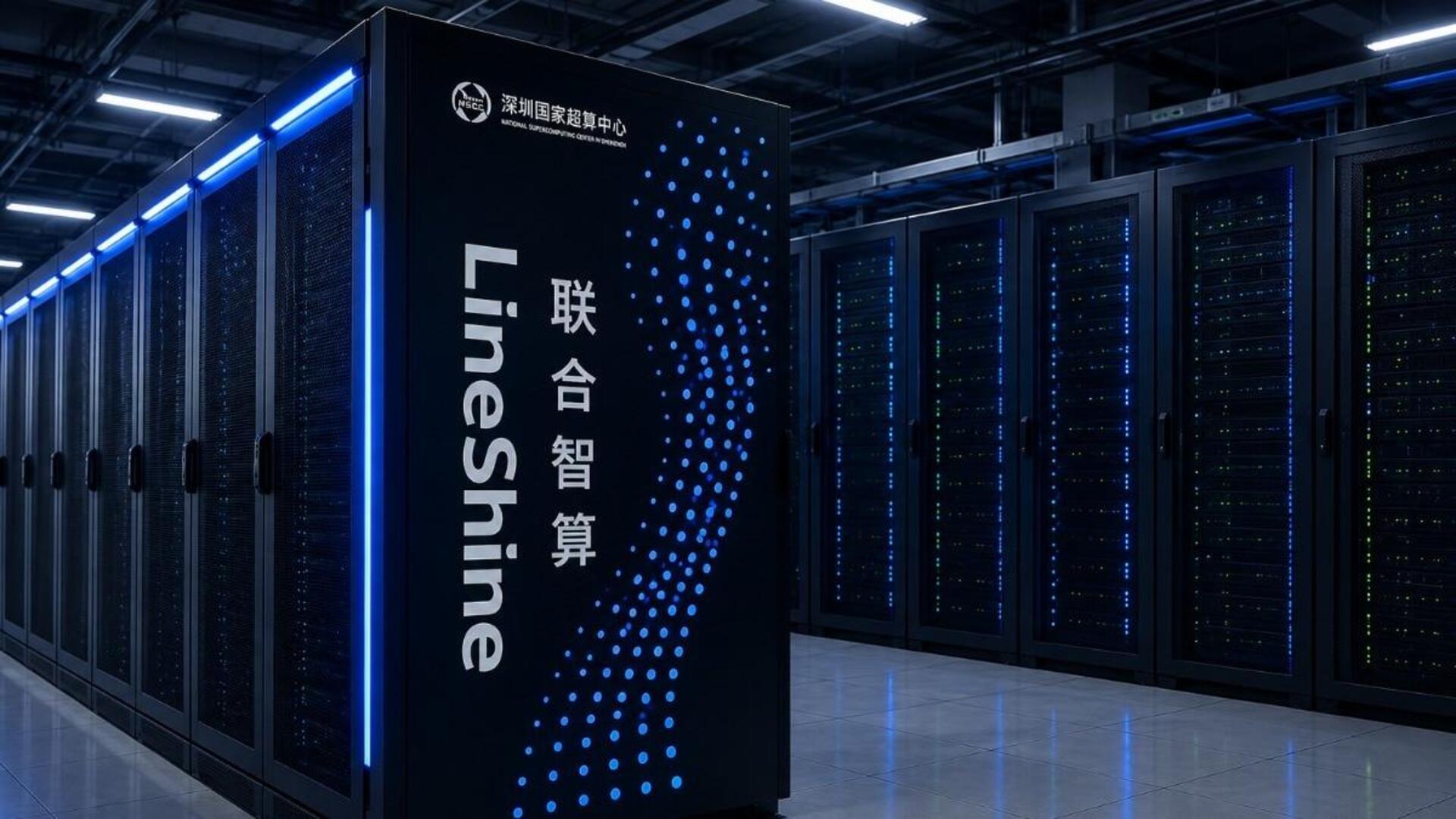
The TOP500 release calls this the first CPU-only system to exceed two sustained HPL exaflops. Its roughly 42 MW benchmark-system power is higher than the measured draw of the other six entries with listed power, but that does not necessarily equate to all-site electrical consumption.
Three definitions of computing power
HPL Rmax is the sustained double-precision result used for these rankings. HPL-MxP tests mixed-precision numerical methods and can rank machines differently. AI FP8 measures lower-precision operations in neural-network workloads and is not a substitute for scientific HPL. Comparing an AI accelerator’s peak dense-FP8 rating with a full machine’s sustained FP64 score obscures more than it clarifies.
Electricity adds a fourth axis. TOP500’s GFLOPS/W rewards benchmark arithmetic per watt of measured computing-system power; it does not capture every building-level auxiliary load. Real deployment economics also depend on power contracts, networking, memory, water and heat removal—the same infrastructure issues now shaping nuclear energy agreements and site-level energy accounting. The June 2026 TOP500 remains the latest published major list as of October 27; the next regular edition is expected in November.
Editor’s Note: This analysis compares systems on the same June 2026 HPL basis and marks unreported power data as unavailable. If you find this research valuable, support BitcoinVersus.Tech with a 5,000-sat donation by scanning the QR code below using a Bitcoin wallet.

Open the QR on another screen and scan it with a Bitcoin wallet to contribute 5,000 sats.


Leave a Reply