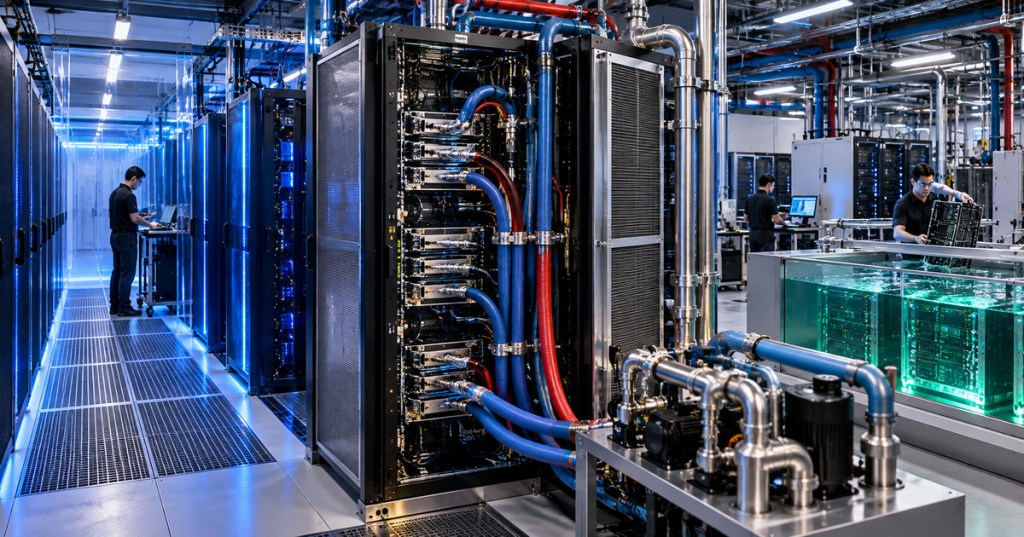
AI racks are pushing data-center thermal design far beyond the era when a raised floor and room-level air conditioning could handle nearly every workload. This countdown ranks seven cooling technologies by their ability to support 2026 AI and HPC rack densities, deployment maturity, retrofit practicality, efficiency, serviceability and long-term scalability.
The ranking follows the direction laid out in ASHRAE’s 2026 AI Data Center Energy Performance Framework, which identifies direct-to-chip liquid cooling as the de-facto standard for AI and HPC, and the Open Compute Project Cooling Environments program, which organizes advanced cooling around cold plates, coolant distribution, immersion, door heat exchangers and heat reuse. BitcoinVersus.Tech has also tracked the shift through our liquid-cooling efficiency study, xFusion’s liquid-cooled OCP systems, and a heat-to-water data-center deployment.
7. Hot-Aisle and Cold-Aisle Containment
Containment remains the foundation of efficient air cooling because it prevents hot exhaust air from mixing with cold supply air. It cannot match liquid cooling at extreme GPU densities, but it is inexpensive, widely understood and still essential in mixed facilities where conventional servers, storage and networking gear share space with liquid-cooled AI racks.
APC by Schneider Electric demonstrates modern aisle containment hardware and installation.
6. Indirect Evaporative Cooling
Indirect evaporative systems reject heat through a separate outside-air stream, allowing operators to exploit favorable ambient conditions without bringing outdoor air directly into the data hall. They can sharply reduce compressor use in suitable climates, but water availability, humidity and local weather still determine how effective the design will be across the year.
Munters discusses the evolving cooling requirements of high-density AI data centers and its thermal-management portfolio.
5. In-Row Cooling
In-row systems move cooling equipment closer to the racks instead of conditioning the entire room from the perimeter. The shorter airflow path improves predictability and makes in-row cooling useful for retrofits, edge sites and medium-density rows, although the technology becomes harder to scale once AI racks move deep into six-figure wattage.
Schneider Electric explains its close-coupled InRow cooling architecture.
4. Rear-Door Heat Exchangers
Rear-door heat exchangers replace or augment the back door of a server rack with a liquid-fed coil that captures hot exhaust before it returns to the room. They rank fourth because they offer one of the cleanest retrofit paths from air toward liquid cooling while preserving standard server form factors and minimizing disruption to the white space.
Schneider Electric shows a modern AI liquid-cooling architecture that includes rear-door heat exchangers, CDUs and facility heat rejection.
3. Two-Phase Immersion Cooling
Two-phase immersion places electronics in a dielectric fluid that boils at a controlled temperature. Vapor carries heat away from the components, condenses on a heat exchanger and returns to the bath. The phase change can move enormous heat flux with little pumping, but fluid selection, material compatibility, service procedures and environmental rules make deployment more specialized than mainstream cold-plate systems.
Open Compute Project presents tray-level two-phase immersion testing for OCP Accelerator Modules, including an 8×1000W OAM thermal test vehicle and fluid comparisons.
2. Single-Phase Immersion Cooling
Single-phase immersion submerges servers in a dielectric liquid that remains liquid while pumps circulate heat to a heat exchanger. It eliminates most server fans and can support very dense compute with excellent component-level heat capture. It ranks above two-phase immersion because the simpler fluid state and growing OCP testing ecosystem can make operation and material qualification easier, although maintenance still requires a major change from ordinary rack workflows.
Open Compute Project testing examines the thermal performance of single-phase immersion cooling.
1. Direct-to-Chip Cold-Plate Liquid Cooling
Direct-to-chip cooling takes No. 1 because it combines high heat-removal capability with conventional rack serviceability and the broadest momentum across modern AI infrastructure. Cold plates sit directly on CPUs, GPUs and other high-power components while coolant flows through manifolds to a CDU and facility loop. The rest of the rack can still use air for lower-power components, making direct-to-chip a practical bridge between legacy data centers and megawatt-class AI systems.
CoolIT Systems explains the direct-liquid-cooling architecture used to move heat away from high-power processors.
The key change in 2026 is not that air cooling disappears. It is that facilities are becoming hybrid. Containment and air cooling remain useful for lower-density equipment, rear-door systems help retrofit existing halls, immersion serves specialized high-density deployments, and direct-to-chip cold plates are becoming the default answer for large AI clusters. The winning design is increasingly the one that matches each thermal technology to the rack density instead of forcing an entire building onto a single cooling method.
BitcoinVersus.Tech Editor’s Note:
We volunteer daily to ensure the credibility of the information on this platform is Verifiably True. If you would like to support to help further secure the integrity of our research initiatives, please donate using the QR code provided

For best QR-code scanning results, please scan this donation code from a desktop or larger screen. Mobile screens may prevent camera recognition.


Leave a Reply