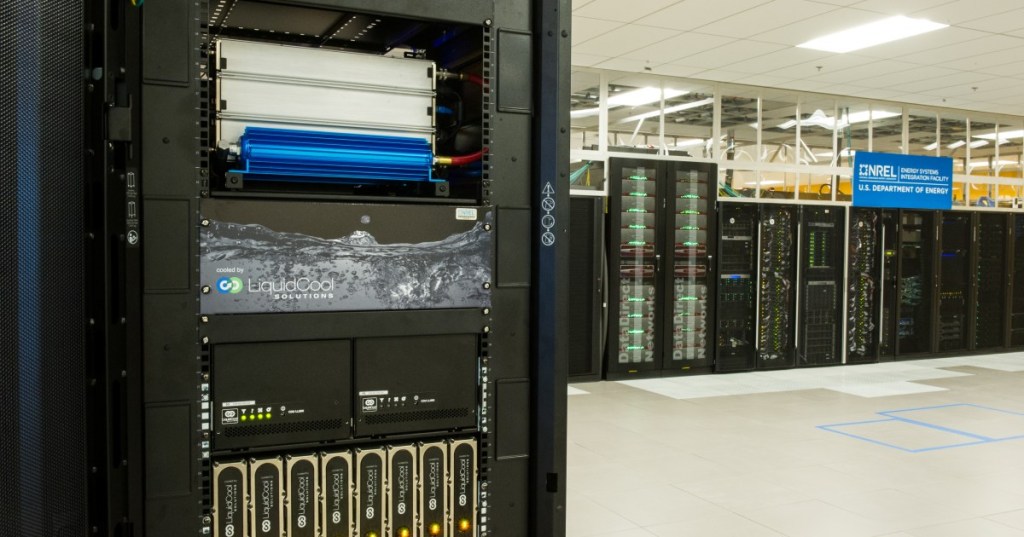
A new open-access SoftwareX study comparing 12 data-center cooling topologies found that a direct-to-chip liquid-cooled design reached a PUE of 1.12 in a full-year Miami simulation, versus 1.35 for its comparable air-cooled configuration—a 17% reduction in PUE.
Liquid cooling won on energy and carbon
The DCOPTEST study used a physics-based Modelica testbed to run 8,760 hourly steps for each of 12 cooling systems under Miami’s very hot-humid climate. Liquid-cooled Types 7–12 consistently outperformed legacy air-cooled Types 1–6 on energy and carbon metrics.
The best-performing liquid topology, Type 7, reached PUE 1.12 and carbon usage effectiveness of 0.45 kgCO₂e/kWh. Its air-cooled counterpart, Type 2, reached PUE 1.35 and CUE 0.54 kgCO₂e/kWh. Air-cooled dry systems climbed as high as PUE 1.43 in the same modeled climate.
Water changes the winner
The energy advantage did not make liquid cooling universally superior. Wet cooling-tower configurations consumed about 2.12–2.57 L/kWh of make-up water. Closed-loop dry-cooler designs eliminated evaporative water use entirely at 0 L/kWh, but required more fan power.
The liquid systems also benefited from higher return-fluid temperatures. In the Miami model, Type 7 could remain in free-cooling mode for 100% of the year, while one dry liquid topology reached about 95%. Several air-cooled systems needed full mechanical cooling for 79%–100% of annual hours.
This was a simulation, not a field trial
The result comes from a standardized virtual testbed, not side-by-side operation of 12 physical data centers. The authors validated modeled PUE and WUE against published reference ranges, but regional climate, grid carbon intensity, controls, rack density and equipment selection can change the outcome. The project’s DCOPTEST v1.2 code is public so other researchers can reproduce or extend the comparison.
BitcoinVersus.Tech has also covered Google choosing air cooling in water-stressed Visakhapatnam, Accelsius expanding two-phase liquid-cooling tests, and the engineering fundamentals behind air and liquid cooling.
BitcoinVersus.Tech is not a financial advisor. This media platform reports on financial subjects purely for informational purposes.
BitcoinVersus.Tech Editor’s Note:
We volunteer daily to ensure the credibility of the information on this platform is Verifiably True. If you would like to support to help further secure the integrity of our research initiatives, please donate using the QR code provided
For best QR-code scanning results, please scan this donation code from a desktop or larger screen. Mobile screens may prevent camera recognition.



Leave a Reply