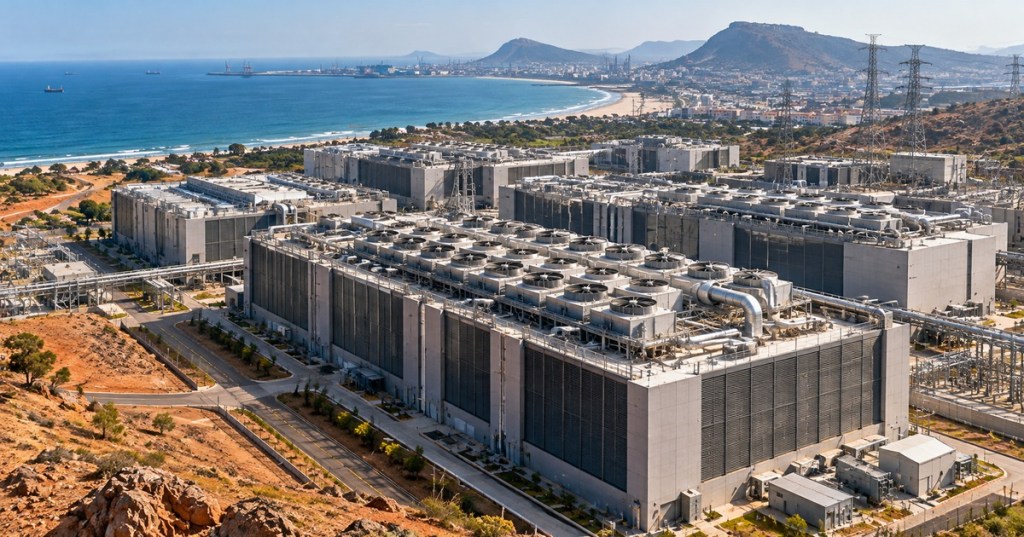
Google says the massive AI hub it is building in Visakhapatnam, India, will rely on advanced air cooling instead of water cooling after the company’s own assessment found pressure on the local watershed. The disclosure adds an important engineering detail to a $15 billion project that is expected to bring gigawatt-scale compute, new power infrastructure and an international subsea cable gateway to India’s east coast.
Key Takeaways
- Google says its Visakhapatnam AI hub will use advanced air cooling rather than water-based cooling.
- The company says a water assessment identified pressure on the local watershed and influenced the cooling design from the outset.
- The wider project is part of roughly $15 billion in Google investment from 2026 through 2030 and includes gigawatt-scale compute across three data center campuses.
- Google says it will fund required power-infrastructure upgrades and invest in additional clean-energy projects, while residents and activists continue to question water, power, land and ecological impacts.
- Air cooling reduces direct cooling-water demand, but it does not make the overall facility water-free or remove the project’s large electricity requirement.
The new cooling detail comes as construction advances and local opposition grows. In an October 11 report based on an interview with Google infrastructure and energy executive Alexander Smith, AFP reported that Google’s water assessment for the site found pressure on the watershed. Smith said that finding shaped the decision to use advanced air cooling rather than water cooling.
Air Cooling Changes the Water Equation
Cooling is one of the defining engineering problems in modern data centers. Servers convert most of the electricity they consume into heat, and that heat has to be moved away continuously. Facilities can use combinations of chilled air, evaporative cooling, cooling towers, direct-to-chip liquid cooling, immersion systems and other designs depending on climate, rack density and water availability.
BitcoinVersus.Tech’s guide to air, water and immersion data-center cooling explains the basic tradeoff: water-assisted systems can move heat efficiently, but they can consume significant water depending on the design. Air cooling avoids that cooling-water demand, though it can require more fan power and can become harder to scale as rack densities rise.
That distinction matters here. Google is not saying the Visakhapatnam complex will consume no freshwater at all. The company says non-cooling facility needs will still use freshwater, while it is committed to replenishing 120% of the freshwater volume it consumes across its operations by 2030. That is different from saying the data center itself will be physically water-neutral on every day of operation.
The cooling decision also does not answer every thermal-design question. Google has not publicly disclosed detailed server rack densities, airflow architecture, economizer strategy or the exact mechanical configuration planned for the campuses. Those details will determine how the air-cooled system performs as AI hardware becomes denser.
The Project Is Much Bigger Than One Data Center
Google first announced the broader investment in October 2025 and broke ground in April 2026. The company says the program represents about $15 billion of investment from 2026 through 2030.
The physical build is planned around three large data center campuses developed with AdaniConneX and Nxtra by Airtel. Google describes the project as gigawatt-scale infrastructure designed to support AI and cloud workloads. At the groundbreaking, project partner Adani said the site was approaching 1 GW in one location.
One gigawatt is 1,000 megawatts. A site operating anywhere near that scale becomes a major grid customer, so the engineering challenge extends beyond server racks to substations, transmission, generation, backup systems, power-quality equipment and long-term energy procurement.
Google says it fully funds the power-infrastructure upgrades required for its facilities and plans new clean-energy projects in the region beyond what regulation requires. The company’s earlier project announcement also described new transmission lines, energy storage and additional clean-energy generation as part of the broader buildout.
Water Is Only One Environmental Question
Local criticism goes beyond cooling water. Residents and activists have raised questions about land clearing, grid demand, wildlife, construction impacts and whether the promised economic benefits will be distributed broadly enough to justify the project’s footprint.
Google says environmental assessments covering power supply, grid stability, water risk, ecology and acoustics are conducted well before projects begin. The company also argues that it will not proceed in a location if adequate power cannot be developed without taking supply away from the surrounding community.
Those claims deserve continued measurement rather than automatic acceptance or rejection. BitcoinVersus.Tech recently reported that work at two Google data-center sites in Finland was halted pending additional environmental review. The Finland and India cases are different, but together they show why power, water and ecological review are becoming central parts of hyperscale data-center development.
Why Air Cooling Is Not Automatically the Easy Option
The AI industry is moving toward increasingly dense racks, especially where accelerators are tightly packed. That has made direct liquid cooling attractive because liquids can carry heat more effectively than air. But water-stressed regions create a different constraint: cooling efficiency cannot be evaluated only by rack density or energy use.
Some vendors are now engineering large AI facilities around water-minimizing or zero-water heat-rejection systems. BitcoinVersus.Tech recently covered Trane’s 250 MW zero-water cooling design for NVIDIA AI factories. Google’s choice in Visakhapatnam fits the same broader industry pressure: sites increasingly have to optimize not just power usage effectiveness but also water usage effectiveness and local resource availability.
Air cooling can reduce direct water demand, but the tradeoffs depend on climate and operating temperature. Hot outdoor conditions can make air-side heat rejection more difficult, potentially increasing electrical demand for fans, compressors or other mechanical systems. The best design therefore depends on the full annual climate profile, hardware density and operating targets rather than a simple “air good, water bad” rule.
The Subsea Network Is Part of the AI Infrastructure
The Visakhapatnam project also includes a major international subsea gateway. Google’s America-India Connect plan calls for new paths linking India with Singapore, South Africa and Australia, plus additional terrestrial fiber routes that connect into Google’s wider global network.
That matters because AI infrastructure is not useful in isolation. Large models and cloud services depend on moving data between users, campuses, regions and continents with low latency and enough bandwidth. Visakhapatnam’s east-coast position can add route diversity to India’s existing major cable landings around Mumbai and Chennai.
Google Is Making Large Economic Claims Too
Google says a development of this kind could generate about $688 million in local economic activity annually. It also says that for every job inside a Google data center, nine additional jobs are supported in the surrounding community, while a typical three-to-five-year data-center development employs about 4,200 construction workers per year on average.
Those figures are company projections, not guarantees. The actual local impact will depend on which contractors win work, how much equipment is sourced locally, the number of permanent technical roles, wage levels, tax structures and whether supporting infrastructure produces lasting benefits beyond the campuses themselves.
What to Watch Next
- Cooling design: whether Google releases more detail about the air-cooling architecture, rack-density limits and seasonal efficiency.
- Water data: site-level freshwater consumption and replenishment reporting once the campuses begin operating.
- Grid upgrades: the size, timing and ownership of new transmission, substations, storage and generation built for the project.
- Clean energy: which specific renewable or firm-power projects Google contracts to support the gigawatt-scale load.
- Environmental review: how regulators and independent assessments address land, ecology, noise and watershed concerns raised by local groups.
- Local jobs: the split between temporary construction employment, permanent operations roles and indirect supplier jobs.
- 2028 target: whether the first major capacity reaches operation on the timetable currently being reported.
Bottom Line
Google’s decision to use advanced air cooling is a concrete response to one of the biggest questions surrounding the Visakhapatnam AI hub: where the cooling water would come from in a region already facing watershed pressure.
It is also only one part of the project’s environmental equation. A gigawatt-scale AI hub still requires enormous electrical infrastructure, land, networking and long-term operating resources. The most useful way to judge the project will be to compare Google’s promises with measured water use, grid impacts, clean-energy additions, local employment and environmental data as construction moves toward operation.
BitcoinVersus.Tech Editor’s Note: Google’s statements about cooling, power infrastructure, clean-energy investment and economic impact are company claims reported by AFP and in Google’s own project materials. Local concerns about water, power, land and ecology remain contested issues. BitcoinVersus.Tech has separated confirmed project facts from company projections and community concerns.
Follow BitcoinVersus.Tech for data centers, AI infrastructure, cooling, networking, energy, semiconductors and emerging computing systems.
Support independent technology reporting: Bitcoin donations help fund BitcoinVersus.Tech research and publishing.
Disclaimer: BitcoinVersus.Tech provides technology and financial news and analysis for informational purposes only and is not a financial advisor.


Leave a Reply