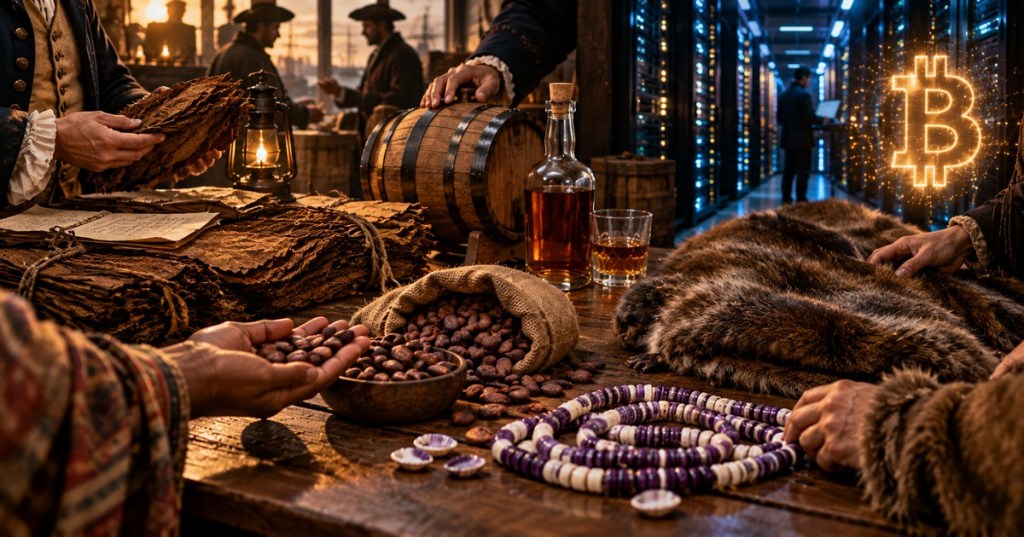
People have used some astonishing things as money: animal skins, shell beads, drinkable alcohol, chocolate beans and even paper receipts redeemable for tobacco.
The pattern makes sense once money is understood as a technology for solving exchange. As BitcoinVersus.Tech explains in The Coincidence of Wants, barter becomes difficult when two people do not simultaneously want what the other person has. A commonly accepted intermediate good can solve that problem.
This ranking is intentionally subjective. “Wildest” means unusually physical, awkward or surprising by modern standards while still having credible historical evidence of monetary use. It is not a ranking of cultural importance.
For the basic economics behind why one commodity can become more monetary than another, see BitcoinVersus.Tech’s Commodity Money lesson.
OpenLearn from The Open University — Creative Commons-licensed overview of the history of money, from early exchange to metal and paper currency.
5. Beaver Pelts
In the North American fur trade, the beaver pelt became more than merchandise. It became a unit for pricing other goods.
The Hudson’s Bay trade used the idea of the “made beaver” as a standard unit. A prime beaver skin could function as a benchmark against which other furs and trade goods were valued. Over time, “beaver money” could operate partly as an accounting unit even when an actual pelt was not physically handed over in every calculation.
A Federal Reserve historical report notes that beaver fur and wampum served as money in northern colonial trade, while tobacco became the dominant commodity money in Virginia.
Why it worked: pelts were useful, scarce, widely demanded and reasonably durable.
Why it was terrible money: every pelt was different. Size, condition, species, season and quality mattered. Carrying a large payment literally meant carrying a pile of animal skins.
Community discussion pointing back to the long history of pelts, wampum and other non-coin money in Canada.
4. Whiskey and Brandy
Yes, colonial Americans really did use alcohol in payment—but this example needs qualification.
Economic histories of the colonies list brandy and whiskey among forms of “country pay”: commodities that some colonial governments accepted for taxes when coin was scarce. Other country-pay goods included hides, furs, corn, wheat, pork, fish and even musket balls.
That does not mean every tavern in colonial America priced everything in whiskey or that whiskey formed a single standardized national currency. It means useful commodities could be accepted directly to settle obligations when specie was scarce.
Why it worked: alcohol was useful, desirable, storable and widely understood.
Why it was terrible money: quality varied, containers varied, alcohol could be consumed, spilled, diluted or stolen, and moving large value required moving heavy liquid.
3. Cacao Beans
In Mesoamerica, money could literally grow on trees.
Maya and Aztec societies used cacao in trade, tribute and everyday exchange. Smithsonian reporting notes that cacao beans were used as currency and were valuable enough that archaeological sites have produced what appear to be counterfeit beans made from clay.
A Smithsonian history of cacao notes that a turkey could be priced at around 100 cacao beans in the 1500s.
Why it worked: beans were small, divisible, portable, widely wanted and relatively standardized.
Why it was terrible money: cacao could spoil, be eaten, vary in quality and be counterfeited. The object serving as money was also the raw material for chocolate.
2. Wampum
Wampum is one of the most misunderstood examples on the list.
Wampum beads made from shell held deep diplomatic, cultural, ceremonial and record-keeping significance in Indigenous societies. European colonists later adopted wampum into their own commercial systems, and it became legal tender in parts of colonial New England and elsewhere for periods of time.
That distinction matters: it is inaccurate to reduce Indigenous wampum simply to “Native American money.” Its monetary use changed substantially through colonial trade.
Why it worked: beads were durable, portable, difficult to make by hand and visually recognizable.
Why it eventually struggled as colonial money: expanded production changed scarcity. Once production scaled, the monetary value could be diluted.
AskHistorians discussion highlighting the important distinction between wampum’s Indigenous cultural roles and its later adoption as colonial currency.
1. Tobacco—and Then Paper Money Backed by Tobacco
Tobacco takes the top spot because colonial Virginia did something especially interesting: it went from using the commodity itself as money to using negotiable paper warehouse receipts backed by stored tobacco.
Tobacco was so central to Virginia’s economy that wages, salaries, debts and taxes could be expressed or paid in tobacco. In 1713 and later under the major 1730 inspection system, official warehouses inspected and stored tobacco and issued receipts representing specific quantities.
Those receipts—often called tobacco notes—circulated from person to person. The holder could eventually present the note at the named warehouse and redeem it for the tobacco represented by the receipt.
That is strikingly modern. Instead of dragging hundreds of pounds of leaf around town, people transferred a paper claim on a commodity sitting in storage.
Why it worked: tobacco had strong export demand, could be standardized through inspection and could back negotiable warehouse receipts.
Why it was still flawed: tobacco quality changed, storage mattered, warehouse integrity mattered, production could expand, the crop could be damaged, and the monetary system depended on inspectors honestly certifying what sat behind each note.
OpenLearn from The Open University — Creative Commons-licensed explanation of why societies moved from physical commodity money toward paper claims and paper currency.
What All Five Have in Common
Every example solved a real problem. People needed something that strangers would accept even when coins were scarce or unavailable.
The recurring weaknesses were also remarkably similar:
- Portability: pelts, barrels and tobacco are heavy.
- Divisibility: making exact change from a pelt or barrel is awkward.
- Durability: food, drink and crops can spoil.
- Fungibility: one pelt, tobacco crop or barrel may not equal another.
- Verification: counterfeit cacao, dirty wampum, diluted alcohol and poor tobacco all created quality-control problems.
- Supply: if production suddenly increases, monetary scarcity can weaken.
Standardized metal coinage solved many of these problems, which helps explain the transition covered in BitcoinVersus.Tech’s Standardized Coinage lesson.
Why This History Helps Explain Bitcoin
Bitcoin is not commodity money in the same sense as tobacco, cacao or beaver pelts. It is a digitally native monetary asset and payment network. But its design targets many of the properties people repeatedly sought in physical money.
Portability: large amounts of bitcoin can be transferred without moving barrels, pelts, metal or crops.
Divisibility: one bitcoin is divisible into 100 million satoshis, so very small amounts can be represented without physically cutting an object apart.
Fungibility of units: the protocol measures value in standardized satoshis rather than by grading the quality of a physical commodity. Bitcoin transaction history can still affect how some intermediaries treat particular coins, so fungibility is not perfect in every practical context.
Verifiability: users do not need an inspector to taste the whiskey or certify the tobacco. Bitcoin nodes independently verify transactions and consensus rules.
Supply predictability: Bitcoin’s issuance schedule is defined by protocol rules rather than by how much tobacco gets planted, how many shells are manufactured or how many beavers are trapped.
Durability: Bitcoin does not rot, evaporate or get eaten. Ownership depends instead on cryptographic keys and a distributed ledger, which introduces a different risk: losing access to private keys can make funds effectively unrecoverable.
Why Bitcoin Can Be a Good Choice—With Tradeoffs
The strongest historical case for Bitcoin is not that “old money was weird, therefore Bitcoin wins.” It is that monetary systems repeatedly converge on the same desired properties: scarcity, portability, divisibility, durability, recognizability and resistance to easy counterfeiting.
Bitcoin performs unusually well on several of those dimensions at once. It is globally transferable, digitally divisible, independently verifiable and governed by a transparent issuance schedule.
But Bitcoin also has tradeoffs that cacao beans and tobacco farmers never faced. Its market price can be highly volatile. Everyday use depends heavily on electrical and communications infrastructure. Self-custody shifts responsibility onto the holder. Tax and regulatory treatment varies by jurisdiction. And most goods are still priced in national currencies rather than bitcoin.
So the historical argument is narrower—and stronger—than claiming Bitcoin is automatically the “best money.” Commodity money shows what humans kept trying to improve. Bitcoin is one modern attempt to combine those monetary properties in a digital system without requiring a warehouse, mint or central issuer.
Bottom Line
Colonial Americans really did settle obligations with tobacco, furs and, in some places, whiskey or brandy. Mesoamerican markets really did use cacao beans. Colonial governments really did monetize shell beads. And Virginia eventually circulated paper receipts backed by tobacco sitting in warehouses.
That history makes Bitcoin less strange, not more. Humans have always experimented with whatever technology or commodity best moves value across time and space. Bitcoin simply moves that experiment into software.
Editor’s Note
Historical monetary systems were not uniform, and terms such as money, currency, barter and commodity money can overlap differently across periods. Wampum in particular had major Indigenous diplomatic, ceremonial and cultural functions beyond its later colonial monetary use. The ranking is editorial and intended to illustrate monetary properties rather than flatten distinct cultures into one economic category.
We volunteer daily to help keep BitcoinVersus.Tech verifiably accurate. Support our independent research through the support options available on the site.
Disclaimer: BitcoinVersus.Tech provides technology, monetary-history and Bitcoin analysis for informational purposes only. Nothing here is financial advice.


Leave a Reply