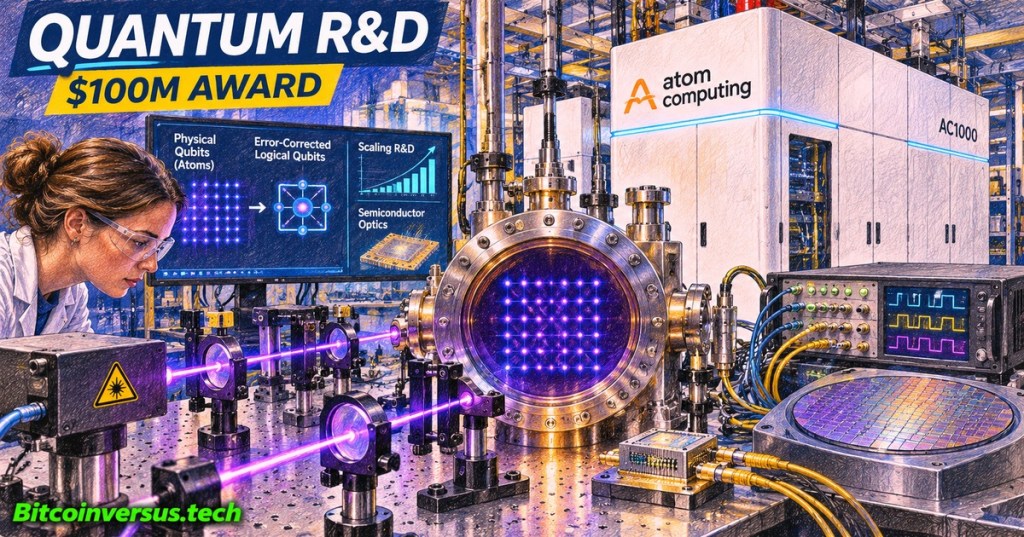
The U.S. Department of Commerce has finalized a research-and-development award of up to $100 million for Atom Computing. Announced November 13, 2026, the CHIPS and Science Act agreement will support engineering and semiconductor technologies needed to operate, control and measure neutral-atom quantum processors with tens of thousands of qubits. The signed award advances a funding plan first outlined in May; it does not mean the entire $100 million has been disbursed.
Official Microsoft video, published August 7, 2025, describing Microsoft and Atom Computing’s neutral-atom hardware and quantum-error-correction collaboration. Historical technology demonstration, not footage of the November 2026 funding announcement. Credit: Microsoft / YouTube.
What Commerce intends to fund
The federal award announcement identifies hardware development and systems integration, including the equipment needed to address, manipulate and validate many thousands of qubits. Atom Computing says its work plan includes greater in-house component development, parallel engineering testbeds and collaboration with manufacturing suppliers. Those activities target bottlenecks in reproducibility and system reliability rather than an immediately available quantum-computing service.
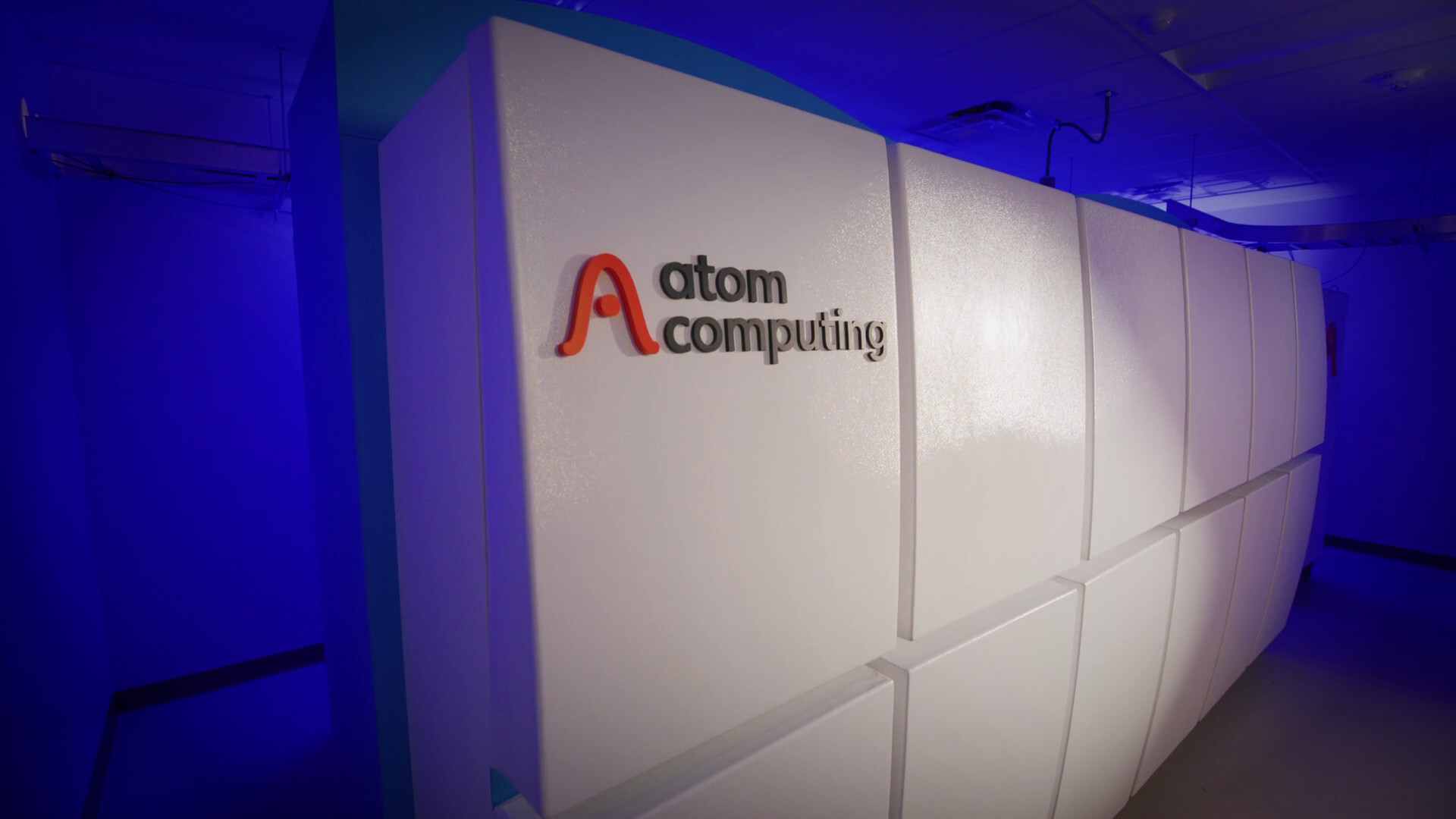
The new agreement differs from the May Commerce letters of intent, which described proposed awards across multiple quantum-hardware approaches. A finalized agreement is a firmer milestone, but public announcements do not establish how much money has been paid, what milestones will govern each tranche or whether all funded research will succeed.
Neutral atoms need precise optical control
Atom Computing builds gate-based processors from electrically neutral ytterbium-171 atoms held in optical traps. Lasers move and control atoms, while optical measurements reveal quantum states. The company’s AC1000 platform advertises more than 1,200 physical qubits, programmable atom movement, mid-circuit measurement, reset and conditional operations. Its listed two-qubit gate fidelity exceeds 99.6%, according to vendor specifications; independently comparable application-level benchmarks remain necessary.

A physical qubit is an individual atom used for computation. A logical qubit combines information from multiple physical qubits and an error-correction procedure to improve reliability. Therefore, a processor with 1,200 physical qubits does not automatically deliver 1,200 dependable logical qubits. Increasing the array size also magnifies requirements for laser steering, readout electronics, feedback latency, calibration and repeatable manufacturing.
Other approaches face different constraints. BitcoinVersus.Tech has covered research on quantum resource reduction, real-time quantum decoding hardware and Google’s progress in reducing error rates. Progress in one measurement, such as qubit count or gate fidelity, cannot substitute for evidence of a completed useful algorithm.
The long road from funding to fault tolerance
Atom Computing separately advanced into DARPA’s final quantum benchmarking stage, previously examined in our report on independent DARPA quantum-architecture validation. The company describes potential DARPA funding of up to $300 million. That figure is conditional and belongs to a different program; it must not be combined with the Commerce award as cash already received.
Commercial readiness requires sustained logical operations, adequate throughput, maintainable optical modules and total system costs that customers can justify. Meanwhile, IBM’s competing hardware roadmap signals continued competition among hardware architectures. Neutral-atom arrays offer scalable geometry, but larger systems could still struggle with control complexity and error-correction overhead.
Bottom line: The award is a verified U.S. quantum-manufacturing commitment, not a declaration that fault-tolerant quantum computing has arrived. Its success will depend on independently measured system performance, repeatable hardware integration and delivery against documented milestones.
Primary sources: Department of Commerce / NIST, November 13, 2026; Atom Computing’s November 13 company statement; AC1000 hardware specifications; official photography archive; Microsoft’s 2025 collaboration video. All performance figures from vendor materials are attributed accordingly.
Editor’s Note: The U.S. Department of Commerce and Atom Computing confirm a signed award of up to $100 million, not full payment, completion of a utility-scale processor or independently proven commercial advantage. DARPA’s separately described potential award is not additional funding known to have been disbursed. AC1000 specifications are company-reported. The original 1200 × 630 colored-pencil featured illustration is a conceptual depiction of Atom Computing and quantum-control equipment, not a documentary image. The two in-story photographs are genuine historical Atom Computing press materials. The official Microsoft video predates the Commerce decision. Public player rendering can be checked, but playback and mobile interactivity are not presumed without separate tests.

BitcoinVersus.Tech is volunteer-run and publishes independent educational technology reporting. An optional 5,000-satoshi donation supports ongoing research. Scan the original QR from a second screen with a compatible Bitcoin wallet; on mobile, use a wallet that supports scanning a saved image. Independently verify the recipient address 3C9o19EH5HSiwEPyCTmEKzxhNCbo2X6TTb and the payment amount before sending. Bitcoin transfers are generally irreversible.
We volunteer daily to ensure information on the BitcoinVersus.Tech platform is Verifiably True. Coverage is educational and informational and does not constitute financial or investment advice.


Leave a Reply