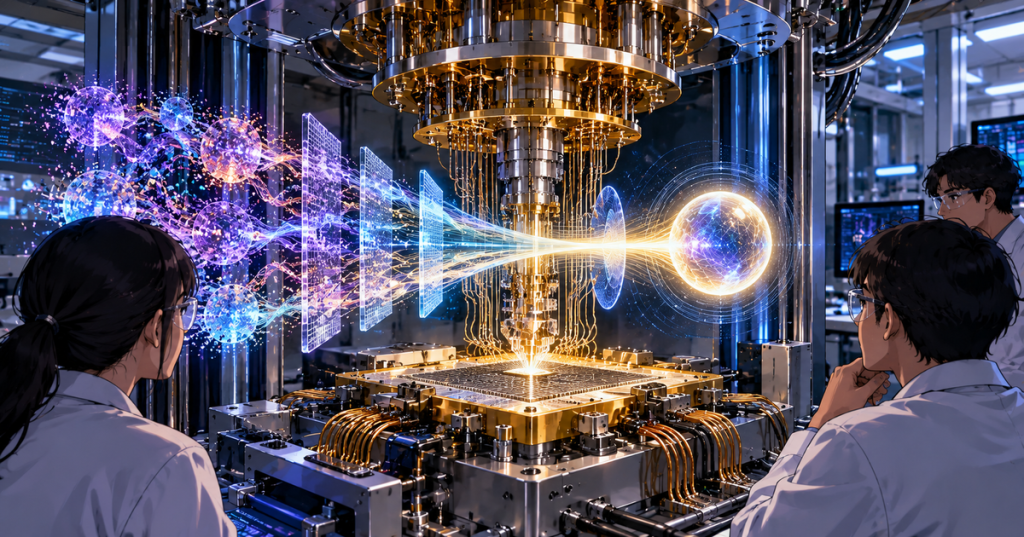
Google Quantum AI says it has demonstrated magic state cultivation on its Willow processor, reducing errors by roughly 40 times compared with uncultivated states and producing T-states with a reported logical fidelity of 99.99%. The result was announced October 15 and published in Science, but it is best understood as progress on one major fault-tolerant quantum-computing bottleneck—not as a finished practical quantum computer.
Google’s technical announcement describes magic states as special quantum resources needed to perform operations required for universal quantum computation. Producing high-quality versions has historically been expensive enough that some estimates assign most of a future fault-tolerant machine’s hardware to the task.
Pichai’s post on X called the work the first physical-hardware demonstration of magic state cultivation. The basic idea is filtering: begin with a noisy quantum state, run coordinated checks, discard attempts that show errors, and preserve the much cleaner survivors.
The 40× number needs context
The headline figure is an error reduction, not a claim that Google made a quantum computer 40 times cheaper or 40 times faster. A Quantum Computing Report summary notes that only about 8% of attempts were retained after filtering. In other words, the experiment traded yield for much higher state quality.
Google Quantum AI explains the Willow magic-state cultivation experiment and why T-states matter for fault-tolerant quantum computing.
The team also showed that a cultivated state could be moved from a distance-3 color code into a distance-5 surface code. That matters because a future machine may need one error-correction method to create a resource efficiently and another to use it inside a larger computation.
This does not mean Bitcoin was broken
The result will naturally revive security questions, but it does not demonstrate a cryptographic attack. BitcoinVersus.Tech recently explained what a real quantum attack on Bitcoin would require and separately covered an AI-assisted quantum attack benchmark that still did not break Bitcoin. Willow’s result improves one ingredient needed for large fault-tolerant systems; it does not provide the scale required to attack Bitcoin signatures today.
It also does not settle which quantum architecture will dominate. As we noted in The Quantum Computing Industry Still Has No Winning Architecture, superconducting systems remain in competition with trapped ions, neutral atoms, photonics and other approaches.
The meaningful takeaway is narrower and more important: Google has moved magic state cultivation from theory into hardware and shown that the method can sharply improve state quality on Willow. Scaling that process, improving acceptance rates and integrating it into useful logical computations are the next tests.
BitcoinVersus.Tech Editor’s Note:
We volunteer daily to ensure the credibility of the information on this platform is Verifiably True. If you would like to support to help further secure the integrity of our research initiatives, please donate using the QR code provided

For best QR-code scanning results, please scan this donation code from a desktop or larger screen. Mobile screens may prevent camera recognition.
BitcoinVersus.Tech provides technical education and analysis for informational purposes only.


Leave a Reply