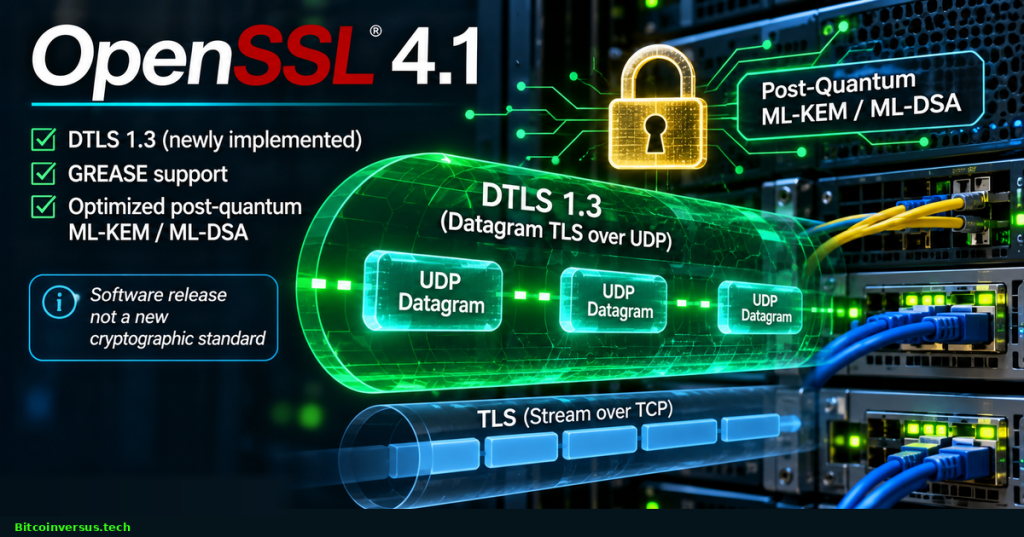
OpenSSL, the open-source cryptography library underpinning secure connections in servers, applications and network equipment, released OpenSSL 4.1.0 on October 23, 2026. The feature release introduces DTLS 1.3 for protecting datagram communications, configurable TLS GREASE support and processor-specific acceleration for post-quantum cryptographic operations. Engineers gain new protocol capabilities, but deployment teams also face documented compatibility changes and known defects.
The release extends the technologies explained in BitcoinVersus.Tech’s HTTPS and TLS primer. A cryptographic library supplies protocol machinery and algorithms; applications must still configure certificates, trust decisions and transport behavior correctly.
DevConf — “PQC in OpenSSL Library” (June 26, 2025), presented by OpenSSL engineer Tomáš Vávra. Background on OpenSSL’s post-quantum implementation; recorded before version 4.1 and not a release demonstration.
DTLS 1.3 Secures Datagram Traffic
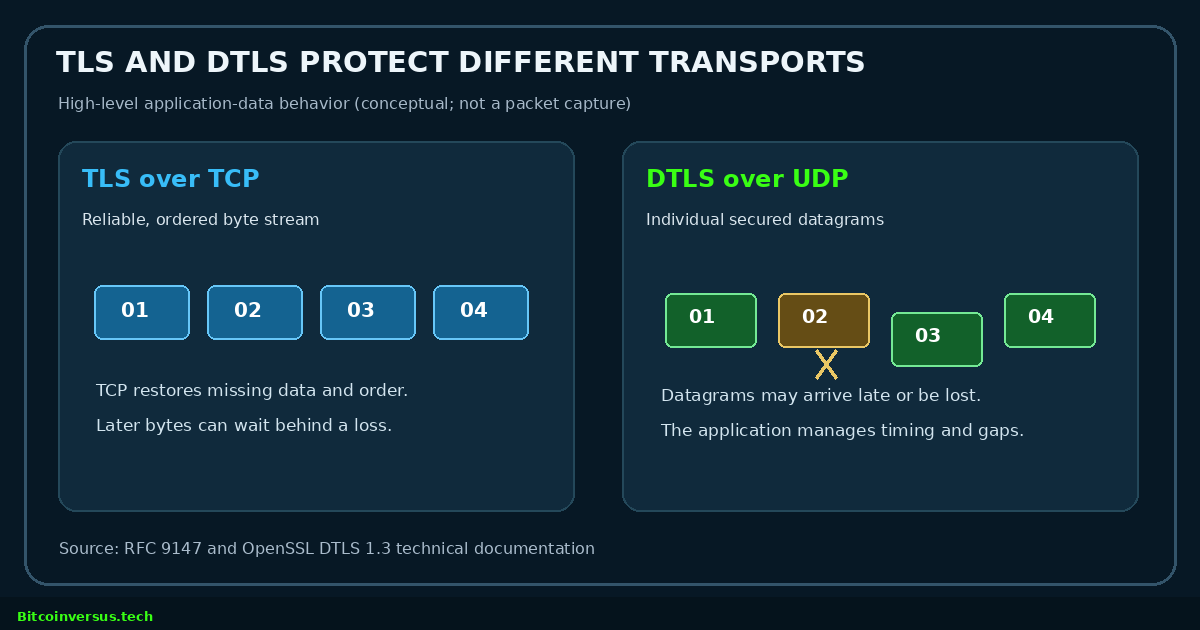
Conventional TLS usually operates over TCP, which delivers a reliable, ordered stream. Datagram TLS, or DTLS, protects message-oriented traffic commonly carried by UDP, while preserving the possibility of packet loss and reordering. Applications built for interactive communications can therefore retain datagram behavior without relying on TCP’s ordering guarantees. The distinction matters for TCP and UDP network engineering.
OpenSSL says its DTLS 1.3 implementation follows IETF RFC 9147. Relative to DTLS 1.2, the protocol adopts TLS 1.3-era cryptographic requirements and a shorter handshake pattern. The library also adds DTLS support to its SSL listener API. Developers maintaining older integrations should note that DTLSv1_listen() does not support DTLS 1.3; the newer SSL_new_listener() API does.
GREASE and Faster Cryptography
OpenSSL 4.1 implements RFC 8701 GREASE, which injects reserved negotiation values when enabled through SSL_OP_GREASE. The technique tests whether network intermediaries tolerate unfamiliar values, helping prevent protocols from becoming locked to existing configurations. GREASE is not a new encryption algorithm or an automatic security patch.
The project also reports optimized ML-KEM and ML-DSA number-theoretic-transform routines on selected processors, including x86_64 and ppc64le. Related SHAKE and AES improvements use supported processor instructions. NIST-standardized post-quantum algorithms were already available in earlier OpenSSL releases; 4.1 extends performance and interoperability rather than inventing a new standard. BitcoinVersus.Tech’s post-quantum cryptography explainer describes the underlying threat model.
The Linux Foundation — “Harvest Now, Decrypt Later: Addressing Quantum-Safe Cryptography in Open Source Development” (April 26, 2024), with Alex Bozarth and Michael Maximilien. Historical OpenSSL implementation context, not footage of the October 2026 release.
Known Bugs Make Validation Essential
OpenSSL lists several outstanding 4.1.0 issues. DTLS 1.3 key updates can drop still-pending post-handshake retransmissions, while some listener failures can yield misleading error codes. Under particular packet-loss timing, a DTLS server may reject an otherwise legitimate handshake. Vendors should run transport-specific regression tests before upgrading production gateways, communications software or embedded equipment.
Version 4.1 is a non-LTS release supported through November 23, 2027. The existing 3.5 long-term-support branch extends through April 8, 2030. Consequently, the newest feature branch is not automatically the best migration target for every fleet. Past reports on Bitcoin-mining firmware certificate fixes illustrate how library and trust-store decisions affect deployed hardware.
OpenSSL has not supplied a standardized, cross-platform performance benchmark for all 4.1 optimizations in the release announcement. Its notes establish feature availability, not measured speed gains for every CPU or application. The next operational questions are whether downstream packages adopt the update, whether developers enable the new APIs, and whether the known DTLS defects are addressed.
Primary documentation: OpenSSL 4.1 final release announcement; DTLS 1.3 engineering explanation; official downloads and support dates; RFC 9147.
BitcoinVersus.Tech Editor’s Note
Published November 8, 2026. Release timing, features, limitations and support dates were checked against OpenSSL’s own publications and the IETF protocol specification. Both embedded videos provide older technical background, not version 4.1 demonstrations. The featured image is editorial illustration and the in-story diagram is conceptual. No independent benchmark or live player-playback result is claimed.
We volunteer daily to ensure the information on this platform is Verifiably True. If you would like to support the research, please scan QR code.

Optional donations of 5,000 satoshis support independent research. To scan with a mobile wallet, display the QR on another device, or use the wallet’s saved-image scanning feature. Verify receiving address 3C9o19EH5HSiwEPyCTmEKzxhNCbo2X6TTb and the requested amount before sending.
BitcoinVersus.Tech is not a financial advisor. Financial coverage is provided purely for informational purposes.


Leave a Reply