
Silicon photonics uses chip-scale waveguides, modulators and detectors to carry information as light rather than electrical current. Short data-center connections often use intensity-modulated signals, whereas long-distance networks rely on coherent receivers capable of recovering phase and amplitude. Researchers led by Peking University now report a silicon-photonics platform tested across both regimes, including 81.92 terabits per second of aggregate short-link capacity and a separate transmission demonstration beyond 4,400 kilometers. The peer-reviewed research appeared in Nature Communications on November 5, 2026.
CienaCorp, “The role of coherent optics inside the data center,” April 30, 2026. Manufacturer discussion of coherent-lite and short-reach optics; it is background context, not footage of the Peking University experiment.
Why a Single Optical Architecture Matters
Conventional intensity modulation detects changes in light power. Coherent links instead mix received light with a reference laser and use digital signal processing to resolve additional signal properties. Coherent technology can improve capacity per wavelength, but its narrow-linewidth lasers, modulation circuitry and power budget have historically made simpler transmitters attractive for short links. The site’s coherent optical engineering guide explains the underlying I/Q modulation and detection.
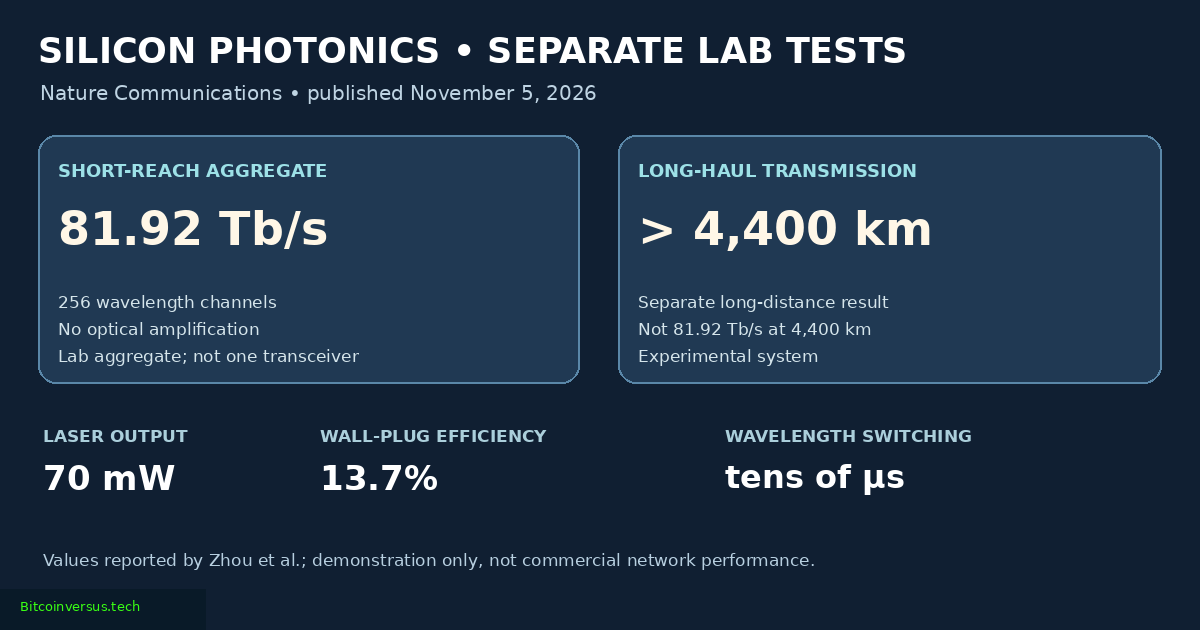
The research team combined an ultralow-loss silicon nitride external laser cavity with silicon-photonic transceivers. The laser produced 70 milliwatts of direct optical output, a linewidth below 1 kilohertz, and 13.7% wall-plug efficiency under reported conditions. Narrow linewidth limits phase noise in coherent reception; wall-plug efficiency measures the relationship between electrical input and optical output for the specified laser, not the efficiency of a complete network.
Two Tests, Not an 81.92-Tb/s Ocean Link
In short-reach testing, the platform transmitted across 256 wavelength channels without optical amplification, reaching an aggregate rate of 81.92 Tb/s. Dividing the total by the channel count gives an average 320 Gb/s per wavelength in the reported configuration. Multiplexing allows many optical colors to share a fiber, but aggregate channel throughput cannot automatically be equated with error-free application payload or an individual pluggable transceiver’s rated capacity.
The same research program separately demonstrated transmission exceeding 4,400 km. The paper does not establish 81.92 Tb/s simultaneously delivered over that long-haul distance. Wavelength switching and transmission restoration were also demonstrated on timescales of tens of microseconds, measurements of optical reconfiguration rather than end-to-end network latency.
Intel, “Silicon Photonics Hardware Demo,” July 26, 2010. Historical 50G silicon-photonics demonstration, included to illustrate earlier hardware generations; unrelated to the November 2026 research measurements.
What Remains Unproven
The results suggest a path toward common coherent interfaces across data centers, metropolitan links and long-haul networks. They do not constitute a commercially shipped module, a field-tested transoceanic system or a measured reduction in total data-center electricity use. Packaging, thermal stability, laser yield, modulation electronics, receiver processing and cost remain deployment questions. Operators must also manage optical signal-to-noise ratio, nonlinear impairments and power margins as reach increases.
Established commercial efforts are moving on related fronts: 400G-per-lane optical interfaces address AI-network bandwidth, while subsea pluggable optics seeks to simplify long-distance equipment. Laboratory advances may inform future designs, but compatibility and operating economics require separate demonstration.
The study involved researchers from Peking University, SiFotonics Technologies and the Chinese Academy of Sciences. Its declared measurements, rather than external product benchmarks, form the basis of the findings. For network diagnostics, BitcoinVersus.Tech’s optical performance monitoring reference explains why optical power, error correction and signal quality must be assessed together.
Primary source: Zhou, Z. and colleagues, “Silicon photonics provides a unified solution for all-distance optical communications,” Nature Communications, November 5, 2026. Publication followed acceptance on October 2; the online article remains an early published version subject to editorial updates.
BitcoinVersus.Tech Editor’s Note
Reviewed November 8, 2026. All reported physical measurements are attributed to the authors’ laboratory work. The 81.92-Tb/s short-distance capacity and the greater-than-4,400-km long-haul reach are distinct demonstrations. The 320-Gb/s average per channel is a calculation using reported aggregate capacity and wavelength count. The featured image is conceptual artwork; neither embedded manufacturer video documents the 2026 experiment. No independently measured commercial deployment, field reliability or full-system efficiency is claimed.
We volunteer daily to ensure the information on this platform is Verifiably True. If you would like to support the research, please scan QR code.

To support independent research, make an optional donation of 5,000 satoshis. Scan the QR code from a second screen with a Bitcoin wallet, or use a compatible saved-image scanner on mobile. Verify the destination address 3C9o19EH5HSiwEPyCTmEKzxhNCbo2X6TTb and amount before payment.
BitcoinVersus.Tech is not a financial advisor. Financial coverage is provided purely for informational purposes.


Leave a Reply