
Cloudflare has introduced a geographically restricted, post-quantum key manager in closed beta, aiming to keep customer decryption keys usable only in approved regions while strengthening protection against future quantum attacks. Announced October 23, 2026, the redesigned GeoKey Manager is part of Cloudflare’s Data Localization Suite. Its central idea is straightforward: encrypted private keys may travel across a global network, but the secrets needed to unlock them remain restricted to authorized locations. General availability is planned for the first quarter of 2027, not confirmed today.
Why regional control needs quantum-resistant encryption
A company operating across continents may need network resilience without allowing sensitive private keys to be decrypted everywhere. A second concern is “harvest now, decrypt later,” in which attackers record encrypted material hoping future quantum computers will weaken classical public-key protection. Our earlier post-quantum cryptography explainer describes the underlying threat. Cloudflare’s approach addresses key-unwrapping confidentiality and geographic authorization together, rather than assuming conventional encryption solves both.
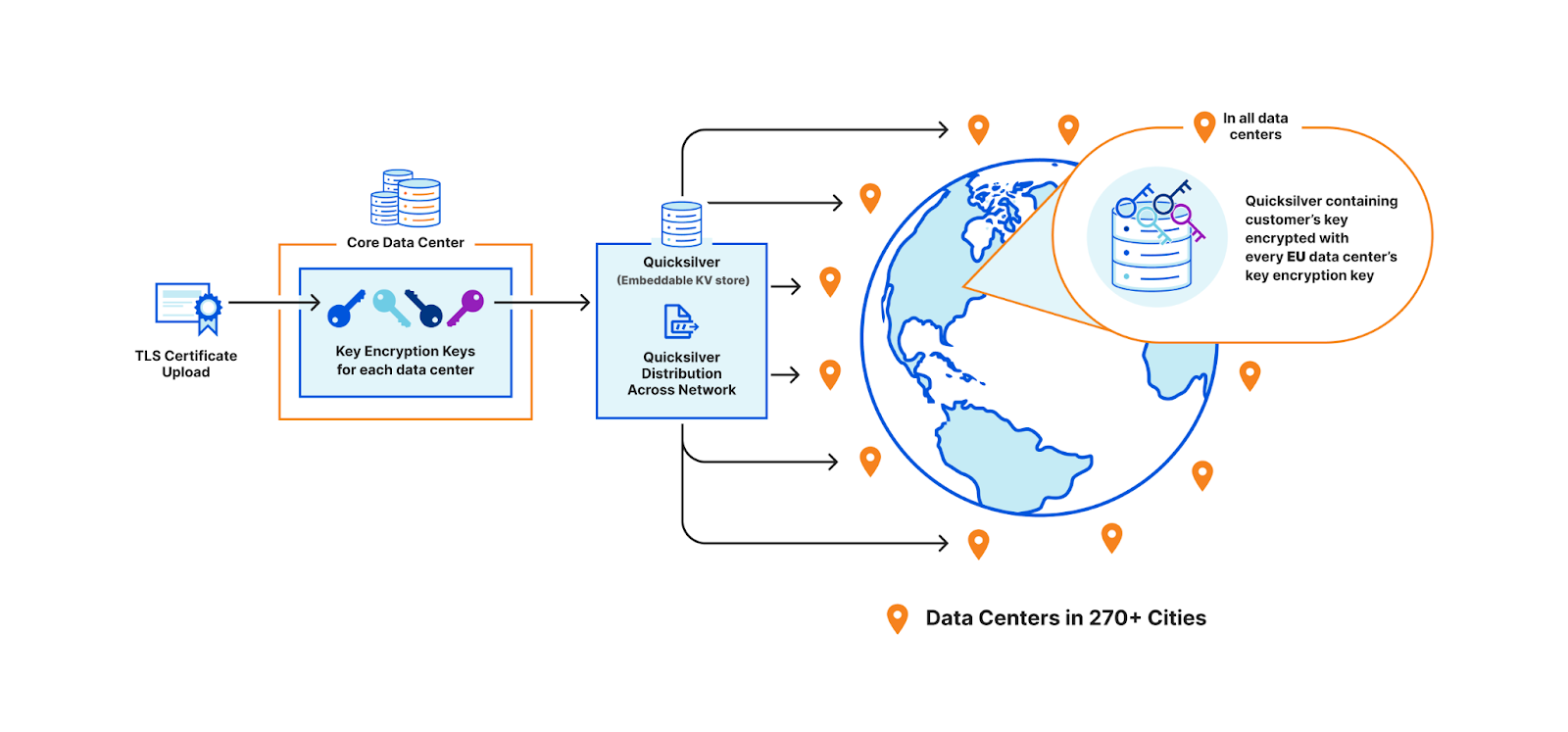
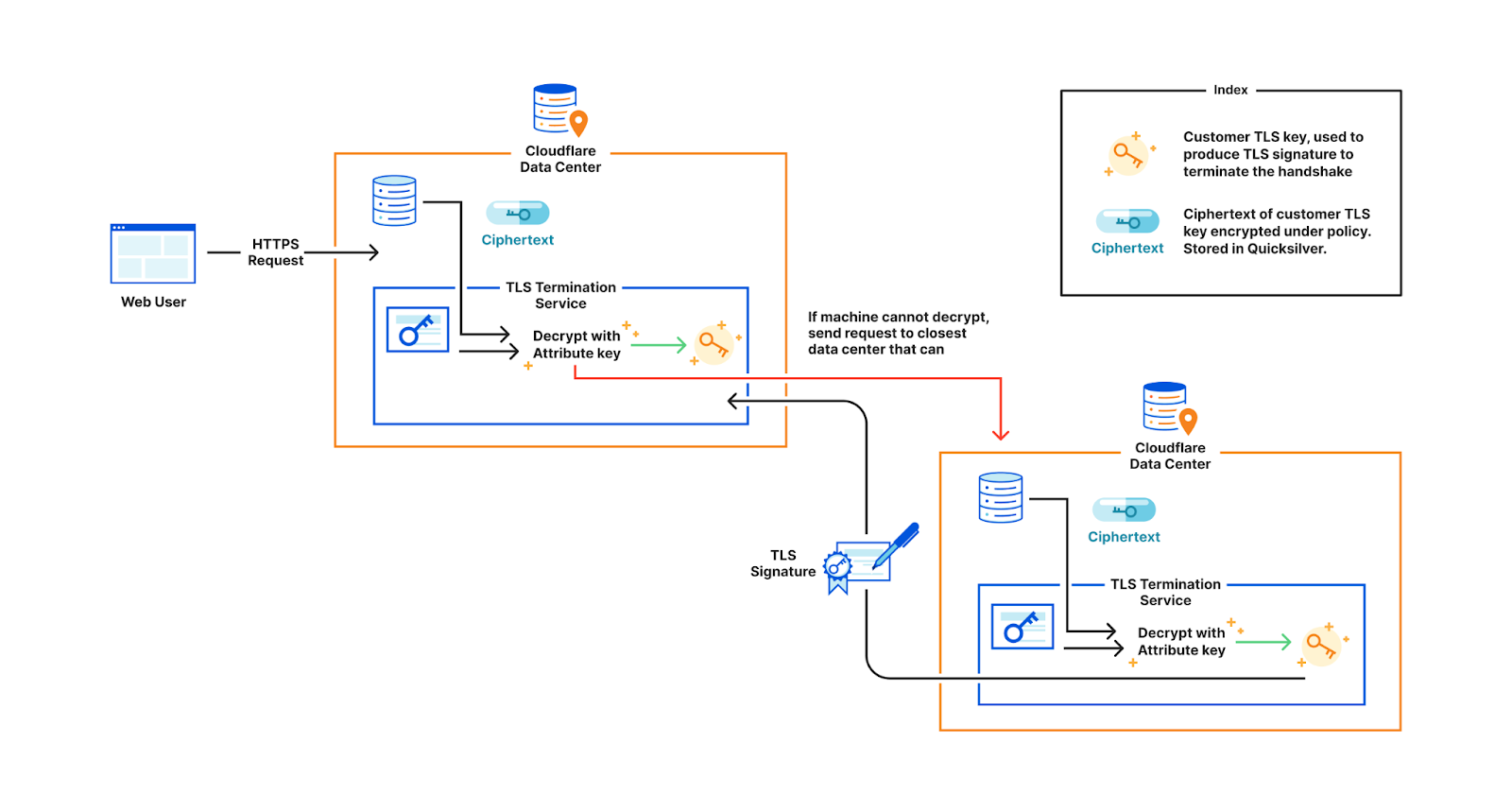
Earlier GeoKey Manager versions used attribute-based encryption to express geographic policies. The 2022 architecture distributed protected customer-key ciphertext globally. Cloudflare says the new Cloudflare One design substitutes region-specific roots and a hybrid key-encapsulation mechanism because a suitable production-ready post-quantum attribute-based encryption scheme is unavailable.
How the new protection works
Each region receives a 256-bit symmetric root secret. Cloudflare derives service-specific key pairs for workloads such as Gateway and Tunnel, tagged by service, region and rotation epoch. Cloudflare One then wraps customer private-key material using Hybrid Public Key Encryption with ML-KEM-768 and X25519, HKDF-SHA-256 key derivation, and AES-256-GCM authenticated encryption. ML-KEM is standardized by NIST; the classical and post-quantum elements provide complementary protection. Our coverage of OpenSSL’s recent cryptographic updates examines the wider software transition.
Quicksilver, Cloudflare’s configuration-distribution system, can replicate wrapped customer keys and their metadata across data centers. It does not receive the regional root secrets. Instead, an independent provisioning service checks the server’s Trusted Platform Module identity, Cloudflare’s Zinc hardware inventory and the configured geographic policy before releasing a regional secret. Authorized systems hold roots in the Linux kernel keyring rather than persisting them to disk. Our hardware key-security guide explains why protecting key material separately from application data matters.
Failure should deny access, not relocate a key
If a node lacks an authorized regional root or sees mismatched service, region or epoch metadata, Cloudflare says it rejects the operation. Missing required keys also prevent its edge key service from initializing. Fail-closed behavior reduces unauthorized decryption risk but introduces an availability tradeoff during provisioning errors or maintenance. Soft key rotation can preserve limited earlier epochs; hard rotation replaces wrapped keys to retire prior access.
An important boundary remains: GeoKey Manager governs where keys can be unwrapped, not where packets are routed, inspected or terminated. Separate Regional Services controls determine those operations. The new architecture also does not automatically establish legal compliance. Our HTTPS and TLS lesson explains the distinction between cryptographic keys and the network path carrying traffic.
What remains unproven
The closed beta is a deployment milestone, not evidence of universal customer coverage, independently measured attack resistance or completed CDN migration. Cloudflare says the existing CDN-focused geographic key controls will receive a separate post-quantum integration later. Security reviews should scrutinize regional root-key concentration and the integrity of hardware inventory and provisioning. Those systems become essential parts of the trust boundary.
Primary references: Cloudflare’s October 23 technical announcement; NIST FIPS 203; InfoQ’s independent technical assessment. Media: two official Cloudflare historical architecture figures, clearly dated 2022. No unverified YouTube playback is claimed. Featured artwork is a separately credited editorial photo illustration, not an image of the beta service running.
We volunteer daily to ensure the credibility of the information on the platform is Verifiably True. If you would like to support to help further secure the integrity of our research initiative, please scan the QR code below.


Leave a Reply