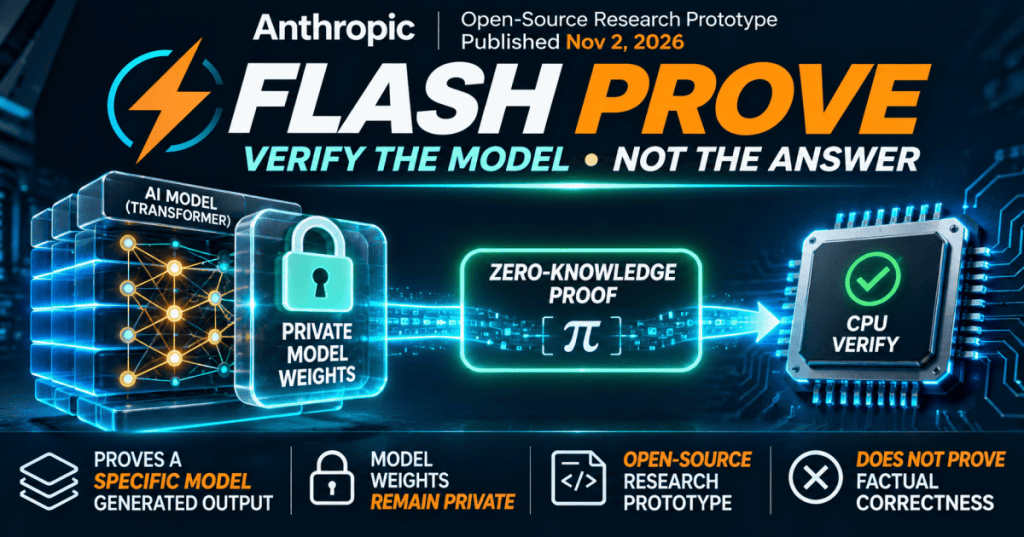
Anthropic published FlashProve on November 2, 2026, releasing a research prototype intended to prove that a particular AI model generated a particular response without exposing the model’s underlying numerical weights. Its technical announcement describes a cryptographic verification system based on zero-knowledge proofs. Unlike an ordinary claim that a server used a specific model, FlashProve creates a certificate an outside party can check.
AI requests increasingly move through cloud gateways, application providers and third-party routers. A user may be told a premium model answered, yet have little independent evidence of which model actually ran. FlashProve targets that provenance problem—not whether an answer is factual, safe or helpful.
How the proof works
The model provider first commits to a fixed set of weights using a cryptographic commitment. When generating output, the provider also constructs a zero-knowledge succinct argument, commonly called a zkSNARK, tying the response to the committed model. A verifier can check the commitment, prompt, output and proof on conventional CPU hardware without downloading or running the full AI model.
The distinction resembles hardware-backed protection of secrets, explored in BitcoinVersus.Tech’s hardware security module guide, but FlashProve is a software cryptographic protocol. Its design conceals numerical model weights while leaving the model architecture visible. It does not certify the correctness of the response’s underlying claims.
A 400-billion-parameter test
Anthropic evaluated the prototype with Llama 4 Maverick, a 400-billion-parameter mixture-of-experts model using publicly available four-bit quantized weights. Only about 17 billion parameters are active for a given token. The researchers measured approximately 110 tokens per second across 24 simultaneous requests on an NVIDIA H100 prover, rather than a guaranteed single-user response speed.
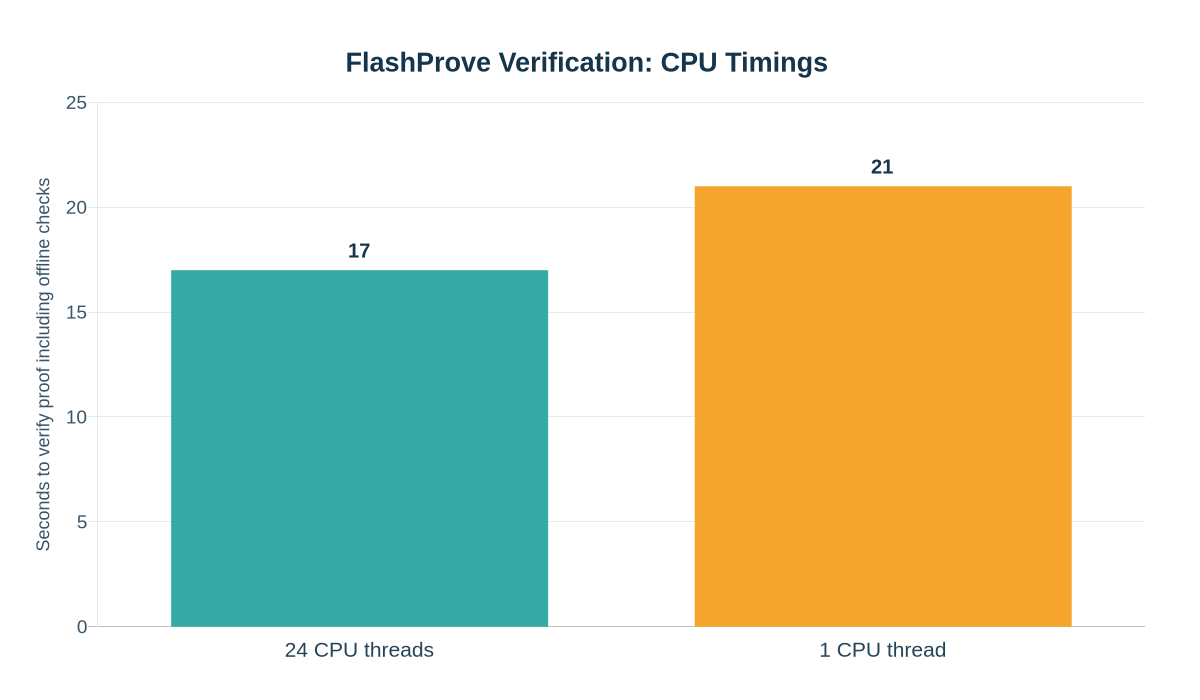
Each proof was roughly 18.78 MB, and the commitment material was about 6.5 MB. Checking a proof took 17 seconds with 24 CPU threads or 21 seconds with a single thread under the researchers’ test conditions. The verifier did not require a GPU, although downloading and processing the proof still imposed a real cost.
Zero-knowledge proofs also have established uses in cryptocurrency privacy protocols, as examined in BitcoinVersus.Tech’s shielded Bitcoin proposal report. A proof of computational provenance is different from a proof that a transaction is valid or that a chatbot’s description of events is accurate.
High compute costs limit immediate adoption
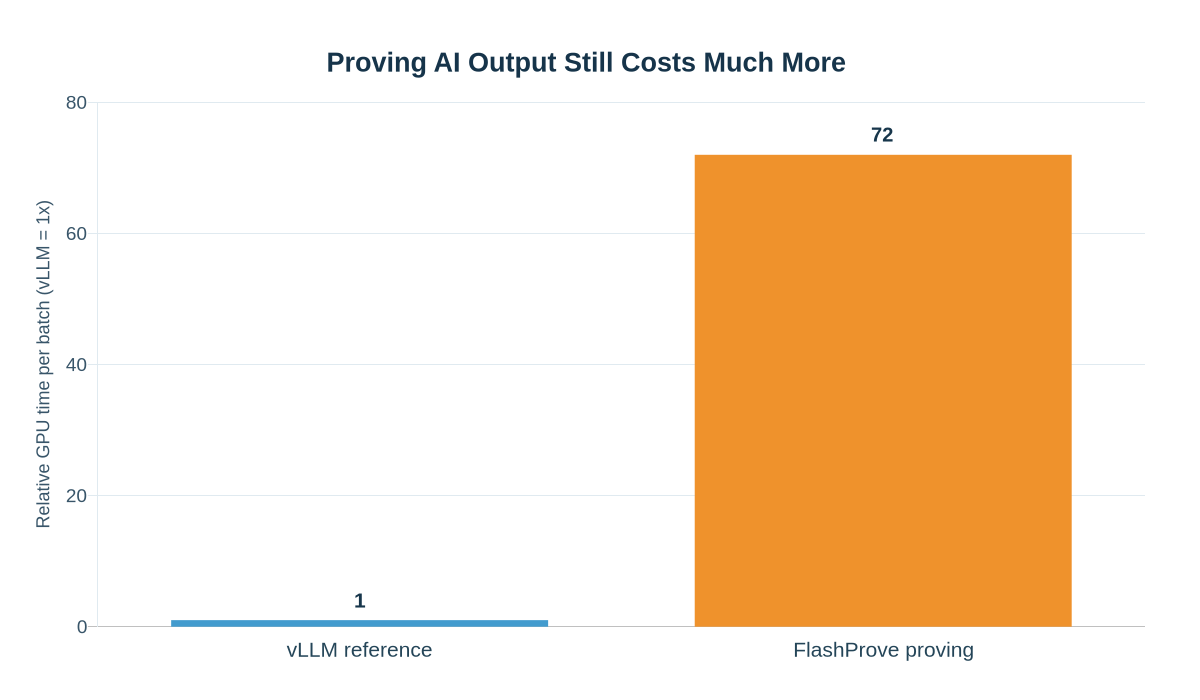
FlashProve remains expensive compared with running a model normally. Anthropic reported about 72 times more GPU time per tested batch than its vLLM reference, with runs ranging from 66 to 77 times; a separate high-load comparison reached about 94 times. The benchmark used different model precisions, so the ratios are study-specific rather than universal hardware multipliers.
The research prototype handles a context window of only 1,024 tokens and proves generated tokens individually. Long conversations, streaming responses, production uptime and operational integration remain unresolved engineering challenges. The public GitHub repository identifies the release as a research artifact rather than a maintained production library.
Model identity could eventually help auditors and users distinguish genuine output from substituted responses, but answer quality still requires independent evaluation. BitcoinVersus.Tech’s retrieval-augmented generation explainer describes a separate technique for grounding answers in documents. Likewise, post-quantum cryptography protects other kinds of information and communication; the terms should not be conflated.
Anthropic released executable code, a technical report, a protocol specification, and formal verification work written in Lean under an Apache 2.0 license. The central advance is an independently checkable demonstration at large-model scale. The central limitation remains practical: proving model identity consumes substantially more resources than answering a request, and it cannot establish truth.
Primary sources: Anthropic’s November 2 research announcement; FlashProve technical report; open-source implementation and documented limitations; and Computerphile’s educational zero-knowledge-proofs video.
Editor’s Note: FlashProve is an open-source research prototype, not a commercially deployed guarantee of AI-answer accuracy. All benchmark numbers, including 110 tokens per second, proof sizes, CPU timings, and GPU overhead, are attributed to Anthropic’s November 2, 2026 research; independent hardware testing was not performed. The Computerphile video dates to 2017 and is educational background. The featured illustration is conceptual artwork.
Support BitcoinVersus.Tech
Support independent research using the original approved QR image below for an optional 5,000-satoshi contribution. On a mobile device, open the article on a separate screen and scan the QR with a compatible Bitcoin wallet, or use a wallet’s supported image-scanning feature. Verify the destination address and amount before confirming.

We volunteer daily to ensure the information on this platform is Verifiably True. If you would like to support the research, please scan QR code.


Leave a Reply