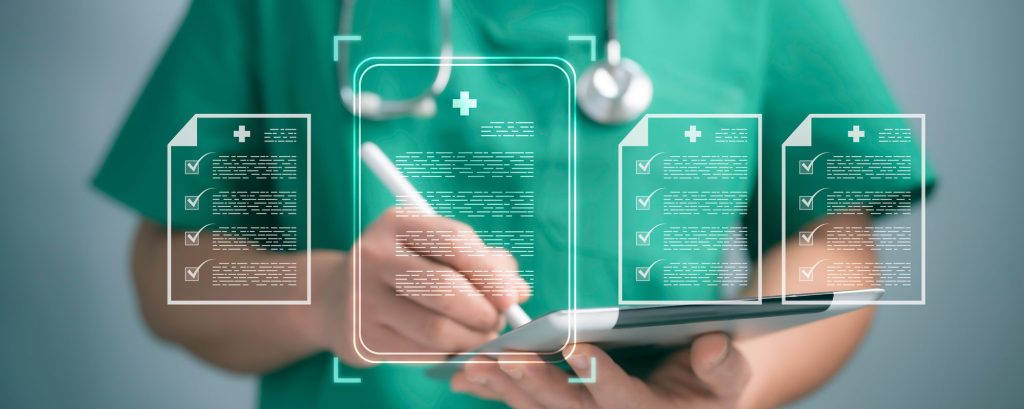
Artificial intelligence can condense lengthy electronic medical records into readable summaries. Determining whether those summaries faithfully represent the underlying records presents a separate engineering problem. On November 25, the University of Wisconsin School of Medicine and Public Health announced that a collaborative evaluation system developed with UW Health and Epic is available to other health systems. Rather than generating another summary, the software grades the quality of the first one.
A nine-part quality inspection
The Provider Documentation Summarization Quality Instrument, or PDSQI-9, provides a structured method for assessing generated clinical documentation. Its criteria include factual fidelity, completeness, organization, usefulness, clarity, concision, synthesis, attribution and potentially stigmatizing wording. Errors can arise through invented information or through the omission of important information already present in the source. Our AI engineering coverage of hallucinations explains why a fluent answer is not necessarily a reliable answer.
Epic’s open-source evaluation repository documents a workflow that accepts a generated summary, its underlying clinical notes and the relevant medical specialty. A configured model receives an evaluation prompt, returns a structured response and has its output processed into scores. The repository provides evaluation infrastructure rather than an independently hosted medical AI service.
What 22 seconds actually means
In a peer-reviewed study published in November 2025, researchers compared automated grading against physician assessments. OpenAI’s o3-mini achieved an intraclass correlation coefficient (ICC) of 0.818 with five examples in its prompt; the reported 95% confidence interval was 0.772 to 0.854. A corresponding zero-shot configuration achieved 0.803. A multi-agent o3-mini configuration reached 0.768. The leading configuration completed its evaluation in 22 seconds, compared with approximately 10 minutes for a physician review.
Converting 10 minutes into 600 seconds gives a nominal evaluation-time ratio of 600 ÷ 22 = 27.3. For 100 sequential evaluations, the respective times would be about 16 hours and 40 minutes versus 36 minutes and 40 seconds. The arithmetic is illustrative, not a hospital productivity trial; it excludes human escalation, infrastructure delays, model charges, privacy controls and other operational overhead.
Agreement is not the same as clinical accuracy
The ICC measures agreement between ratings, not the percentage of correct clinical facts. An ICC of 0.818 therefore must not be reported as 81.8% diagnostic accuracy. The study also found weaker agreement on a separate diagnosis-summarization task, where the same five-example approach reached 0.710. Generalization across clinical settings remains an important limitation. Our coverage of AI reliability testing examines a related distinction between performance on a benchmark and consistent performance in practice.
UW Health reports using the instrument within its oversight process, and Epic has incorporated the scorecard into its evaluation tools. A defensible deployment would still require approved data-handling infrastructure, testing on local documentation patterns, clinical review of high-risk failures and monitoring after model updates. Open software does not make sensitive patient information appropriate for submission to an unapproved external service.
From generating information to auditing it
Medical AI illustrates a broader architectural shift: the system that produces information need not be the same system responsible for evaluating it. Independent assessment, source verification and structured escalation can make errors more visible, but correlated mistakes between models remain possible. The approach complements other efforts to improve reliability, including grounding AI assistants in official documentation and verifying model provenance. The key advance is the ability to scale quality inspection, not the elimination of professional judgment.
Featured image: University of Wisconsin School of Medicine and Public Health news illustration, November 25, 2026. It is conceptual artwork, not a screenshot of the deployed system.
We volunteer daily to ensure the credibility of the information on this platform is Verifiably True. If you would like to support to help further secure the integrity of our research initiative, please scan the QR code below.



Leave a Reply