
Artificial intelligence can solve advanced programming problems yet make elementary mistakes when interpreting pictures or following precise instructions. On November 24, 2026, Google DeepMind announced Humanity’s First Exam (HFE), a benchmark designed to measure repeatable performance on straightforward tasks rather than exceptional performance on difficult ones.
The accompanying technical report evaluates 18 models from Google, OpenAI and Anthropic using 544 prompts arranged into 136 families. The five highest-scoring models achieved approximately 96% to 98% single-attempt accuracy, yet their average score under the stricter family-reliability measure was 85.8%. Featured image: Google’s actual neon-sign benchmark example, cropped from the announcement.
Kaggle’s November 24 announcement introduces the benchmark and community competition. The results below use the fixed technical report rather than a changing leaderboard.
Why answering correctly once is not enough
Conventional pass@1 measures the probability of a correct answer on one attempt. HFE also measures consistency across four related prompts and four runs per prompt, producing a stricter family pass⁴ score. A family fails the all-correct criterion when any of its 16 sampled answers is incorrect. The report estimates the metric from repeated model evaluations rather than assuming independent, identical probabilities.
For illustration only, if each of 16 answers were independent and had a 98% probability of being correct, the probability of getting every answer right would be 0.98 raised to the sixteenth power, or approximately 72.4%. Real model errors can be correlated, so the illustration cannot predict a particular model’s measured score.
SmartChart #26: Where reliability breaks down
A heatmap uses a common percentage scale for all 72 model-category combinations. The four categories measure the same family-reliability statistic, although they contain different numbers of prompt families. The chart allows direct comparisons within each category while making uneven capability profiles visible.
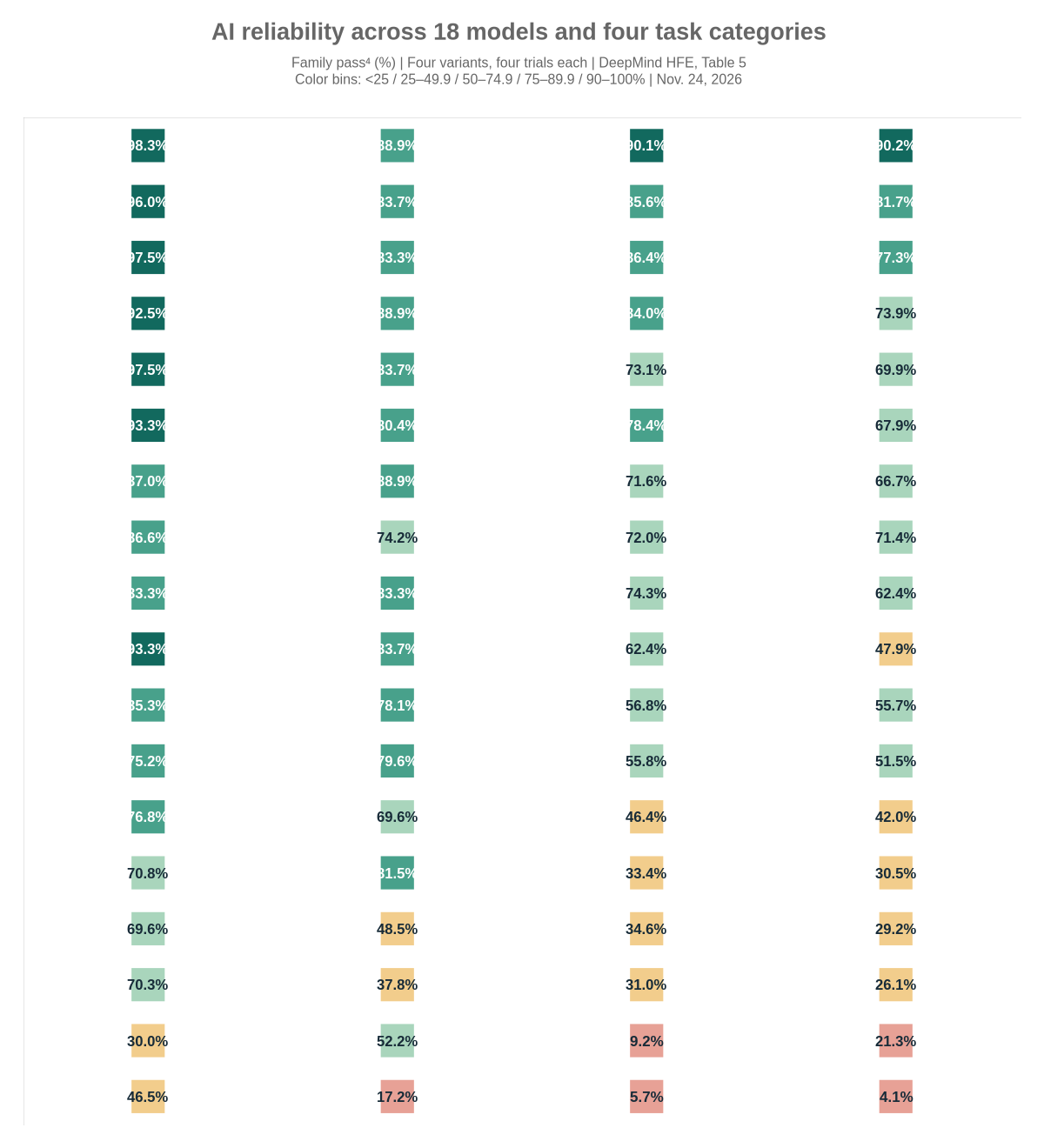
The reported vision scores among the top nine models range from 62.4% to 90.2%, a 27.8-percentage-point spread. Their math and algorithmic scores span only 15 points. The wider vision gap suggests that visually grounded elementary tasks distinguish models more strongly on the selected dataset. The leading model’s overall family score was 92.4%, compared with 97.8% on single attempts.
Practical implications for automation
A reliable automated workflow should validate results against explicit requirements instead of assuming that advanced reasoning guarantees correct execution. Image interpretation can benefit from independent checks; numerical output can be recalculated; and software changes can be tested against deterministic acceptance criteria. Our earlier coverage of local AI agents, AI inference infrastructure, AI-assisted circuit design and industrial machine vision illustrates the diversity of applications where validation matters.
HFE deliberately selects tasks that expose surprising failures, rather than sampling all everyday activities randomly. Its results are not an estimate of error rates across every deployment, and small score differences may fall within statistical uncertainty. The Kaggle leaderboard and community competition offer a way to expand the evaluation. For engineering teams, the central lesson is to measure consistent completion of a workflow, not merely whether a model demonstrates the capability once.
We volunteer daily to ensure the credibility of the information on this platform is Verifiably True. If you would like to support to help further secure the integrity of our research initiative, please scan the QR code below.


Leave a Reply