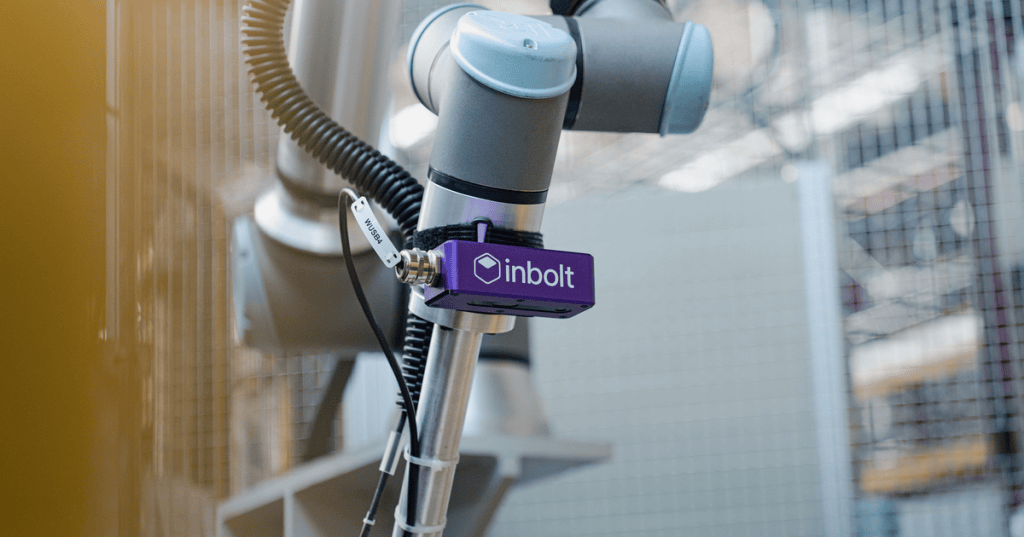
Industrial robots traditionally depend on precisely positioned workpieces. When a component shifts inside a tray or fixture, a programmed movement may miss its target. At the SPS automation exhibition in Nuremberg on November 24, 2026, Universal Robots and Inbolt announced a native machine-vision integration that addresses part-position variation without a separate industrial computer.
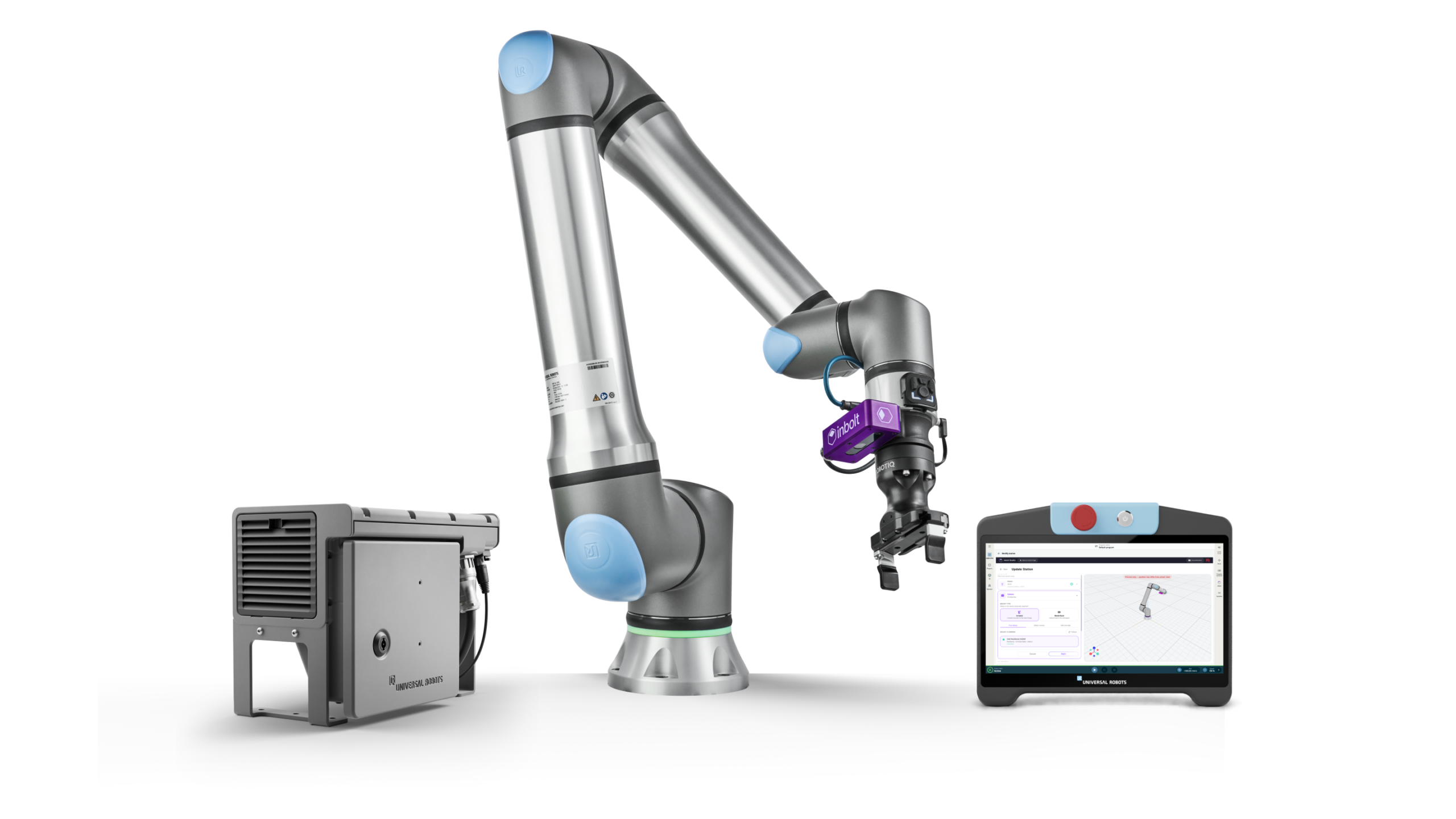
Inbolt Standard executes its localization workload on the Gen 7 platform’s CB7 Core controller. An arm-mounted depth camera connects through the tool flange on compatible g-Series arms. Removing a dedicated vision computer can simplify cabinet design, installation and maintenance. The camera itself remains necessary. Featured photograph: Universal Robots’ official November 24 press image of an Inbolt-equipped arm.
Earlier Inbolt demonstration at Automate 2026, showing vision-guided robot movement. The demonstration predates the native Gen 7 announcement.
Why a robot needs to know where a part is
A taught trajectory defines a sequence of positions and orientations in a coordinate system. A conventional automation cell often uses mechanical stops and locating pins to make the workpiece match the programmed reference. Errors in part placement can accumulate alongside gripper tolerances, calibration errors and tool deflection.
Three-dimensional machine vision offers another approach. Depth measurements can be matched against a geometric model of the component to estimate its pose, which includes three translational and three rotational coordinates. A coordinate transformation then maps the intended tool path from the nominal workpiece frame to the estimated frame. The robot still requires valid motion limits and collision-clearance checks; localization alone cannot guarantee safe operation.
According to Inbolt’s technical overview, CAD-based training takes less than ten minutes per component, and its fixed-part repeatability specification is 0.5–0.7 mm. Repeatability describes consistency under specified conditions, not necessarily absolute positioning accuracy. A 1 Gbit/s flange connection carries camera data on the g-Series, while localization runs locally rather than in the cloud.
An edge-computing advantage
Universal Robots’ September platform announcement claimed 40% greater controller computing capability alongside a 30% smaller footprint compared with earlier generations. If both changes are expressed relative to their respective previous values, the ratio of compute capability to footprint becomes 1.4 divided by 0.7, or twice the previous ratio. The calculation is illustrative; it is not a measured power-efficiency benchmark.
The architectural shift complements FPGA and AI processor integration for industrial robotics and low-power edge intelligence. Local processing reduces dependence on external infrastructure, but integrators must still evaluate thermal limits, controller utilization and worst-case latency.
Inbolt’s earlier Ford assembly-line case study illustrates the broader vision-guidance approach; moving-line applications are distinct from the newly announced Standard license.
Factory performance and remaining constraints
Universal Robots reports a 91% reduction in tightening failures at an earlier Stellantis engine assembly station using Inbolt guidance. The result is a specific vendor-reported production case, not a guaranteed improvement from the new controller integration. Standard targets stationary workpieces presented in predictable orientations; more complex random-part and moving-line capabilities are separate products.
Potential applications include fastening electronics assemblies and loading hardware trays, connecting robotic automation to the manufacturing systems behind semiconductor production and data center networking hardware. The companies have not disclosed universal savings or independently benchmarked every compatible application. Production trials, safety validation and total lifecycle costs will determine the economic value for individual factories.
We volunteer daily to ensure the credibility of the information on this platform is Verifiably True. If you would like to support to help further secure the integrity of our research initiative, please scan the QR code below.


Leave a Reply