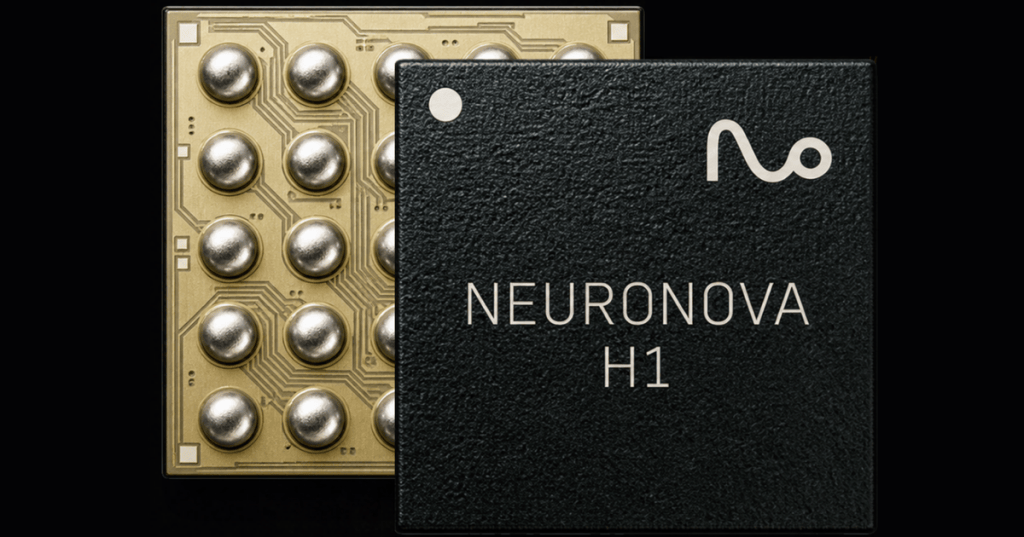
Italian semiconductor developer Neuronova has announced evaluation kits for its H1 Marconi, an analog neuromorphic processor designed to recognize patterns in sensor signals while consuming exceptionally little electrical power. In an October 26, 2026 announcement, the company reported receiving 13,000 functional chips from a full-mask manufacturing run using a 180-nanometer process in France.
Neuronova reports that the processor performs voice activity detection at below one microwatt, including its analog input stage, neural computing circuitry and digital output. Evaluation kits were offered for ordering, with shipments expected in the following weeks. The announcement also disclosed an unnamed customer’s paid order exceeding 100 chips. Those figures describe the manufacturer’s reported milestone, not independently audited sales or a third-party performance benchmark.
A processor built around the sensor
A conventional digital signal-processing pipeline frequently samples an incoming electrical signal, converts samples into binary numbers and executes mathematical operations on them. A neural network then processes those numerical representations to identify a pattern. Each conversion, memory access and computation contributes to energy demand.
Neuronova instead implements a neural network using analog circuitry. Physical electrical behavior participates directly in computation, and the processor can produce a compact digital signal when relevant information is detected. Cadence’s February 2026 engineering profile describes the company’s analog approach to processing sensor inputs. The intended applications include microphones, motion sensors and biological signals.
Voice activity detection is fundamentally narrower than speech recognition. Detecting whether somebody is speaking does not require transcribing sentences, identifying speakers or running a conversational language model. A low-power detector could wake a more capable processor only when necessary, reducing the time other components spend active.
What one microwatt means for energy consumption
One microwatt equals one millionth of a watt. At exactly that power, uninterrupted operation for 24 hours consumes 24 microwatt-hours, equivalent to 0.024 milliwatt-hours. Over 365 days, the same load consumes 8.76 milliwatt-hours, or 0.00876 watt-hours. Neuronova’s reported detection power falls below that reference level.
For perspective, a hypothetical 3-volt, 100-milliamp-hour battery stores approximately 0.3 watt-hours under nominal conditions. Dividing by 0.00876 watt-hours per year produces a theoretical 34-year energy budget for a constant one-microwatt load alone. Real batteries self-discharge, age and have operating constraints. Microphones, voltage regulators, wireless radios, host processors and other circuits can consume substantially more power. The calculation is not a battery-life forecast.
Why a mature manufacturing process matters
A 180-nanometer process is far removed from the leading-edge manufacturing nodes used by contemporary high-performance CPUs and GPUs. Analog chips, however, face different design priorities. Device matching, noise, leakage and stable electrical behavior can matter more than transistor density alone. A mature process may offer a practical manufacturing environment without requiring the smallest available transistors.
The engineering challenge now extends beyond obtaining functional silicon. Developers need measurements of detection accuracy, false wake-ups, response latency, environmental tolerance and total board consumption. Analog circuits also face variations across manufactured devices and changes in temperature. A fair comparison against digital alternatives would hold the workload, input conditions and detection quality constant.
The EDGE AI Foundation identifies the H1 and accompanying evaluation platform as a route for developers to investigate always-on inference. The commercial significance of Marconi will depend on how successfully customers integrate the processor into complete devices. The initial batch provides an opportunity to move from laboratory design claims toward reproducible application-level measurements.
Related reporting: 20 types of processors, BrainChip’s neuromorphic development kit, DEEPX’s edge AI processor and Ceva’s neural processing architecture.
Featured image: Neuronova manufacturer press image, October 26, 2026.
Editor’s Note: We volunteer daily to ensure the credibility of the information on this platform is Verifiably True. If you would like to support to help further secure the integrity of our research initiative, please scan the QR code below.



Leave a Reply