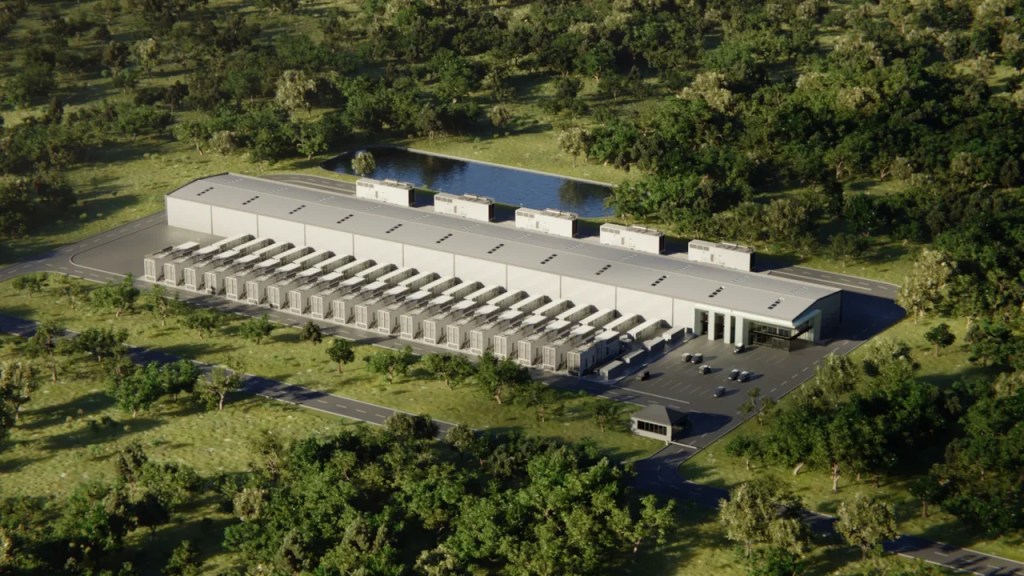
A Texas company that began by turning flared natural gas into electricity for Bitcoin miners is now building a 60-megawatt artificial intelligence campus. On November 17, 2026, Giga Energy announced an approximately $1 billion, ten-year lease for Project Clay in Hunt County. The customer is an unnamed American AI cloud provider. Construction began in July, and the developer targets readiness for service in spring 2027. Reuters independently reported the agreement.
From stranded gas to industrial AI
Texas A&M University documented Giga’s origins in 2022: its founders started a gas-powered Bitcoin mining business in 2019. Project Clay represents an evolution from monetizing energy through specialized hashing hardware toward supplying facilities for networked AI systems. It is not a confirmed conversion of an existing mining facility, and its electricity supply should not be confused with the founders’ earlier flare-gas operations.
The developer’s community information identifies Farmers Electric as the power provider and describes available electrical capacity, dedicated feeds and upgrades funded by Giga. Transformers, switchgear, protective relays and distribution equipment must turn a utility connection into dependable power at server racks. A contractual allocation of electricity is not equivalent to a commissioned electrical system.
How much electricity could 60 MW represent?
If the campus drew its full stated 60 MW continuously, it would consume 1,440 MWh per day or 525,600 MWh over a 365-day year. At an illustrative 80% average utilization of the stated power capacity, annual consumption would be 420,480 MWh. Neither calculation is measured usage. The developer has not specified a critical IT capacity separate from the announced site power, so accelerator counts cannot be reliably inferred.
Dividing the stated lease value by ten years yields an arithmetic average of $100 million annually, or approximately $1.67 million per announced megawatt per year. The ratio is not an electricity tariff, construction budget or profit forecast. Payment schedules, operating expenses and tenant obligations remain undisclosed.
Closed-loop cooling and factory assembly
Giga’s design recirculates water-glycol coolant rather than relying on continuous evaporative cooling. Heat still needs to be rejected to the environment, requiring fans and other equipment that consume electricity. The company says the campus will not require local water for daily compute cooling. Initial coolant fill, maintenance, fire protection and ordinary building water use remain separate considerations. Actual water and electrical performance will require operating measurements.
Factory assembly can overlap equipment fabrication with site preparation, potentially reducing construction time. Nevertheless, utility interconnection, commissioning, fiber connectivity, equipment delivery and integrated systems testing remain critical. Giga expects approximately 300 construction jobs and 24 permanent positions; these are developer estimates, not employment totals already achieved.
What to watch before energization
Project Clay joins a broader competition for powered land and ready-to-use electrical infrastructure. Related developments include PowerBridge’s Texas campus, the proposed Big Lake mining conversion, Applied Digital’s 150 MW lease and Alberta’s Beacon power project. The next meaningful evidence for Project Clay will be utility energization, commissioning results and customer acceptance. Until then, the lease establishes commercial intent, not operational computing capacity.
Cover: Giga Energy’s official project rendering, representing the proposed development rather than a completed facility.
We volunteer daily to ensure the credibility of the information on this platform is Verifiably True. If you would like to support to help further secure the integrity of our research initiative, please scan the QR code below.



Leave a Reply