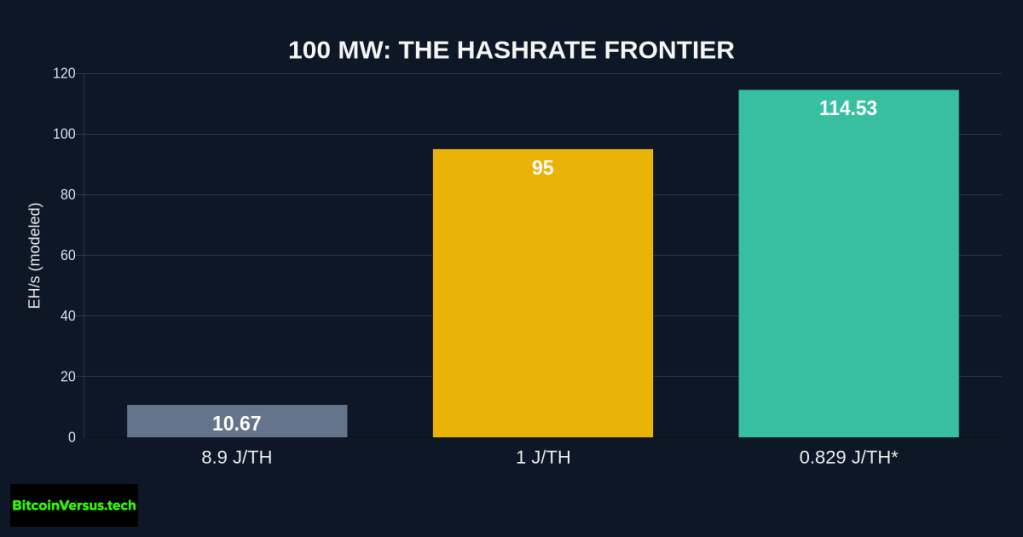
Could a 100-megawatt Bitcoin mining campus support more than 100 exahashes per second? A new BitcoinVersus.Tech mathematical investigation places simulated superconducting SHA-256 results inside a hypothetical facility power budget. At equal available electrical capacity, the most favorable modeled case supports 114.5 EH/s, versus 10.67 EH/s for manufacturer-rated 8.9 J/TH hardware. Neither the superconducting system nor its projected hashrate exists as a demonstrated commercial installation.
The analysis extends our November 21 AQFP investigation, rather than reporting a new chip announcement. The IEEE paper reports simulated chip efficiency of 548.35, 173.08 and 56.32 TH/J at 2, 5 and 10 GHz respectively. Researcher Coenrad Fourie discussed a hypothetical 400-fold cooling overhead at 4 K. The paper first appeared online in May 2026; its November issue motivates the follow-up.
BITMAIN’s S23 XP Hyd. product video supplies commercial context: 600 TH/s and 8.9 J/TH are ratings, not independent field data. Direct video link.
A facility-level energy equation
Define effective variable energy E = Mq/F + A, where F is simulated chip TH/J, M is the assumed total multiplier encompassing chip and cooling energy, q is a workload adjustment, and A is an illustrative additional 0.1 J/TH allowance for variable auxiliary loads. Neither q nor A is measured. Bitcoin uses double SHA-256; q = 1 and q = 2 bracket examples rather than establish actual implementation costs.
For 2 GHz, M = 400 yields 0.8295 J/TH at q = 1 and 1.5589 J/TH at q = 2. Solving E = 1 gives M = (1 − 0.1) × 548.35 ÷ q. The allowable multiplier falls from 493.52 to 246.76 as the assumed workload factor doubles. For comparison, matching 8.9 J/TH allows 4,825.48 or 2,412.74 respectively.
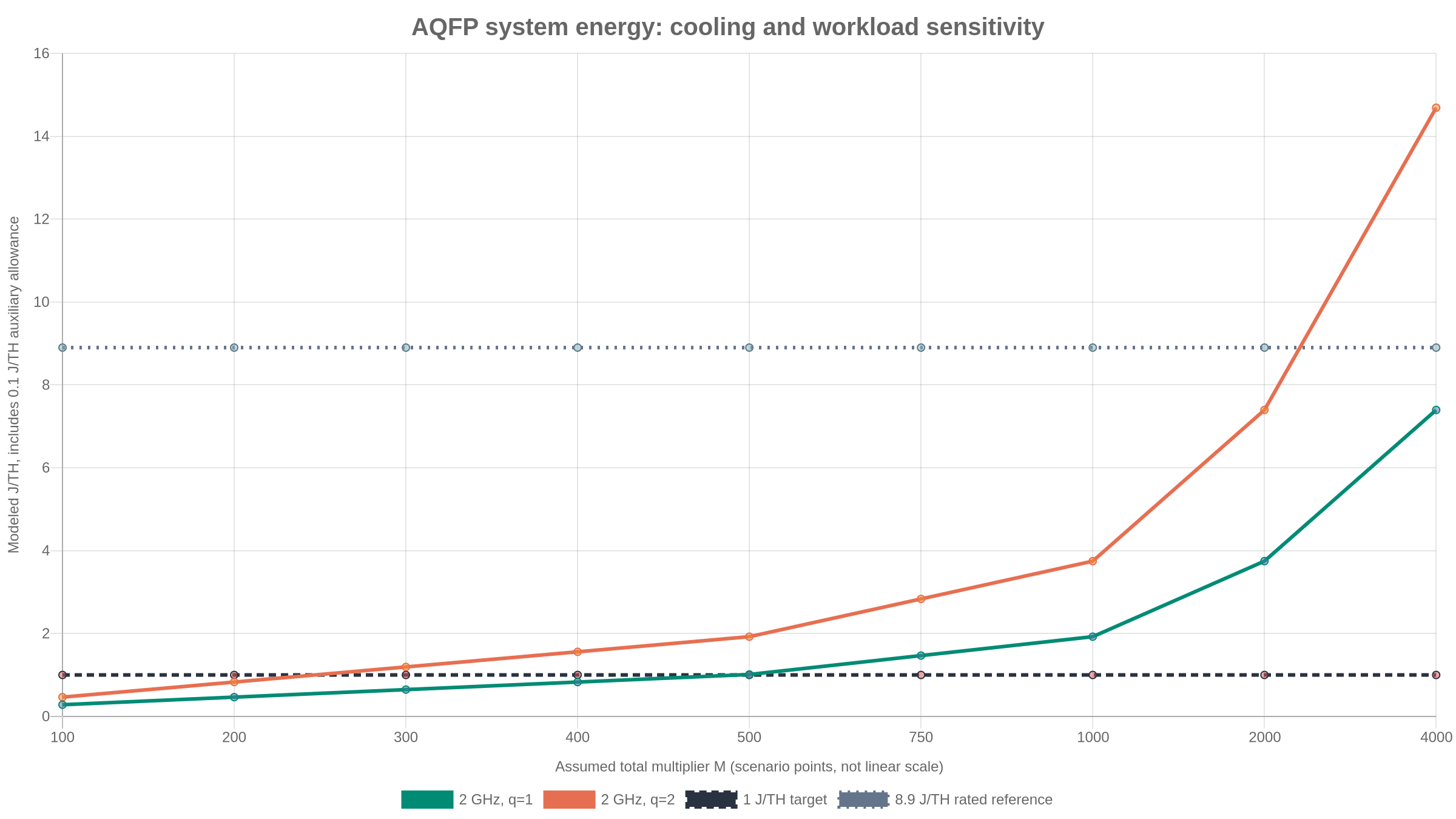
Clock choice matters. At M = 400 and q = 1, the 5 GHz and 10 GHz simulations imply 2.411 and 7.202 J/TH respectively. Higher clock speed is not automatically superior energy efficiency. The ASHRAE cryogenics handbook describes the substantial thermodynamic cost of refrigeration near 4 K. Actual cold-stage heat leaks, compressor efficiency and other loads could alter every estimate.
How much hashrate fits inside 100 MW?
Reserve 5 MW for fixed infrastructure, leaving 95 MW for variable computing and associated loads. Because 1 EH/s equals one million TH/s, H(EH/s) = 95 ÷ E(J/TH). The commercial reference uses the manufacturer’s 8.9 J/TH with the same fixed allowance; actual variable site overhead for that reference is not modeled. See our earlier miner-versus-site efficiency analysis.
| Scenario | Variable J/TH | Capacity (EH/s) |
|---|---|---|
| Commercial rating | 8.900 | 10.67 |
| Singularity threshold | 1.000 | 95.00 |
| 400×, q = 1 | 0.829 | 114.53 |
| 400×, q = 2 | 1.559 | 60.94 |
| 1,000×, q = 2 | 3.747 | 25.35 |
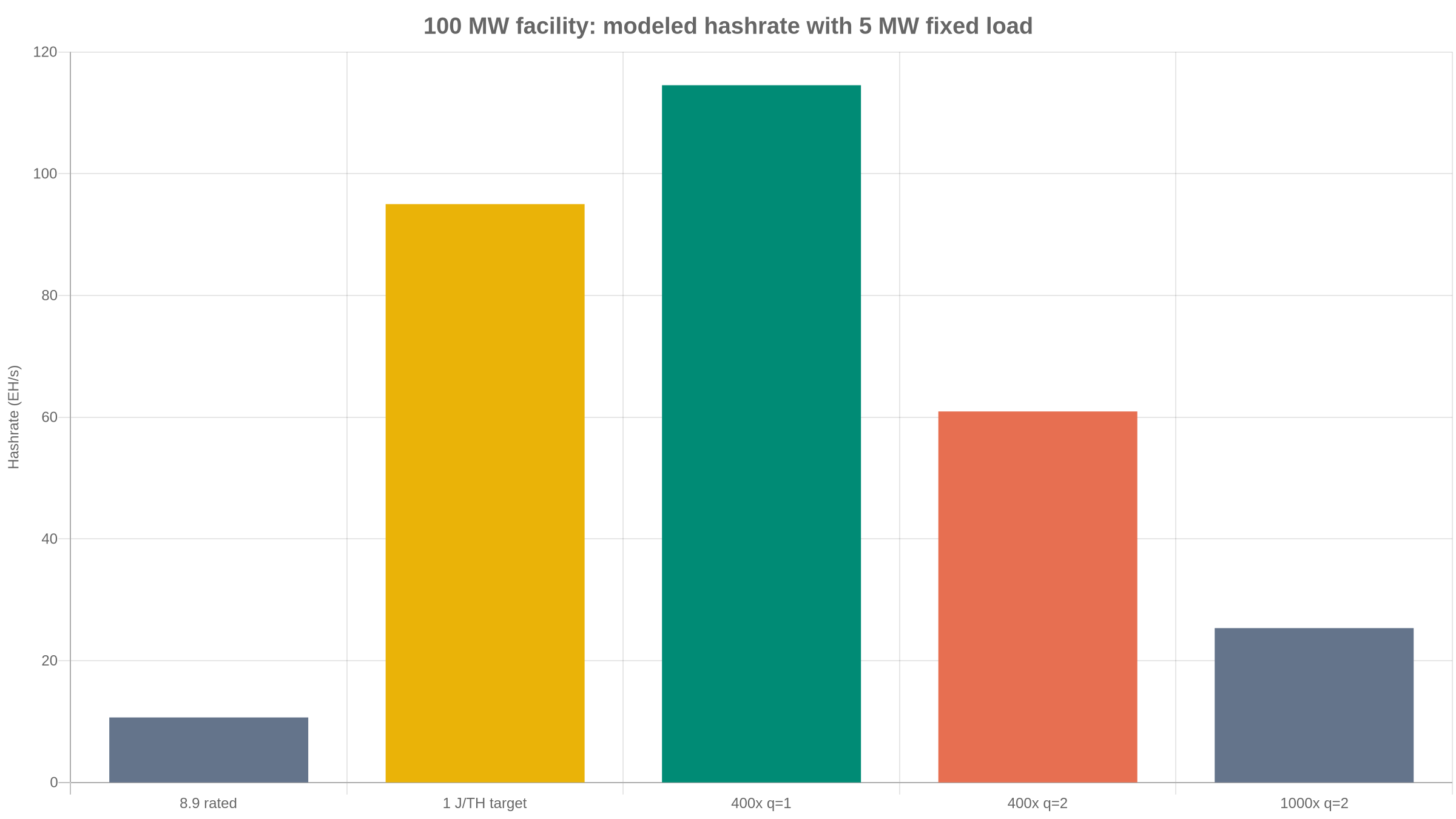
At 10 EH/s, the same comparison implies 94 MW total for commercial hardware versus 13.29 MW in the favorable superconducting scenario. The difference, 80.71 MW, would correspond to approximately $35.35 million in annual electricity savings at $0.05/kWh and uninterrupted operation. Capital costs, reliability and refrigeration availability remain unknown; savings do not establish profitability.
Revisiting the Singularity curves
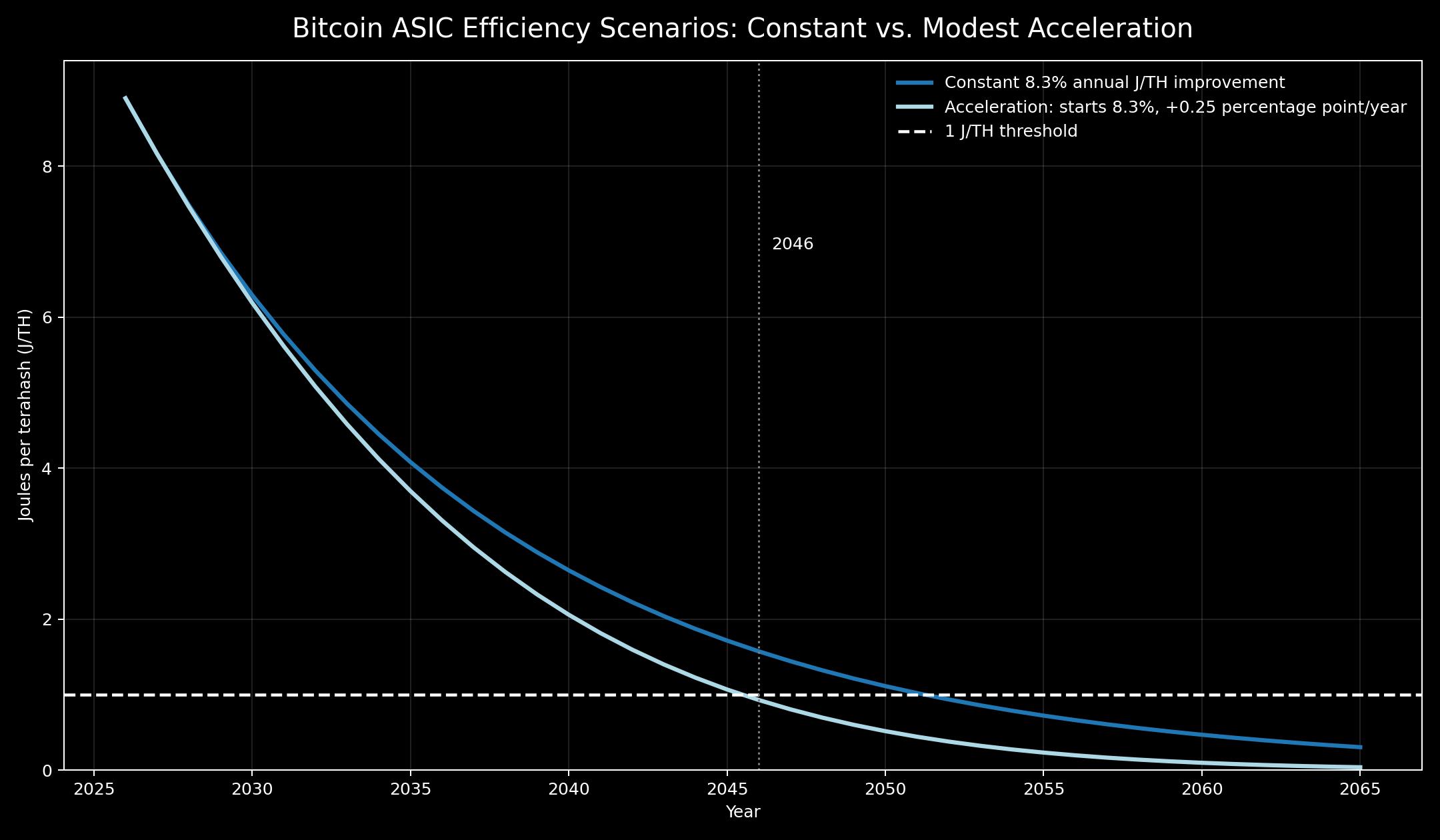
Our original dissertation modeled J/TH decline under thermoeconomic capitulation, with a historical 2033–2039 milestone window. The later 8.3% scenario and 2046 analysis stress-tested slower progress. A fabricated AQFP device would potentially introduce an architecture discontinuity rather than merely extend a CMOS curve.
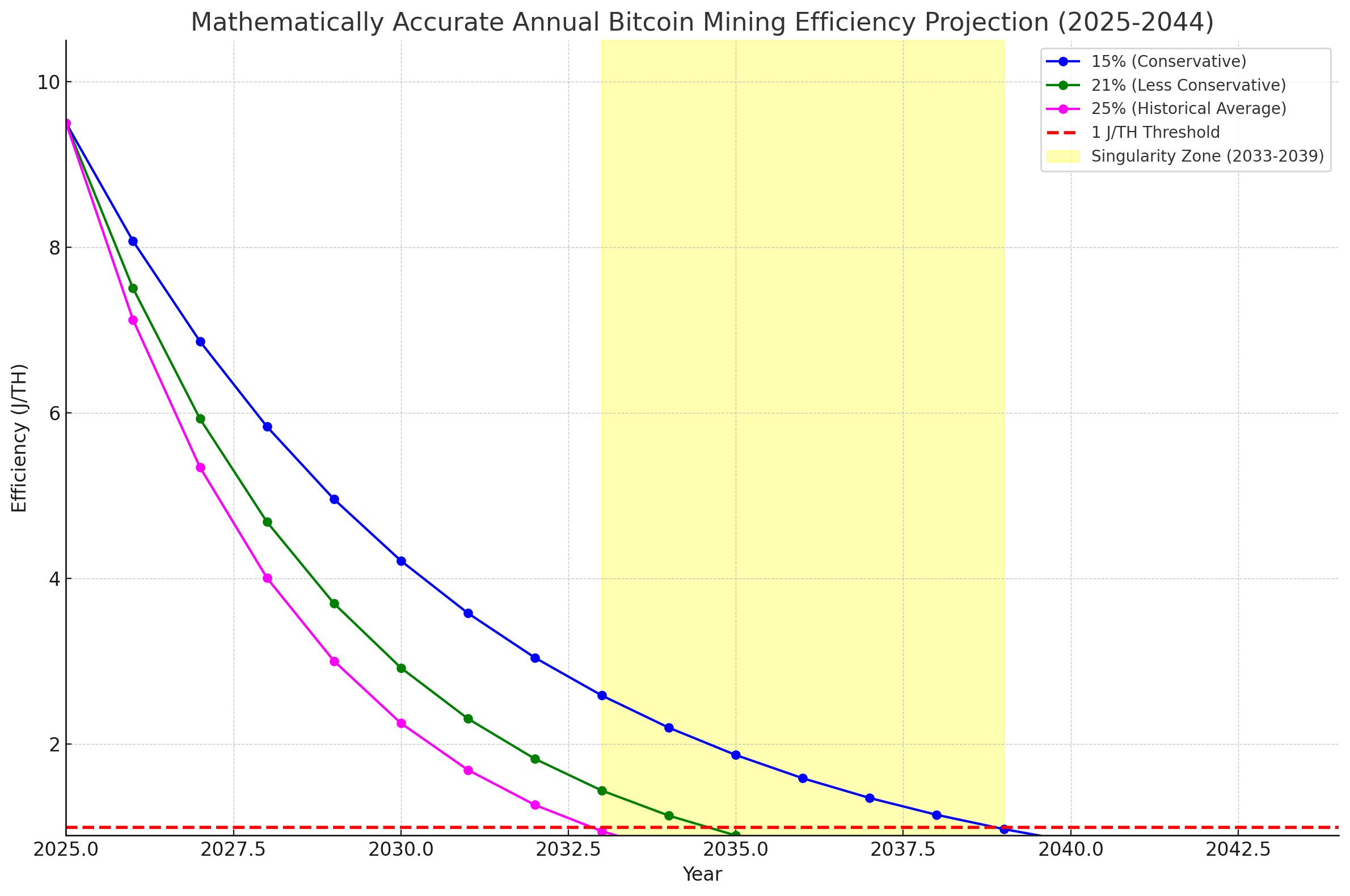
Original August 2025 BitcoinVersus.Tech research post identifies the conditional 2033–2039 milestone.
The Power Efficiency Theory framework must retain separate commercial, experimental and simulated series. The PEI index cannot treat estimated AQFP hashes as verified network growth. Nor would reaching 1 J/TH establish a universal Landauer limit or guarantee Bitcoin price appreciation. The next credible data point requires a fabricated Bitcoin-specific accelerator with sustained accepted work and independently measured facility input. Until then, the modeled capacity is an engineering research question, not a revised commercial frontier.
Methodology: primary IEEE abstract and researcher statement, ASHRAE refrigeration reference, original BitcoinVersus.Tech calculations; SmartChart chart-selection methodology (line sensitivity and zero-baseline vertical bars), rendered via QuickChart. Full paper access and independent hardware measurements were unavailable. In-page playback and device-level visual testing were not performed.
BitcoinVersus.Tech Editor’s Note: We volunteer daily to ensure the credibility of the information on this platform is Verifiably True. If you would like to support to help further secure the integrity of our research initiative, please scan the QR code below.

BitcoinVersus.Tech publishes research and journalism for informational purposes, not financial advice.


Leave a Reply