A rural electric cooperative is investing in a battery chemistry designed to operate for long periods without relying on conventional lithium-ion cells. On November 17, 2026, Dairyland Power Cooperative announced an approximately $56.2 million long-duration energy storage program supported by $28 million in federal funding. Three battery systems are planned across Frentress Lake, Illinois, and Alma, Wisconsin, with two systems at the Wisconsin location.
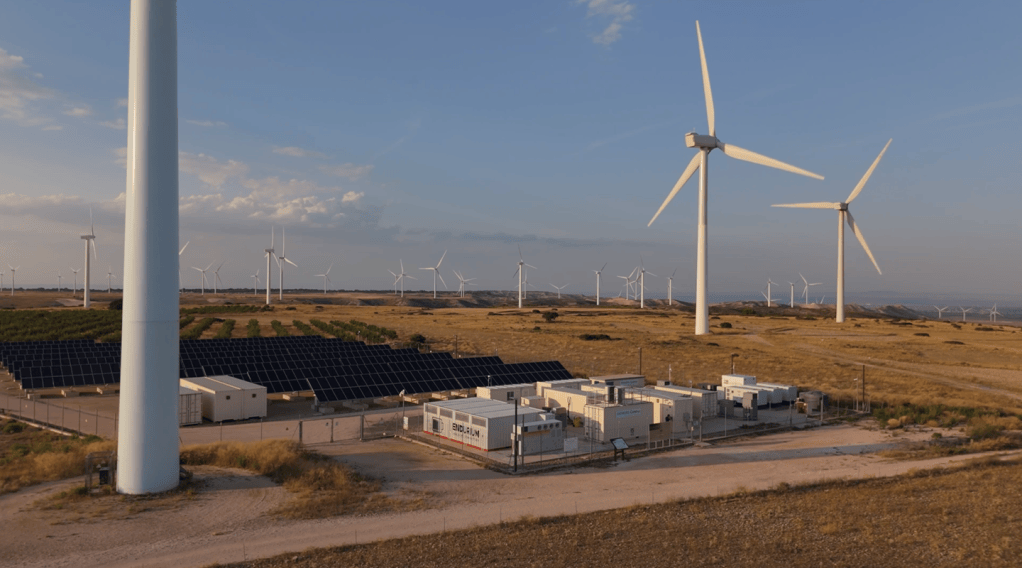
Supplier Invinity Energy Systems confirmed on November 18 that the previously announced 43 MWh order will serve the three installations. Deliveries are expected to begin in late 2027, with U.S. manufacturing planned. The announcement establishes a procurement and deployment plan, not an operational battery fleet. Featured photograph: Gamesa Electric’s earlier La Plana installation in Spain, courtesy of Gamesa Electric via Invinity.
Technology background: Sumitomo Electric’s explanation of vanadium redox flow batteries, published in 2023; not footage of Dairyland’s project.
How liquid electrolyte stores electricity
A vanadium redox flow battery stores chemical energy in two tanks of aqueous electrolyte. Pumps circulate the liquids through an electrochemical stack, where vanadium ions exchange electrons through reversible oxidation and reduction reactions. A membrane separates the electrolytes while allowing charge-balancing ions to pass. External circuits and power conversion equipment deliver electricity to the grid.
Unlike conventional battery packs, flow battery architecture can partly separate energy capacity from electrical power. Larger electrolyte inventories can extend discharge duration, while stack and inverter capacity constrain instantaneous output. The configuration is attractive when an electrical network needs sustained support rather than only a short burst of power.
Invinity reported on November 9 that engineering changes increased its Endurium module energy capacity from 342 to 516 kWh, approximately 50.9%. Enlarged tanks and improved fluid controls contributed to the change. The manufacturer has not specified in the November project update whether the full Dairyland order uses the upgraded module configuration.
What 43 MWh can deliver
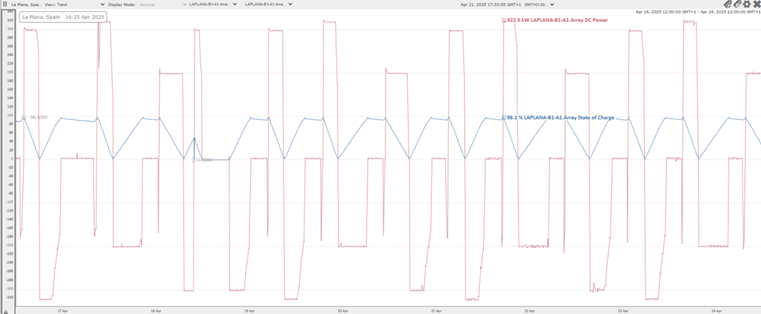
Energy capacity should not be confused with power. In an idealized calculation, 43 MWh can support a 4.3 MW aggregate load for ten hours, or 2.15 MW for twenty hours. Actual delivery depends on the individual site power ratings, usable capacity, battery state of charge, conversion losses and network conditions. Neither example represents an announced Dairyland discharge rating.
Dividing the stated $56.2 million program investment by 43,000 kWh produces roughly $1,307 per kWh of planned battery capacity. The quotient is a program-level capital indicator, not a battery purchase price or a levelized cost of storage. Infrastructure, engineering and other project expenses may contribute to the total.
Earlier regional coverage illustrates why capacity and duration matter: Utah’s 600 MWh battery installation and recent U.S. storage deployment figures provide useful context. Different project scopes and technologies prevent a direct cost comparison.
The grid resilience opportunity
Rural distribution networks may have long feeders and limited alternative supply paths. Strategically located storage can help manage peak demand or maintain selected loads during disruptions, provided local protection, isolation and control systems support the intended operating mode. Storage cannot guarantee uninterrupted service during every outage.
Flow systems also require pumps, maintenance, electrolyte management and site space. Their aqueous electrolyte reduces the risk of cell-level thermal runaway associated with some lithium-based systems, but electrical hazards and chemical handling still require safeguards. Round-trip efficiency and lifetime maintenance costs remain important economic variables.
Dairyland’s program complements developments such as second-life EV battery storage and flexible computing powered by surplus renewables. The next milestone is physical delivery, followed by commissioning and measured performance under real grid conditions.
We volunteer daily to ensure the credibility of the information on this platform is Verifiably True. If you would like to support to help further secure the integrity of our research initiative, please scan the QR code below.



Leave a Reply