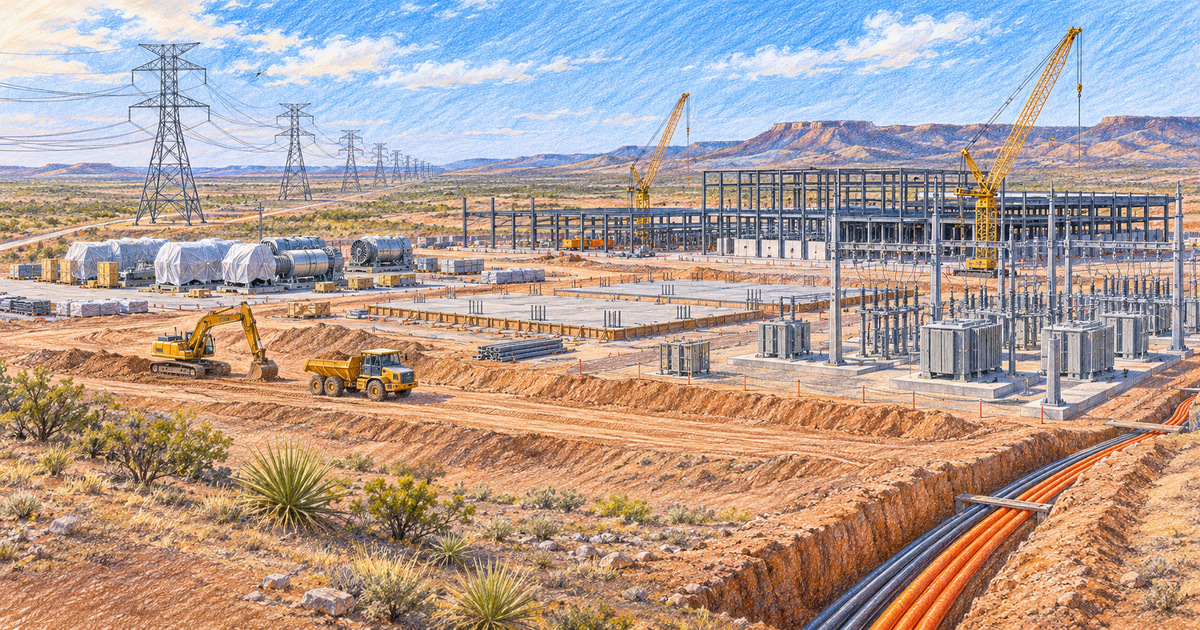

Original editorial illustration of a conceptual West Texas power campus, not a photograph of actual construction. Existing BitcoinVersus.tech watermark asset reused at bottom left.
DATA CENTERS / ENERGY | November 23, 2026
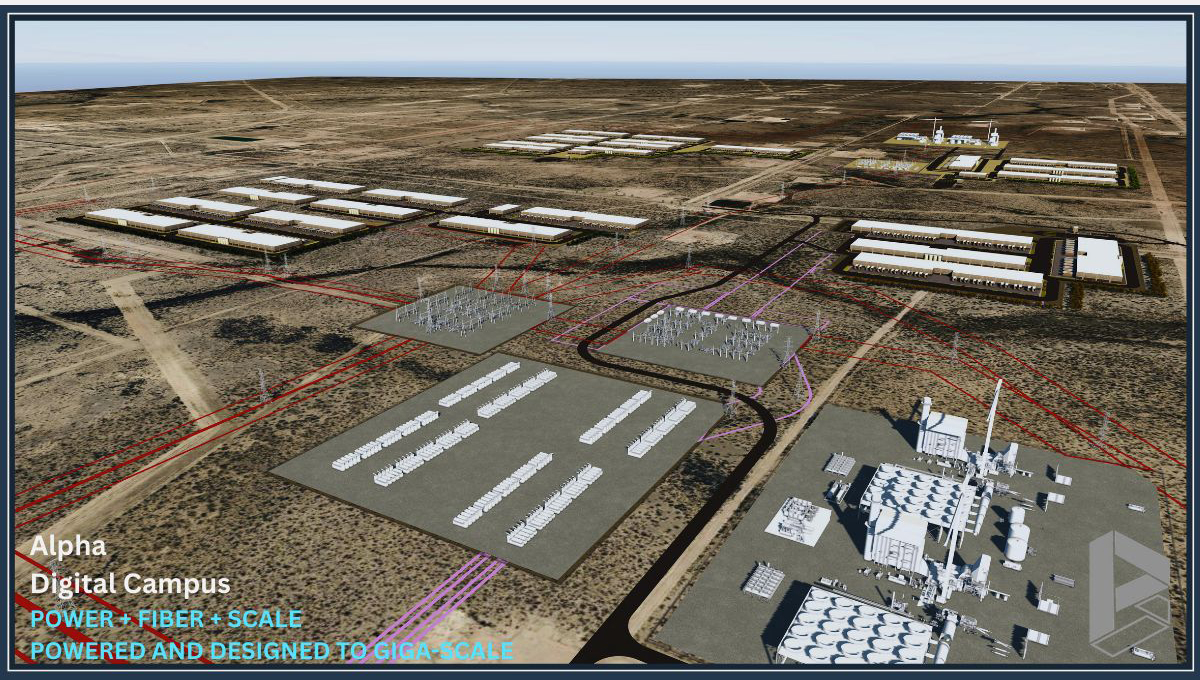
Construction has started on the first phase of PowerBridge’s Alpha Digital campus in Reeves County, Texas. The project blends planned natural-gas power generation, electrical infrastructure and fiber pathways for future hyperscale computing customers. Landowner LandBridge says the initial development covers 825 leased acres and is expected to include more than 300 megawatts of planned power capacity. The widely advertised 2-gigawatt campus figure refers to longer-term generation ambitions, not electricity already available to server racks.
From land option to construction
The November 2026 LandBridge results announcement states that PowerBridge exercised an option on 825 acres during the third quarter, out of approximately 3,400 acres covered by its original development option. The partners executed a long-term ground lease and a power-royalty agreement in September, when Phase I construction began. A later November 13 report from Data Center Dynamics documented the public groundbreaking milestone near Pecos.
PowerBridge targets its first delivery of electricity in the fourth quarter of 2027. Further construction and larger-scale output remain future milestones; an active construction site is not evidence of 300 MW currently energized. The company has not published verified operational IT load, facility power usage effectiveness or measured cooling consumption for Alpha Digital.
How the power architecture is supposed to work
The campus is near the Waha natural-gas hub, with a joint venture between PowerBridge and Liberty Energy intended to supply modular, gas-fueled generation, site power management and potential interaction with the ERCOT grid. PowerBridge is also developing power distribution and fiber conduit infrastructure, aiming to deliver utility-ready land where customers can build their own data halls. Grid interconnection, fuel logistics, electrical protection, redundancy and environmental approvals all affect the eventual service date.
Co-located generation could allow a computing customer to receive power before conventional grid upgrades finish. However, operating in island mode requires generation to follow changing loads and maintain voltage and frequency without relying on grid support. Exporting surplus electricity later would also require the appropriate interconnection and operating arrangements. Neither future grid exports nor 2 GW of commissioned generation has been demonstrated.
A 2 GW headline is not 2 GW of computing
Generation nameplate capacity, facility electrical input and useful IT load are different quantities. For scale, a hypothetical 300 MW generator running continuously for 8,760 hours would produce 2.63 terawatt-hours annually, before any availability limits or losses. At the same illustrative utilization, 2,000 MW would yield 17.52 TWh. Those figures are arithmetic upper-bound illustrations, not forecasts of Alpha’s output or data-center demand. Actual IT consumption would be lower than generation after auxiliary loads, electrical losses and other demands.
The contrast matters across the industry. BitcoinVersus.tech recently examined Cipher’s proposed gas pipelines for AI power, a 150 MW Applied Digital customer lease, EdgeCore’s 216 MW planned Reno IT campus and NTT DATA’s proposed 900 MW fuel-cell deployment. Another report followed 643 MW of early-stage grid engineering work at Willdan. Each number describes a different stage or part of infrastructure.
What must happen next
The most meaningful checkpoints are approved power-plant permits, installed generator equipment, transmission and interconnection arrangements, tested power delivery, signed computing tenants and actual IT commissioning. The original April lease announcement described up to 2 GW of co-located power generation; the November construction update provides firmer evidence for the initial land commitment and Phase I work, but not for full-campus operation.
Primary sources: LandBridge Q3 2026 results; Liberty Energy–PowerBridge joint venture announcement; LandBridge’s original site-development agreement. Independent milestone reporting: Data Center Dynamics, November 13, 2026.
We volunteer daily to ensure the credibility of the information on this platform is Verifiably True. If you would like to support to help further secure the integrity of our research initiative, please scan the QR code below.



Leave a Reply