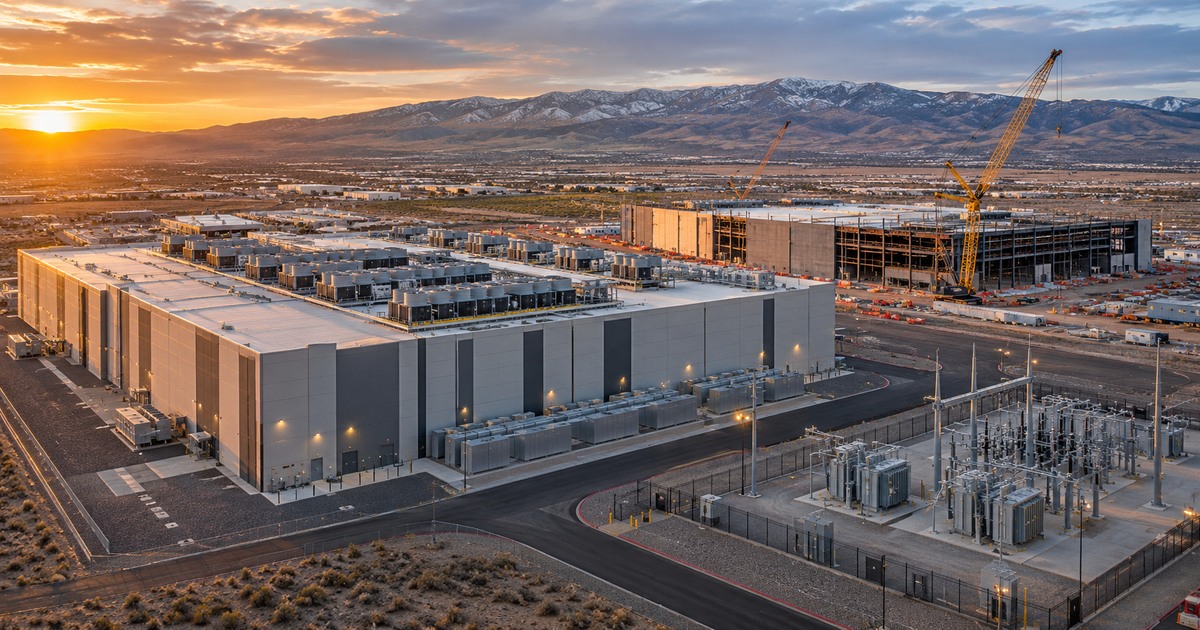

Original editorial illustration, not a photograph of EdgeCore’s Reno facility. Approved BitcoinVersus.tech watermark reused at the lower left.
RENO, NEVADA | November 23, 2026
A ribbon-cutting at EdgeCore Digital Infrastructure’s Reno Industrial Center campus marks a new stage for one of Nevada’s large AI-focused data center developments. On November 19, 2026, the company celebrated the opening of its first building, RN01, while the structural shell of a second, RN02, reached its topping-out milestone. EdgeCore’s long-term campus plan calls for three buildings and 216 megawatts of critical IT capacity. The distinction between an opened building and a fully energized 216 MW campus is essential.
Official project milestone: EdgeCore’s November 2026 LinkedIn announcement, including photographs from the RN01 and RN02 event.
Two construction milestones, not 216 MW online
EdgeCore confirmed both milestones in an official company update. The project occupies 56 acres at the Tahoe-Reno Industrial Center in Storey County, east of Reno. When complete, the campus is designed to approach one million square feet. Earlier company construction updates described three 72 MW buildings, yielding a combined 216 MW of planned critical IT load. The announcement did not disclose how much IT capacity had been energized or occupied at RN01 on ribbon-cutting day, nor did it establish a delivery date for RN02 and RN03.
A topping-out ceremony indicates that a building’s principal structural work has reached a milestone. It does not establish completion of utility interconnection, switchgear commissioning, cooling-system testing or customer acceptance. Even an opening ceremony should not be treated as proof that every rack is operating. Campus-wide planned capacity and current consumption remain different measures.
The electrical and cooling challenge

EdgeCore markets the Reno campus for dense cloud and AI workloads, including direct-to-chip liquid cooling alongside air-cooled equipment. A high-density AI hall must coordinate the utility connection, transformers, distribution gear, backup power, cooling plants and server-side heat removal. Commissioning can require load-bank testing and staged acceptance before production equipment reaches sustained demand.
The company specifies a water usage effectiveness, or WUE, design target below 0.01 liter per kilowatt-hour, supported by a closed-loop chilled-water approach. WUE measures site water use relative to IT energy, not the share of electricity devoted to cooling. EdgeCore’s number is a company-reported design figure, not an independently verified operational measurement for the entire Reno campus. Its one-building, one-tenant model also allows cooling and power systems to be tailored for a particular customer’s hardware.
What 216 MW would mean at full utilization
At a hypothetical continuous 216 MW of IT demand, annual server electricity alone would equal 216 × 8,760 = 1,892,160 MWh, or approximately 1.89 terawatt-hours. The calculation is a full-load illustration, not a forecast of 2026 energy use. Facility electricity would be higher after electrical losses and cooling overhead; no independently verified Reno power usage effectiveness, or PUE, was disclosed alongside the milestone.
The result highlights an infrastructure bottleneck followed across the industry: construction progress, available utility capacity, installed computing equipment and operational electrical load advance on different schedules. Other recent BitcoinVersus.Tech reporting has examined a 150 MW AI leasing agreement in Louisiana, Cipher’s gas-pipeline plans for AI data center power, Empire AI’s cooling and heat-reuse plans in Buffalo, and modeled U.S. hyperscale electricity demand. Each illustrates a separate part of the build-out problem.
What to verify next
The next useful disclosures would be the actual energized IT megawatts at RN01, tenant occupancy, commissioning acceptance, measured water consumption, PUE, and the utility delivery schedule for RN02 and RN03. EdgeCore also cites proximity of roughly 250 miles and about three milliseconds of network latency to Silicon Valley; actual performance depends on carrier route and service configuration. Opening the first building is a tangible project milestone, but it cannot substitute for measured campus-wide operating data.
Primary and independent sources: EdgeCore’s official milestone post; EdgeCore Reno project specifications; Data Center Dynamics, November 20, 2026. Building milestones and design claims are distinguished from operating measurements.
We volunteer daily to ensure the credibility of the information on this platform is Verifiably True. If you would like to support to help further secure the integrity of our research initiative, please scan the QR code below.



Leave a Reply