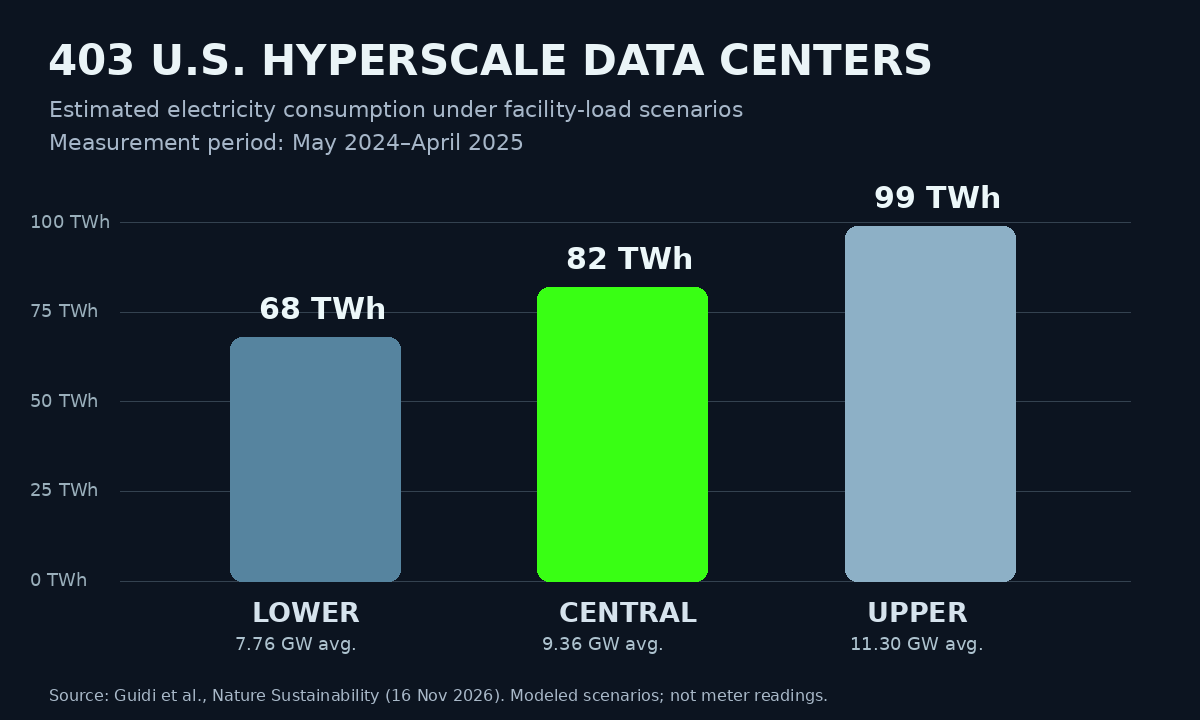
A peer-reviewed assessment of 403 U.S. hyperscale data centers puts their combined electricity consumption at approximately 82 terawatt-hours (TWh) over May 2024–April 2025. The central modeled estimate equates to 9.36 gigawatts (GW) of continuous average electrical demand, not 9.36 GW of nameplate capacity or a measurement of demand in November 2026.
Published November 16 in Nature Sustainability, the research by Gianluca Guidi and colleagues integrates facility-level information with regional power-generation data. Across alternative load assumptions, the facilities’ modeled electricity use spans 68–99 TWh. The central value equals approximately 1.8% of U.S. electricity consumption during the reference period, according to the authors.
STATS: 82 TWh becomes 9.36 GW
Energy measures the quantity of electricity used over time. Power measures the rate at which energy is consumed. Converting 82 TWh to 82,000 gigawatt-hours and dividing by the 8,760 hours in a 365-day year gives 9.36 GW. Spread evenly across 403 facilities, the arithmetic corresponds to 203.5 GWh per facility per year, or 23.23 MW of average load per facility. Those averages do not describe any particular campus.
The scenario range matters
The 31 TWh difference between the lower and upper cases reflects assumptions about facility utilization. It should not be labeled a statistical confidence interval. Under the lower case, annual electricity corresponds to 7.76 GW of continuous average load; the upper case implies 11.30 GW. Grid planners still need site-specific peaks, power factors, redundancy designs, transmission constraints and commissioning schedules. Annual averages alone cannot predict a transformer’s peak loading.
Carbon attribution: 25.7 million tons
The study attributes approximately 25.7 million metric tons of CO₂ to the central electricity scenario using a location-based, regional generation attribution approach. About 54% of the associated electricity generation was attributed to fossil-fuel sources. Dividing rounded headline emissions by rounded energy use gives roughly 313 g CO₂/kWh; the paper reports approximately 314 g CO₂/kWh using its underlying values and methodology.
Emissions attribution is not the same as measuring exhaust from every data center. The researchers used generation and emissions inventories to estimate where electrical supply originated. Exact facility coordinates and identifying details are restricted under data-use agreements, preventing independent public reconstruction of every site result.
Why the number matters for infrastructure
A modeled continuous demand above nine gigawatts illustrates the scale of the hyperscale sector already operating during the historical study window. Future capacity announcements, including a proposed 600 MW Texas power arrangement, are plans and cannot be added to historical electricity use as if already energized.
Power delivery involves more than generation. Medium-voltage UPS development and grid-fault ride-through safeguards illustrate equipment requirements behind reliable deployments. For context, compare the modeled load with EIA’s 2025 generation breakdown and its November 2026 national electricity outlook.
What the finding does not establish
The analysis covers May 2024–April 2025, rather than live 2026 consumption; 403 studied facilities are not every U.S. data center. Neither the 82 TWh estimate nor the 9.36 GW conversion should be treated as direct utility-meter readings. WIRED’s November 16 reporting also describes the challenge of accounting for on-site power generation and facilities undergoing rapid expansion.
Primary source: Guidi et al., “Assessing the carbon emissions and energy consumption of US hyperscale data centres,” Nature Sustainability (November 16, 2026).


Leave a Reply