Vertiv has introduced an outdoor, medium-voltage uninterruptible power system designed to shield artificial-intelligence data centers from grid disturbances while smoothing rapid GPU-driven changes in electricity demand. Announced November 12, 2026, the PowerNexus MV UPS is rated for 3.0 MVA at 34.5 kV, with a claimed 98.5% peak AC-to-AC efficiency. Vertiv expects customer shipments to begin in mid-2027; the product is not yet a broadly deployed commercial installation.
Instead of keeping every critical power-conversion stage inside a data hall, Vertiv’s concept places a factory-integrated 40-foot skid outdoors near the electrical connection. Medium-voltage protection, battery coordination, reactive-power support and control of abrupt AI loads become part of a common system. The manufacturer’s two-page technical sheet identifies the equipment and operating ratings.
Vertiv’s official 2025 AI Load Simulator video demonstrates how fluctuating computing loads can be reproduced for UPS testing. Credit: Vertiv/YouTube. Archival demonstration of a testing method, not footage of the new PowerNexus MV UPS.
Three MVA does not automatically mean three megawatts
The 3.0 MVA specification describes apparent electrical power, whereas real power in megawatts depends on the load’s power factor. The datasheet lists two 2.5 MVA power-conversion systems in a redundant arrangement. Adding their nameplate ratings does not turn the overall UPS into a 5 MVA continuously deliverable output; the complete system carries the published 3.0 MVA rating.
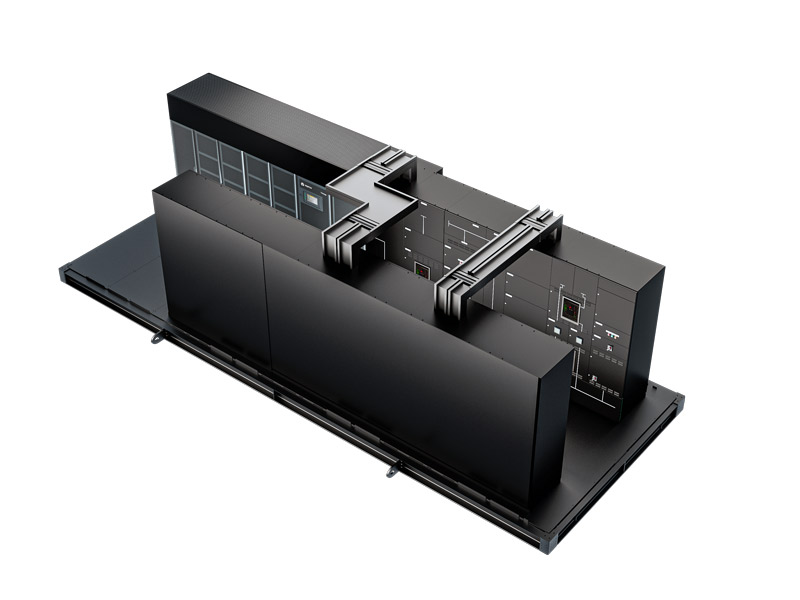
The power train combines a medium-voltage line reactor, coupling transformer, bidirectional converters and external long-duration battery storage. The transformer reduces 34.5 kV to the conversion interface, while batteries connect through the converters to support the load during an outage. Vertiv lists one to four hours of backup depending on battery configuration, not four hours guaranteed for every installation. Its published 97% battery-mode efficiency is separate from the 98.5% peak on-grid figure.
Other electrical hardware choices are explained in BitcoinVersus.Tech’s UPS ride-through and integrated testing lesson. Site designers must still verify coordination, protection, battery capacity and downstream distribution against real load profiles.
What the Bologna demonstration actually established
Vertiv reports that QTS, SoftBank and Rosendin observed proof-of-concept tests at its Bologna, Italy research center. The system reportedly remained stable across 0–100% loading and rode through a 100% input-voltage sag lasting 150 milliseconds, plus a 25% overvoltage lasting five seconds, while meeting specified output-voltage requirements. QTS publicly endorsed the demonstration, but no independent long-term operating dataset accompanied the announcement.
Fault ride-through protects against brief grid abnormalities; battery energy provides sustained outage coverage. Load smoothing addresses a different challenge: when synchronized accelerators abruptly change consumption, power converters and storage can buffer transients before they reach the utility. Separating those functions helps avoid implying a 150-millisecond ride-through test proves four-hour endurance. The potential importance is highlighted by Virginia’s growing data-center power-request pipeline.
Vertiv’s official November 2025 video shows the earlier integrated PowerNexus platform and explains factory-built power infrastructure. Credit: Vertiv/YouTube. The older platform is distinct from the newly announced 34.5 kV PowerNexus MV UPS.
Faster grid access remains a goal, not a permit
Vertiv says a common factory-built design, grid-interactive controls and outdoor installation could simplify interconnection engineering and free indoor electrical space. However, equipment efficiency and simulation models cannot replace a utility’s studies, available generation, transmission upgrades or local approvals. Oregon’s recently approved large-data-center electricity tariff underscores the contractual and cost-allocation issues hardware alone cannot solve.
The company also plans a dedicated Bologna medium-voltage laboratory for 2027, including work on future medium-voltage-to-800 V DC systems. That laboratory roadmap does not establish an 800 V DC output for the announced UPS. Parallel work on solid-state transformers for 800 V DC infrastructure addresses a distinct architectural layer.
Pricing, named purchase orders, commercial-site uptime and actual whole-campus efficiency remain undisclosed. PowerNexus MV UPS is a concrete, customer-demonstrated electrical design with supplier performance claims, not evidence of an operating hyperscale deployment. Independent field results after the projected 2027 shipments will be the decisive measure.
Sources and methodology
Primary references: Vertiv’s November 12 product announcement; PowerNexus MV UPS datasheet, October 2026 revision; manufacturer product information; Vertiv AI Load Simulator video; and Vertiv earlier PowerNexus demonstration. Ratings and test results are attributed to Vertiv; no independent field benchmark is implied.
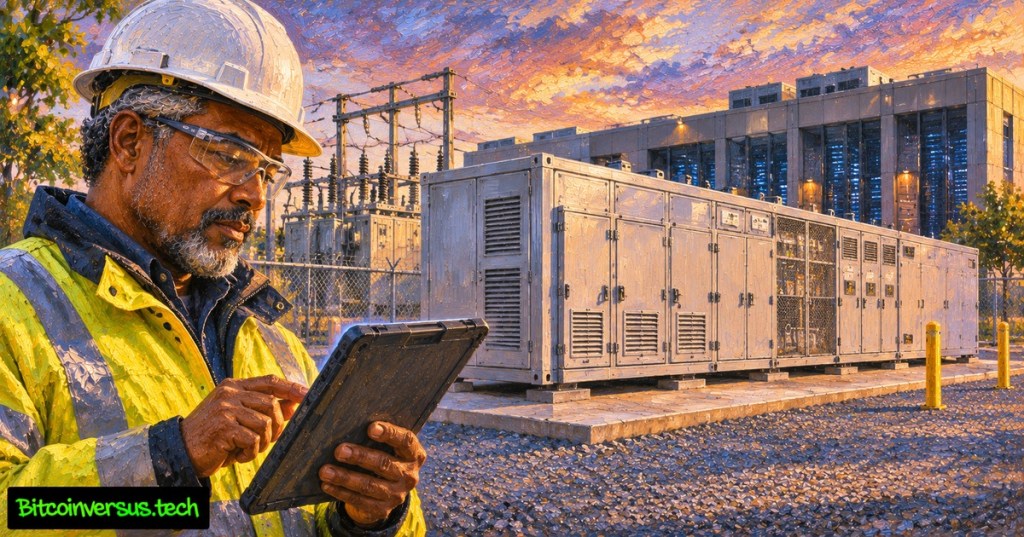
Editor’s Note: Vertiv’s public release reports proof-of-concept demonstrations with customer observers; its new 3.0 MVA PowerNexus MV UPS has projected mid-2027 shipments, not verified fleet deployment. The outdoor backup duration depends on separately configured batteries. The 1200 × 630 oil-painting cover is an original conceptual illustration of a fictional engineer and equipment, not a photograph of the Vertiv test site. The in-story manufacturer image and second video show an older, different PowerNexus product and are labeled accordingly. WordPress-rendered iframe presence cannot establish actual playback on every device.
Support BitcoinVersus.Tech
An optional 5,000-satoshi donation helps support independent research and electrical-engineering journalism. Scan the original BitcoinVersus.Tech QR with a compatible wallet on a second device. On mobile, save the QR picture and import it into a wallet supporting saved-image scanning. Always verify the receiving address and amount before authorizing payment.

BitcoinVersus.Tech is volunteer-run and publishes independent technical journalism. Donations are voluntary; Bitcoin transactions may be irreversible. Verify Bitcoin recipient 3C9o19EH5HSiwEPyCTmEKzxhNCbo2X6TTb and the 5,000-satoshi amount before sending. The article is informational reporting and not an electrical design approval, equipment performance certification or financial recommendation.


Leave a Reply