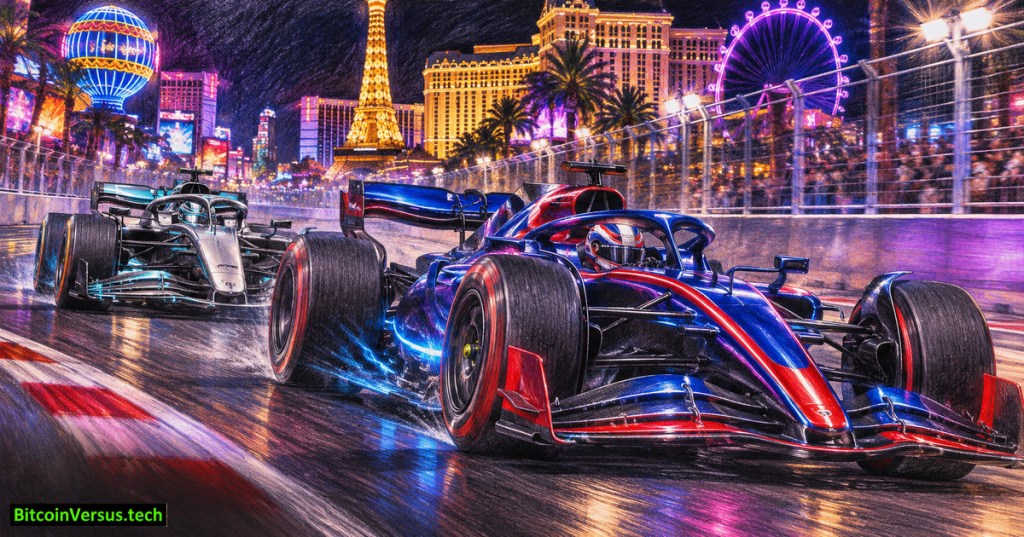
Max Verstappen won the 2026 Las Vegas Grand Prix on November 21 after 50 laps of relentless position changes. Formula 1 recorded 35 lead changes, and the FIA’s post-race press conference cited 352 overtakes. Verstappen crossed the line just 0.639 seconds ahead of McLaren’s Lando Norris, with Oscar Piastri third. The result showcased a new tactical problem in racing: when to spend electrical energy, not merely how much horsepower a car can produce.
The official Formula 1 race report describes repeated overtaking among the leaders and late setbacks for Mercedes. For direct footage, see Formula 1’s eight-minute race highlights and its Russell–Verstappen battle clip. Both are official F1-hosted videos.
Official Formula 1 technical explainer, January 2026. Background on the new regulations, not footage from the Las Vegas race.
A 350-kilowatt tactical weapon
The 2026 cars use a hybrid power unit combining a combustion engine, battery, control electronics and a motor-generator unit called the MGU-K. The electric system can deliver up to 350 kilowatts, nearly three times the former 120-kilowatt figure. Braking and other operating phases recover energy that drivers can deploy later when accelerating or defending.
Power and energy are different measurements. A 350-kilowatt electrical output sustained for ten seconds represents 3.5 megajoules of energy (350 kW × 10 s), before accounting for the operating rules and losses. The calculation is an illustration, not a measurement of Verstappen’s battery use. Engineers cannot infer one car’s actual state of charge from a television overtake.
April FIA adjustments reduced the permitted maximum recharge figure from 8 MJ to 7 MJ and differentiated 350-kW deployment zones from sections limited to 250 kW. Those changes were designed to discourage excessive energy harvesting and allow more consistent high-speed racing.
Why Las Vegas became a rolling chess match
A driver deploying electrical boost can close a gap on a straight but may have less energy available for the next defensive move. A rival can conserve charge, follow closely and attack at a better moment. Leading continuously may therefore require clever deployment rather than simply winning one drag race.
Red Bull’s official race-day comments place energy deployment, timing and awareness of rivals’ strategies at the center of Verstappen’s victory. Mercedes remained a major threat until late difficulties, while the McLarens recovered to complete the podium. The public record supports energy management as a major factor, but not a claim that battery strategy alone caused every pass or decided the full result.
RacingNews365 engineering explainer, April 2026: battery deployment, super-clipping and earlier regulatory debates. Historical technical context, not a replay of the November Las Vegas Grand Prix.
Why the engineering matters beyond motorsport
Hybrid racing strategy increasingly resembles real-time optimization. Software must estimate energy availability, target lap time, traffic, braking opportunities and future overtaking windows. A perfect attack now can be a poor decision if it leaves the driver exposed seconds later.
Similar tradeoffs appear across technology. Our analysis of F1 biometric telemetry examines how teams and viewers interpret live data. Another report covers the FIA’s remote race-control infrastructure. Professional basketball is adopting related tools through 3D replay tracking and AI-enhanced broadcast cameras.
Verstappen’s Las Vegas win offers a vivid demonstration: mechanical performance remains essential, but the timing and management of stored energy can transform competition. The next technical breakthrough may be measured as much in better software decisions as in raw peak power.
Primary sources and video
- Formula 1: official Las Vegas race report, November 22, 2026
- FIA: post-race press conference, overtaking totals
- FIA: 2026 hybrid energy-management refinements
- Formula 1: team reaction and strategic details
- Formula 1: official race highlights video
We volunteer daily to ensure the credibility of the information on this platform is Verifiably True. If you would like to support to help further secure the integrity of our research initiative, please scan the QR code below.

Confirm the recipient and amount in your own Bitcoin wallet before approving any transfer.


Leave a Reply