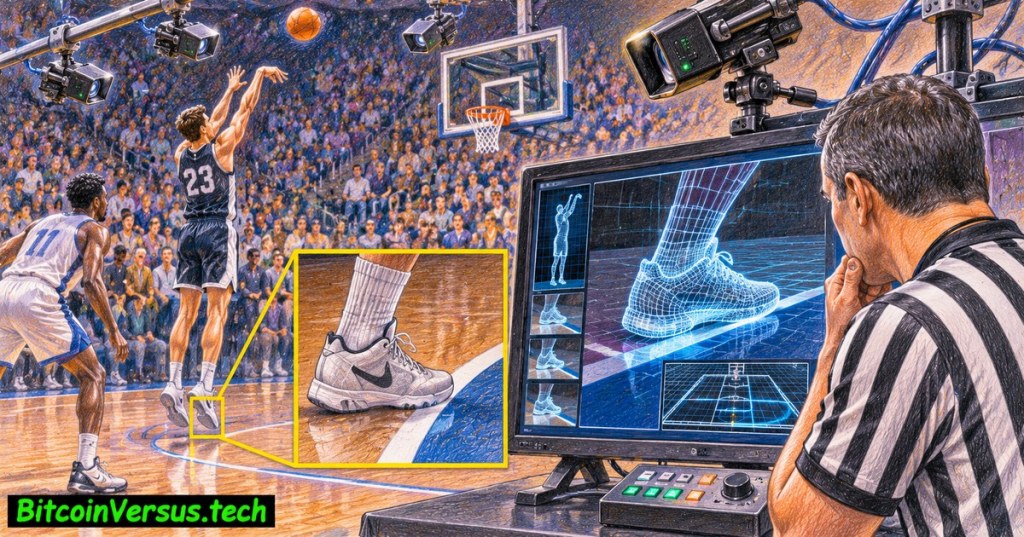
The NBA has introduced a 3D mesh replay system to help referees determine whether a shooter’s foot crossed the three-point line. A November 18, 2026 Defector investigation reports that the technology has already helped with dozens of close calls during the 2026–27 season. It gives officials a reconstructed view when ordinary footage is blocked, without handing every decision to a machine.
The development builds on the league’s 2023 partnership with Sony Hawk-Eye Innovations. Cameras track players and the ball in three dimensions, while human Replay Center staff in Secaucus, New Jersey, evaluate evidence and determine rulings.
Bilawal Sidhu’s independent February 2026 technology explainer describes optical sports tracking and 3D replays; archival background, not footage of the new NBA review tool. Original video.
How cameras reconstruct a shooter’s feet
Corner three-pointers can be difficult to judge when spectators or defenders obstruct the closest video angle. Combining calibrated arena cameras, the mesh creates a three-dimensional representation of the player’s shoe against the court. Replay officials can examine the reconstruction as an additional perspective, especially where the three-point arc is obscured.
The NBA says Hawk-Eye captures 29 tracked body points per player at 60 samples per second, alongside the ball, according to its October 20 technical publication. Position estimates allow useful new views but do not eliminate calibration or reconstruction error. The league has not disclosed an independently audited error rate for the new foot mesh.
The capability differs from AI-assisted 360-degree broadcast replays, which help viewers understand a play rather than settle an official scoring review.
Existing automation still depends on a referee
The NBA began using goaltending and basket-interference decision support in 2025–26. A Replay Center official identifies the video frame when a player touched the ball. Software then evaluates the ball’s trajectory, backboard contact and position near the basket. A league spokesperson told Defector the technology assisted in just over 80 reviews during the previous season.
NBA Official’s March 2026 example of goaltending review using Court iQ, predating the new 3D mesh reporting. Official NBA source post.
Such limited applications should not be confused with automatic whistles throughout live games. Out-of-bounds rulings present another challenge because cameras may struggle to resolve whether a fingertip made contact before a ball crossed the line. The league’s October smart-ball and wrist-wearable tests sought to investigate related sensor and communication problems.
The NBA wants half-second calls, but takes 40 seconds today
Replay Center chief Kane Fitzgerald said definitive out-of-bounds decisions take about 40 seconds on average. NBA strategy executive Tom Ryan described a future ambition of roughly 0.5 seconds for an automated alert. The shorter figure is a development target, not a demonstrated production latency.
A connected basketball could help detect touches that optical cameras miss. Ryan reported blind preseason trials and interviews with more than 100 players, with no detected change in playing performance. Expanded testing in the G League is planned for 2026–27. The sensor-equipped ball was not making binding NBA regular-season calls during its preseason test.
National Basketball Referees Association veteran-official roundtable from December 2024 on technology and rule changes. Archival perspectives, not 2026 testing footage. Original video.
Referees want better decisions without constant interruption
Referee Zach Zarba said wrist wearables tested during the preseason generally received favorable feedback for delivering haptic and text alerts. Headsets were less popular because they could distract officials or interfere with hearing players and coaches. The question is not merely whether software detects an incident, but whether the alert helps the crew respond correctly while play continues.
Automation is most plausible for measurable position and timing questions. Contact fouls and contextual interpretations remain substantially more subjective. Related examples include MLB’s automated strike-zone system and Sony’s 3D athletics tracking, where the decision and measurement tasks differ.
The near-term gain is better evidence for replay officials, not replacing human referees. A responsible rollout would demonstrate accuracy against independently measured ground truth, establish appeal procedures and show that additional computing actually shortens delays.
Sources and verification
Primary source: Defector interviews, November 18, 2026. Official technical context: NBA–Sony partnership, NBA Hawk-Eye tracking details and preseason test announcement. Review totals and future latency targets were reported by NBA staff, not independently measured.
Reporting Note: The colored-pencil cover is original conceptual artwork, not an NBA game photograph or an actual Replay Center screen. The social post illustrates an earlier official goaltending review; the videos are historical technical context. The league has not announced full machine-controlled officiating.
Editor’s Note: We volunteer daily to ensure the credibility of information on our platform is Verifiably True. Support our research by scanning the QR code below to donate 5,000 sats.

For mobile scanning, open the article on another display and scan the QR code with a Bitcoin wallet. Verify receiving address 3C9o19EH5HSiwEPyCTmEKzxhNCbo2X6TTb before sending.
BitcoinVersus.tech provides technical and financial journalism for informational purposes only and does not provide investment, legal or cybersecurity assurance.


Leave a Reply