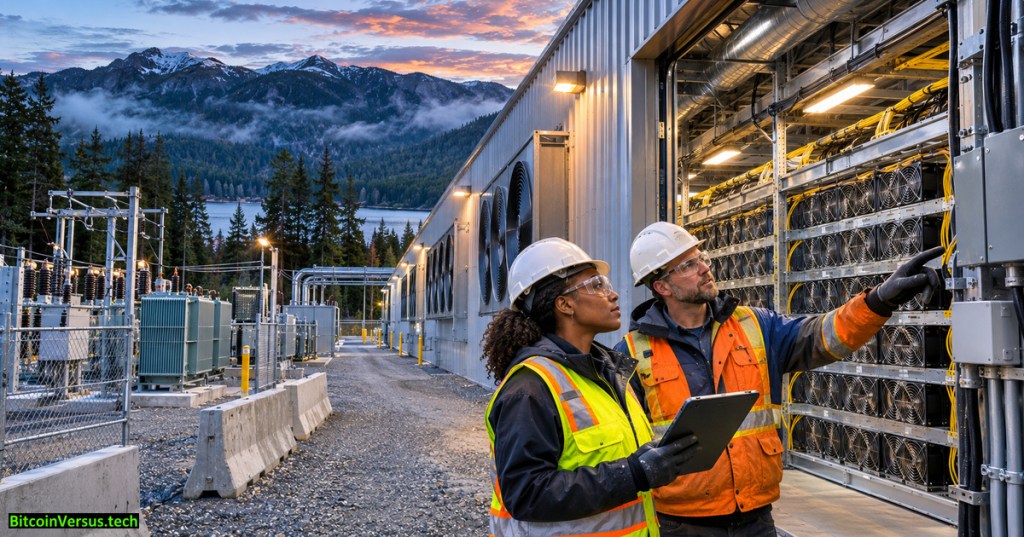
Canadian digital-asset company Luxxfolio Holdings announced November 12, 2026 that 50 additional Bitmain Antminer L9 units have been fully commissioned at DMG Blockchain Solutions’ Christina Lake facility in British Columbia. The expansion raises its Scrypt fleet to 338 miners with approximately 5.58 terahashes per second (TH/s) of nameplate capacity. Unlike a future purchase or construction plan, Luxxfolio describes the machines as already installed and operating.
The 50 machines add a company-reported 832 gigahashes per second (GH/s) and were purchased using cash from operations. The miner count rose 17.4% from 288 units, but the reported figure describes rated capacity, not independently measured accepted pool hashrate or a guaranteed daily Litecoin yield.
Luxxfolio-linked Litecoin Foundation interview, September 2026, discussing the company’s mining and treasury strategy. Archived background, not footage of the November installation Watch on YouTube.
Why an industrial hosting facility matters
Luxxfolio owns the Scrypt ASICs, while DMG provides its Christina Lake hosting infrastructure, including electrical distribution, space and on-site operations. DMG identifies its British Columbia campus as a 65 MW data center with an owned substation. The campus power figure refers to the wider facility, not Luxxfolio’s dedicated electric demand, which was not disclosed in the November announcement.
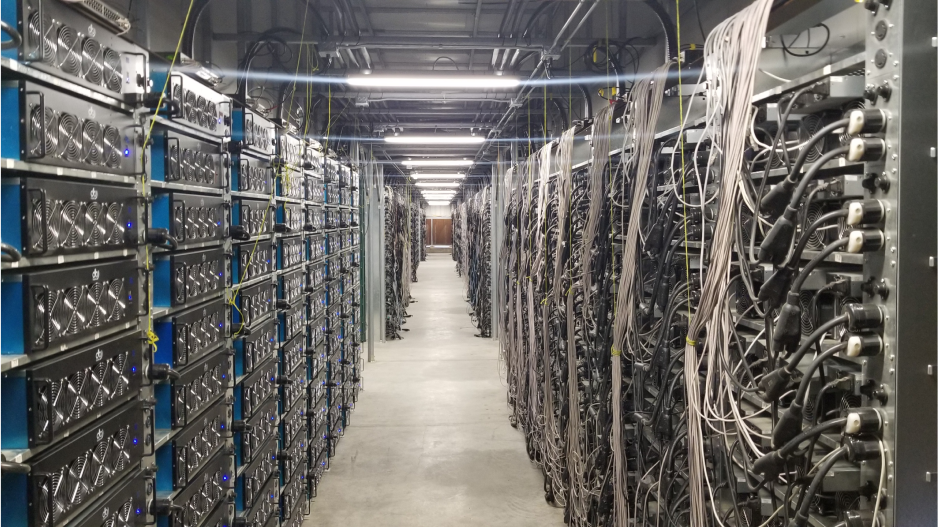
An industrial ASIC installation needs more than empty rack slots. Engineers must account for power-distribution unit circuits, compatible input voltages, heat rejection, maintenance access, Ethernet connectivity, pool authentication and actual uptime. DMG’s historical facility image demonstrates the type of electrical and mechanical environment involved without confirming individual new-machine placement.
The energy math behind 50 more Antminers
BITMAIN’s official L9 specification rates its 16 GH/s configuration at 3,360 watts and 210 joules per gigahash (J/GH), measured under specified conditions. Fifty machines of that exact configuration would nominally draw 168 kW before site-level auxiliary load (50 × 3.36 kW). Over 24 hours, continuous operation at that rating would use about 4,032 kWh, excluding facility cooling and distribution overhead.
Luxxfolio’s announced additional 832 GH/s averages 16.64 GH/s per new machine, so the 16 GH/s reference is illustrative, not proof of the supplied units’ precise power draw. Actual wall power, pool-accepted solutions, temperatures and hardware mix would be needed for a reliable fleet efficiency calculation.
BITMAIN’s original Antminer L9 product launch video from 2024. Manufacturer hardware background, not on-site footage or proof of Luxxfolio’s new installation Watch on YouTube.
One pool, multiple proof-of-work networks
Luxxfolio reports that LuxxPool reached 7.7 TH/s across 520 workers on November 11, including approximately 2.1 TH/s contributed by third-party miners. A pool worker is a configured connection, not necessarily a physical ASIC. Pool-wide hashrate therefore should never be mistaken for Luxxfolio-owned mining capacity.
The pool currently supports merged mining across 11 Scrypt networks, including Litecoin, Dogecoin and Soqucoin. Compatible auxiliary-proof-of-work designs permit rewards from several chains using the same underlying Scrypt work, without proportionally duplicating hardware or electricity. Actual rewards still depend on pool rules, network difficulty, valid shares and blockchain conditions.
Mining growth versus genuine operating returns
As of November 9, the company estimated 26,838.23 LTC held in its treasury, compared with 3,599.13 LTC cumulatively self-mined. The difference reflects the company’s broader treasury strategy; the full balance must not be described as Bitcoin-equivalent mining production. Luxxfolio also reported 1,514.58 LTC received during the preceding 30 days, a point-in-time indicator rather than guaranteed future output.
The contrast with Datacentrex’s 500-miner deployment and Bitdeer’s Scrypt-versus-Bitcoin revenue analysis is instructive. Large ASIC fleets, pool platforms and self-custody wallets are different pieces of infrastructure. Readers can compare Litecoin pool protocol changes, Bitcoin and Litecoin energy efficiency and new Scrypt chip development. The key follow-up metrics are measured electrical demand, machine uptime, accepted pool hash rate and net mining margin after hosting fees.
Sources and verification
Primary sources: Luxxfolio company release, November 12, 2026; BITMAIN official specifications; DMG operations page. Mining numbers and treasury totals are company-reported; the featured cover is a photorealistic editorial illustration, not actual site photography.
We volunteer daily to ensure the credibility of the information on this platform is Verifiably True. If you would like to support to help further secure the integrity of our research initiative, please scan the QR code below.

Information only. Not financial, investment, legal or tax advice.


Leave a Reply