
Bitdeer is putting greater emphasis on Scrypt cryptocurrency mining, saying it earns more revenue per megawatt than Bitcoin mining. Chairman Jihan Wu made the comparison during the company’s November 10, 2026 third-quarter earnings call, according to the published transcript. His statement concerns revenue relative to power capacity, not independently verified profits. Cryptocurrency miners must still cover energy, equipment, depreciation, cooling and maintenance.
Why Bitdeer is interested in Scrypt
Bitcoin ASICs calculate SHA-256 hashes, while Litecoin and Dogecoin use Scrypt. A Bitcoin machine cannot switch between algorithms by changing its pool address. Scrypt ASICs offer a separate use for semiconductor wafers and powered infrastructure. Bitdeer’s remarks followed an analyst’s question about chip supply. Wu said wafer availability is tighter amid AI demand and indicated slower cryptocurrency-mining capital investment next year, while planning further Scrypt expansion. He also said Bitdeer had no Zcash ASIC plans. The argument is about limited manufacturing and electricity resources, not abandonment of Bitcoin.
The two kinds of ASICs share electrical and site-management challenges. Our mining infrastructure guide describes the physical operating constraints, while the Paraguay power-capacity analysis explores competition for scarce megawatts.
A 7.8 kW Scrypt ASIC
Bitdeer’s June 1 announcement gives its SEALMINER DL1 Hydro a normal hashrate of 52.5 GH/s, efficiency of 149 J/GH and typical draw of 7,823 W. The hydro-cooled 2U machine is intended for industrial facilities and supports Litecoin, Dogecoin and other Scrypt coins. Its official product page still says launching soon, making any claim of large-scale customer deliveries premature.
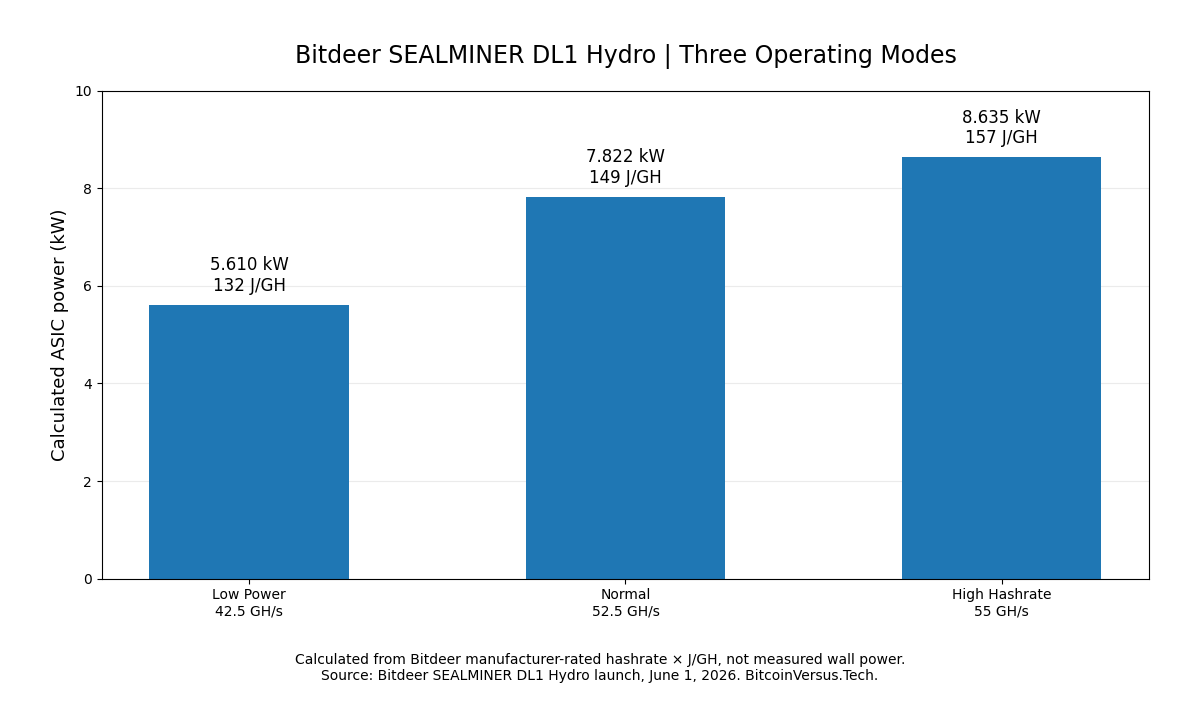
Power consumption is only one side of the equation
A continuously operating 7.823 kW machine uses about 187.75 kWh per day before infrastructure overhead. Electricity alone would cost approximately $9.39 daily at five cents/kWh or $18.78 at ten cents/kWh. Neither calculation represents realized profit or a mining payout. The Texas wind-power report explains why power prices can undermine otherwise efficient installations.
Litecoin and Dogecoin can be merge-mined where supported, but Scrypt GH/s and Bitcoin SHA-256 TH/s cannot be compared as equivalent computational work. Our Bitcoin mining efficiency rankings track SHA-256 machines using an algorithm-specific metric.
What remains unproven
Bitdeer has not supplied an independently audited same-period, same-capacity comparison of Scrypt and Bitcoin revenue after energy, capex, maintenance and cooling. Its November 10 quarterly results document substantial SEALMINER investment but do not establish a universal profit advantage. Reliable evaluation would require actual metered power, accepted mining shares, rewards, uptime and sale prices over matched periods.
Bottom line: Bitdeer’s expansion into Scrypt shows how a miner can allocate wafers and power across competing proof-of-work opportunities. The DL1 gives operators measurable engineering trade-offs, while long-term profitability remains unsettled.
Editor’s Note: The earnings-call statement is attributed to Bitdeer management. DL1 specifications come from company documentation; power and electricity calculations are illustrative, not measured performance or forecasts. Three original-source videos were identified, but playback and mobile rendering are not independently verified. The sole 1200×630 featured image is conceptual editorial art, not a photo of a Bitdeer facility.

BitcoinVersus.Tech publishes independent technology journalism. Optional contributions of 5,000 satoshis support research. Independently verify recipient 3C9o19EH5HSiwEPyCTmEKzxhNCbo2X6TTb and amount before sending; Bitcoin transfers are generally irreversible.
We strive to make reporting Verifiably True. Mining hardware and revenue discussion are informational, not buying recommendations, engineering approval, investment advice or guarantees of returns.


Leave a Reply