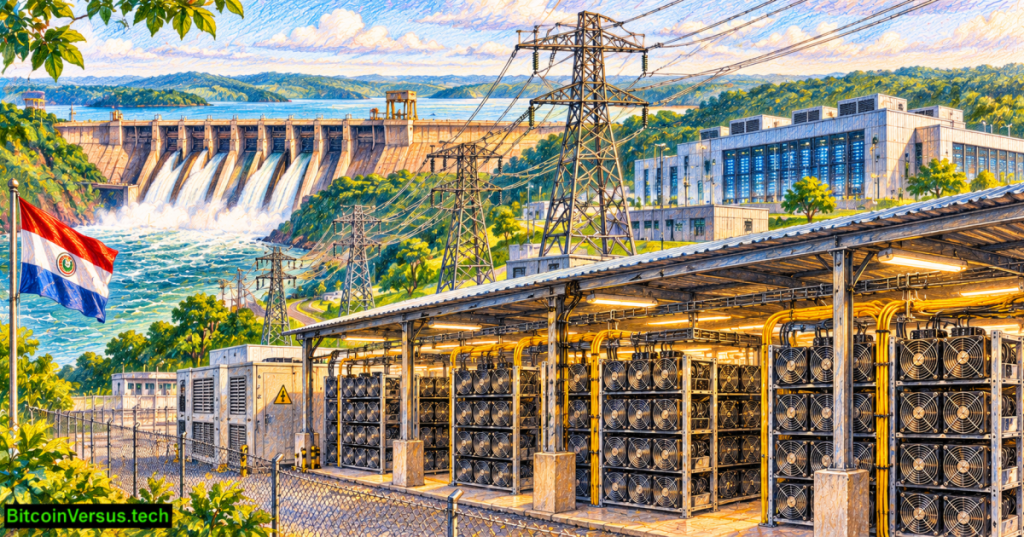
Paraguay’s cheap hydropower is becoming a competition between Bitcoin miners and AI data centers. The state utility ANDE has approximately 944 megawatts of capacity contracted to cryptocurrency miners, according to an April 2026 figure reported by local and international journalists. Their special electricity contracts cannot extend beyond December 31, 2027 under the current rules. A November 13 CoinDesk investigation, updated November 18, shows why that existing deadline has become more consequential as AI infrastructure competes for supply. It does not mean Bitcoin mining is newly banned.
Original AmityAge and Jednoducho Bitcoin 2024 walkthrough of hydro-powered mining containers operating in Paraguay. Historical operator footage, not the November 2026 ANDE negotiations.
The December 2027 deadline is already written into the rules
ANDE’s special intensive-consumption tariff annex explicitly limits contracts to December 31, 2027. Its categories cover crypto mining, data processing and related high-load activities at 23, 66 and 220 kilovolts. Contract expiration is distinct from permanently prohibiting the activity; any successor arrangement would depend on applicable policy, network capacity and negotiation.
The 944 MW is contracted electrical capacity, not proof that miners consume 944 MW every minute. CoinDesk reports ANDE expects about $350 million in mining-related revenue during 2026, versus $295 million in 2025. The reported mining tariff is $44 per megawatt-hour, equivalent to 4.4 cents per kilowatt-hour before any additional facility charges.
A proposed auction would make megawatts harder to secure
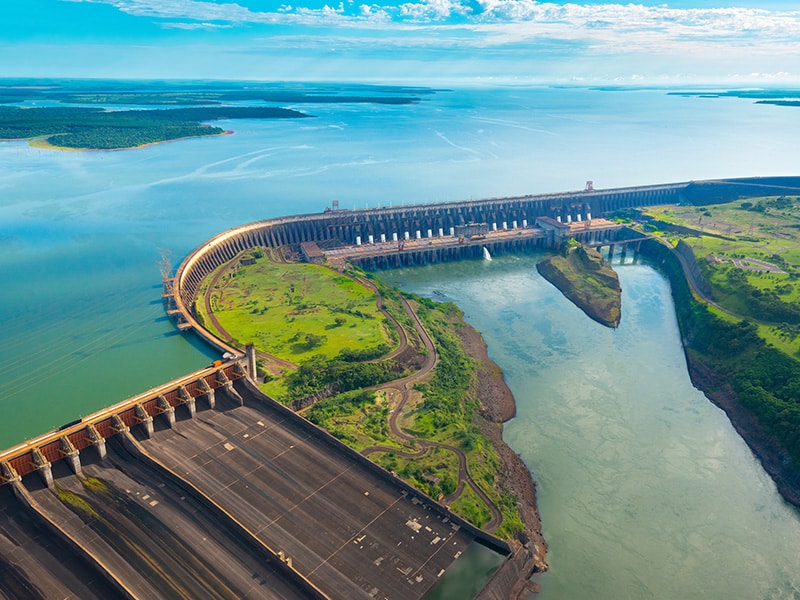
ANDE engineers have proposed limiting combined crypto, AI and data-center allocations to 700 MW from January 2028 and awarding power through competitive bids with a suggested $56/MWh floor. The engineers’ plan is not an enacted government cap. Nevertheless, its proposed 700 MW ceiling is 244 MW below the capacity reportedly held by miners alone, highlighting the scale of the negotiation.
| Electricity scenario | Rate per MWh | 30-day cost at 1 MW |
|---|---|---|
| Reported existing mining rate | $44 | $31,680 |
| Engineers’ proposed auction floor | $56 | $40,320 |
For a constant 1 MW load, moving hypothetically from $44 to $56/MWh would add $8,640 per 30-day month, or roughly 27.3% to the electricity line item. Actual costs depend on demand charges, load factor, curtailment and any future tariff. Bitcoin mining margins would also vary with ASIC efficiency, network difficulty, block subsidies and transaction fees.
Bitcoin verstehen’s January 2024 interview with Munich International Mining operators discusses Paraguay’s hydroelectric mining economics and local conditions. Background interview, not current policy confirmation.
AI buyers are already signing longer contracts
On October 22, ANDE signed a 15-year, up-to-286 MW supply deal with Kuntur, linked to the proposed Iguazú AI City project. Local reporting identifies an average 220 kV tariff of $48.91/MWh, indexed to inflation, with a different price at 23 kV. The proposed AI development is not the same contract class as the expiring mining agreements, and its full 286 MW allocation is not already operating.
HIVE Digital’s filings identify 200 MW in Yguazú and 100 MW in Valenzuela under power agreements ending in 2027. BitcoinVersus.tech previously followed HIVE’s Paraguay expansion and its renewable mining strategy. The company has discussed extensions but no permanent replacement arrangement is established by the latest reporting.
What determines who keeps the power?
Miners can provide flexible loads, reducing consumption when grids are constrained. AI facilities may offer longer commitments and higher-value services, but can also impose heavy cooling, networking and transmission demands. A useful comparison must consider prices, flexibility, grid investment, employment, tax revenue and export alternatives, rather than assuming either industry automatically delivers greater national benefit.
For further context, BitcoinVersus.tech has examined hydro-cooled mining operations in Paraguay and the electricity-contract dispute behind Tether’s Uruguay mining reversal. The next decisive developments will be ANDE’s adopted allocation rules, any new signed agreements and the actual number of mining megawatts renewed after 2027.
Sources: CoinDesk reporting, November 13, updated November 18; ANDE tariff annex, section 1.2; ABC Color, October 24. Contracted MW, proposed future policies and actual energy consumption are separate measures.
Editor’s Note: We volunteer daily to ensure the credibility of the information on this platform is Verifiably True. If you would like to support our work and help further secure the integrity of our research initiatives, please scan the QR code below to donate 5,000 sats.

Disclaimer: BitcoinVersus.tech publishes independent educational reporting, not investment, electrical engineering or procurement advice. Future government policy, power contracts and mining economics remain subject to change. Always verify original regulations and utility terms.


Leave a Reply