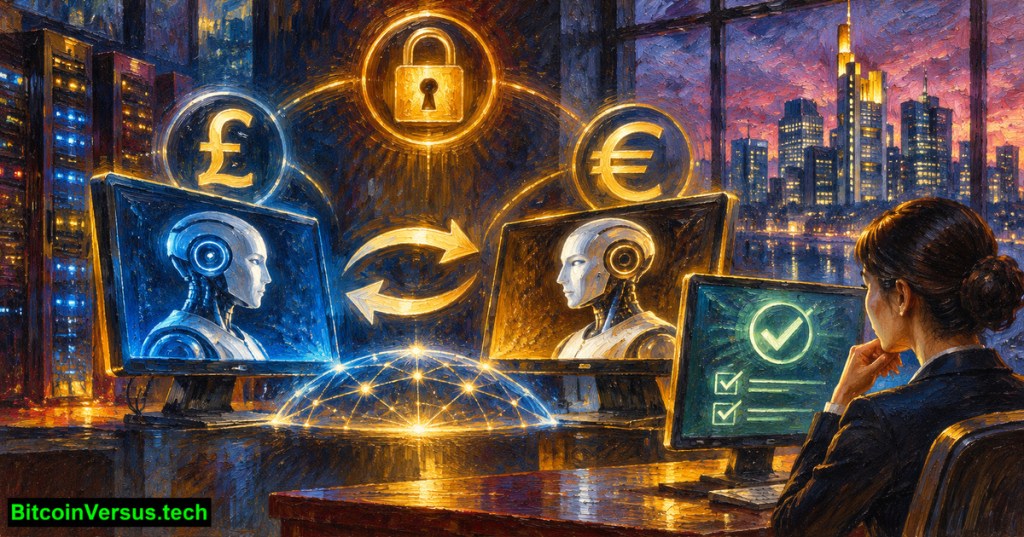
An artificial intelligence agent has completed a simulated currency trade after another AI agent verified its authority to act. Hyundai Card and Kinexys by J.P. Morgan announced the controlled test on November 18, 2026, demonstrating how corporate treasury operations could run without a person approving every routine transaction. No real funds moved. The banks tested a proof of concept, not a commercially available service.
The experiment connects AI decision-making to banking controls rather than trusting a chatbot’s instructions alone. According to J.P. Morgan’s announcement, the AI systems checked balances, evaluated foreign-exchange quotes and processed a simulated conversion only after verifying a digitally signed mandate. The bank describes the trial as the first phase of its work on trusted transactions between autonomous software agents.
J.P. Morgan’s 2026 discussion of institutional blockchain infrastructure provides background on Kinexys. The video predates the Hyundai Card demonstration and is not footage of the test.
How the AI trade worked
Hyundai Card’s treasury agent was assigned a narrow task: keep a Frankfurt account funded in euros. When the simulated balance dropped below its required level, the agent determined that it should sell British pounds from a named London account. It requested quotes from three banks, selected the most competitive offer and passed an execution instruction to a separate Kinexys agent.
The receiving agent did not simply obey. Each software agent was associated with a registered cryptographic identity. A signed, machine-readable mandate specified the accounts, approved currency pair, transaction limits and operating conditions. The authorized business principal reviewed and approved the mandate before any agent action could proceed. J.P. Morgan’s technical case study describes the process in detail.
The distinction is significant. An AI system may select a price or recommend a transfer, but the banking infrastructure independently determines whether the instruction is permitted. A private key identifies the agent sending the request; permission comes from a separate, previously approved mandate. An agent cannot expand its authority merely by generating persuasive text.
Three possible outcomes, not unlimited access
Engineers exercised three different outcomes. A valid routine request passed the checks and generated a simulated executed trade. A request exceeding the autonomous approval threshold was held for human authorization. A request involving an unapproved currency was denied. The checks also included whether the accounts belonged to the client, whether the mandate remained valid and whether the proposed action matched its stated objective.
Each step produced an audit trail identifying the agent, client, mandate version, currency pair, decisions and transaction state. Records distinguish an instruction being requested from a trade being executed. An agent’s confident claim that payment has happened is not equivalent to confirmation from the execution system.
J.P. Morgan’s May 2026 Kinexys film explains programmable financial infrastructure. Historical company background only; no footage of the November AI-agent proof of concept.
Why programmable finance needs stronger controls
Financial services already use automation, but systems negotiating and initiating actions introduce new risks. Compromised keys, fabricated exchange quotes, malicious prompts and conflicting instructions could make seemingly valid requests dangerous. J.P. Morgan previously emphasized that software prompts cannot replace enforceable transaction rules. Independent authorization and human escalation become particularly important when AI systems are allowed to act at machine speed.
The research fits a wider transition. BitcoinVersus.Tech reported on Franklin Templeton’s agent-payment thesis, central-bank trials of synchronized foreign-exchange settlement, Visa’s expansion of stablecoin settlement and AI-assisted purchases requiring biometric approval. Those projects use different infrastructure and security models, but all raise questions about how software receives and proves permission to move money.
What comes next
The proof of concept operated inside a controlled test environment connected to back-end systems. It did not demonstrate a live multi-bank network, real customer money movement or proven resilience under hostile conditions. The bank’s report acknowledges that authorization accepted by one institution cannot yet automatically travel to another. Shared standards for identity, delegated authority and audit records remain open problems.
J.P. Morgan and Hyundai Card plan to explore more complex agent interactions, potentially including connected vehicles and fleet payments. No commercial launch date was established. The November result is narrower but important: AI agents can propose and execute simulated financial instructions while a separate banking control layer decides which actions are allowed.
Sources and verification
- J.P. Morgan Payments, November 18, 2026: Hyundai Card and Kinexys agentic payments proof of concept
- Kinexys and Hyundai Card, Trust in the Agentic Economy, technical case study
- CoinDesk, November 18, 2026: independent reporting and Hyundai Card’s description
- J.P. Morgan Payments, September 29, 2026: enforceable control requirements for AI agents
Editor’s Note: We volunteer daily to ensure the credibility of the information on our platform is Verifiably True. If you would like to support our work and the integrity of our research initiatives, scan the QR code below to donate 5,000 sats.

To scan on a mobile phone, open the article on another screen. Verify recipient address 3C9o19EH5HSiwEPyCTmEKzxhNCbo2X6TTb and the network before sending.
Disclaimer: BitcoinVersus.Tech reports on technology and finance for informational purposes. A simulated proof of concept does not demonstrate a production banking service or constitute investment, legal or security advice.


Leave a Reply