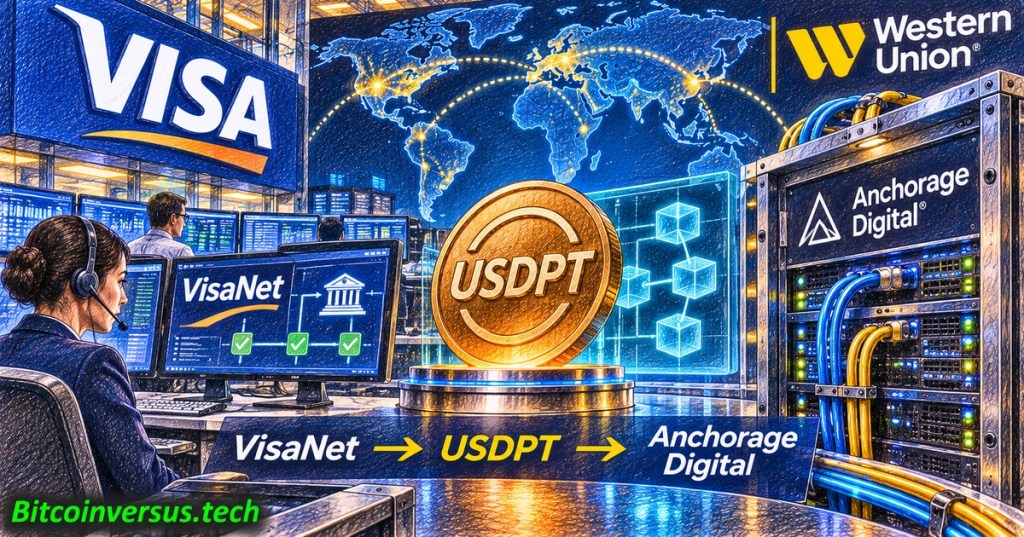
Visa and eligible partner institutions can now use Western Union’s USDPT stablecoin to settle obligations on the VisaNet payment network. The arrangement, announced by Anchorage Digital on November 12, 2026, makes USDPT the first stablecoin issued by Anchorage Digital Bank to become a native VisaNet settlement option. It expands the choice of assets used between financial institutions, not the way ordinary shoppers tap or swipe their Visa cards.
Official November 12 announcement by Anchorage Digital, the federally chartered bank issuing USDPT for Western Union. The post describes an available institutional settlement option. Original X post.
An additional way to settle VisaNet balances
Card payments involve separate steps. A bank authorizes a purchase; the transaction is cleared; participating financial institutions then reconcile and transfer the net amounts owed. Settlement is the final movement of money between those institutions. Under the new Anchorage–Visa agreement, eligible Visa partners may satisfy selected settlement obligations in USDPT rather than relying exclusively on conventional bank transfers.
USDPT represents a dollar-denominated stablecoin associated with Western Union, issued by Anchorage Digital Bank N.A. The token debuted on Solana in May 2026. Yet the November announcement does not name the blockchain that will carry VisaNet’s USDPT settlements, identify the first participating institution, quantify actual transfers or guarantee universal partner access. An available settlement option is not evidence that every participating bank has adopted it.
Federal bank supervision matters—but does not eliminate token risk
Anchorage says its issued stablecoins are backed by U.S. dollars and cash equivalents, redeemable one-for-one and minted under federal supervision. The bank’s charter is relevant to institutional due diligence, but a stablecoin holding should not automatically be treated as an FDIC-insured consumer bank deposit. Treasury teams still need to evaluate redemption arrangements, reserve disclosures, blockchain uptime, custody arrangements, compliance and the liquidity needed to convert tokens.
The transaction architecture resembles other attempts to connect digital assets to the established banking system. BitcoinVersus.Tech previously covered Citi and Coinbase’s bank-payment integration and Rain’s embedded stablecoin wallets. Those businesses operate at different layers, however: wholesale VisaNet settlement is neither a new retail wallet nor a new cryptocurrency payment acceptance rule for merchants.

Visa already tested bank settlement in USDC
Visa’s December 16, 2025, USDC settlement launch named Cross River Bank and Lead Bank as initial U.S. participants and described seven-day settlement availability over supported blockchains. The new USDPT addition broadens token choice but does not disclose a comparable launch-partner list. Nor does the release prove that switching tokens cuts total settlement expenses. Blockchain network fees may be only a fraction of funding, custody, reconciliation and compliance costs.
November 8 interview context: Anchorage Digital CEO Nathan McCauley discusses why consumers may eventually encounter stablecoin infrastructure without choosing an individual issuer. Interview clip from Scott Melker; recorded before the Visa USDPT announcement. Original X post.
The broader market is also becoming more interconnected. BVNK’s expansion of Open USD across blockchains and Mastercard’s BVNK-linked payments strategy illustrate competing infrastructure approaches. None establishes that USDPT will win substantial VisaNet share: that requires data on actual settlements, volumes, participating banks and operational performance.
What remains unproven
Anchorage says the arrangement creates a framework to evaluate additional stablecoins issued by its bank, but names no next token or date. The company also operates its Atlas counterparty settlement network; the Visa announcement does not establish that VisaNet transactions use Atlas. Western Union’s consumer remittance flows, USDPT issuance, and VisaNet obligations must therefore be evaluated as separate functions rather than one fully demonstrated end-to-end deployment.
Bottom line: Visa’s USDPT support is a concrete extension of institutional stablecoin settlement capability. Its commercial significance will depend on verified adoption, bank treasury economics, redeemability and reliable settlement—not on the availability announcement alone.
Sources and methodology: Anchorage Digital’s November 12, 2026, primary announcement; official Anchorage X post; Visa’s December 2025 USDC program release; Unchained’s November 12 reporting on undisclosed partner and blockchain details. No USDPT settlement volume is inferred from Visa’s networkwide stablecoin statistics.
Editor’s Note: The announcement concerns an institutional VisaNet settlement option, not direct merchant payments or a consumer card launch. Reserve backing and redemption representations are issuer statements, and no independent USDPT settlement-volume data or first eligible bank was disclosed. The original 1200 × 630 featured image is conceptual colored-pencil artwork; two official company images are credited separately. The interview predates the USDPT agreement and is used only for context.

BitcoinVersus.Tech is volunteer-run. If readers wish to contribute, scan the original QR code using a compatible Bitcoin wallet from another screen. On a phone showing the QR, use a wallet’s saved-image scanning feature, where supported. Verify recipient address 3C9o19EH5HSiwEPyCTmEKzxhNCbo2X6TTb and the optional amount of 5,000 satoshis before sending. Bitcoin transfers are generally irreversible.
We volunteer daily to ensure information on BitcoinVersus.Tech is Verifiably True. Coverage is educational and informational, not individualized investment, financial, banking or legal advice.


Leave a Reply