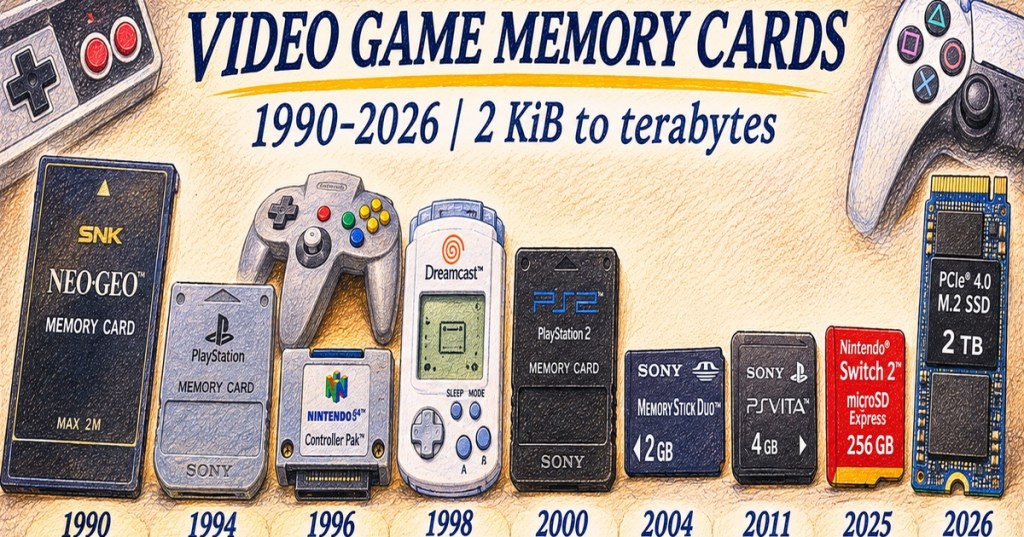
From 2 KiB to terabytes, video game memory-card history spans more than three decades—but the evolution is not one continuous kind of storage. A Neo Geo save card in 1990 stored a few thousand bytes. PlayStation memory cards established a mainstream removable-save format in the mid-1990s. Handheld systems later adopted flash media measured in gigabytes. In 2026, terabyte-class cards and SSDs mainly hold installed games, while many modern save files stay inside the console or in the cloud.
The distinction changes both the historical starting date and how the numbers should be charted. Saving progress was possible before SNK introduced a removable save card: cartridges, audio cassettes and writable disks all retained game data. The following report separates those precedents from dedicated memory cards, and compares published capacities without confusing bits, bytes, usable save blocks, volatile RAM or maximum compatibility limits.
Nintendo of America, “Getting to Know Nintendo Switch 2 — Freeing up Storage Space,” August 11, 2026. Official explanation of downloadable software and microSD Express expansion; Nintendo documents separately that game-save files remain in system memory. Credit: Nintendo of America / YouTube.
Quick facts
- 1984: Nintendo’s Family BASIC Data Recorder provided cassette-based program and some game-data saves; it was not a solid-state memory card.
- 1986: Famicom Disk System used writable game disks, enabling persistent saves in supported titles.
- 1990: SNK’s Neo Geo introduced an original 2 KiB removable, battery-backed save card usable between compatible arcade and home systems.
- 1994: Sony’s PlayStation established the 128 KiB / 15-user-block memory card.
- 2011: PlayStation Vita launched in Japan with proprietary flash cards starting at 4 GB.
- 2025–2026: Nintendo Switch 2 supports up to 2 TB microSD Express for installed software; PlayStation 5 supports up to 8 TB M.2 game storage. Neither is equivalent to an old removable save-file card.
A surviving 1990 SNK trade advertisement promotes the ability to resume arcade games at another time or location, an exceptionally strong contemporary record of the idea. SNK’s official Neo Geo museum independently documents home-to-arcade save transfers. A more general explanation of game RAM, VRAM and SSD technology is available in the BitcoinVersus.Tech technical archive.
When did saving begin?
Early games frequently retained no progress across power cycles. Arcade operators could keep high scores in backed-up electronics, while console players encountered passwords, passwords transcribed on paper, and cartridge-based save chips. Nintendo’s 1984 Famicom Data Recorder used analog cassette recordings through Family BASIC-compatible equipment. It could preserve user programs and data, but there was no fixed, standardized card capacity: tape length and encoding determined available storage.
In February 1986, the Nintendo Famicom Disk System made rewriteable disks a console-game medium. Its writable format allowed some games to retain progress without a battery inside a ROM cartridge. Battery-backed game cartridges subsequently became another prominent approach in the late 1980s and early 1990s, including releases in the Zelda lineage. None should be incorrectly dated as the first general-purpose memory card.
1990 — Neo Geo establishes the removable save card
The original Neo Geo card used battery-backed SRAM and the JEIDA memory-card form factor. Developer documentation describes a 2 KiB (2,048-byte) official card and wider firmware support for other card sizes. Its major innovation was portability: select games could carry progress from an MVS arcade cabinet to an AES home unit. SNK’s original promotional material mentioned support for up to 27 games, although actual storage consumption varied by title.
Earlier removable cartridges and disks already carried saves, so describing the Neo Geo as the first system to save games would be wrong. The narrower claim—that it was a pioneer of the detachable, multi-game console memory-card model—is supported by the manufacturer and historical hardware records. The contemporary card’s tiny capacity reflected compact game-state files, not the size of the games themselves.
1994–2001 — The dedicated-card era
Sony’s PlayStation launched in Japan in December 1994 with a memory-card ecosystem designed for CD-based games. Its official SCPH-1020 card held 1 megabit = 128 KiB. It offered 16 logical blocks, one reserved for management and 15 available for game saves. A single save could consume multiple blocks. Consumers therefore saw a count of blocks rather than a reassuringly large number of bytes.
The Sega Saturn instead included 256 kilobits (32 KiB) of backed-up internal RAM and supported optional backup cartridges, commonly 512 KiB. The Nintendo 64 Controller Pak of 1996 provided 256 kilobits (32 KiB), divided into 128 pages of 256 bytes; five pages were reserved, leaving 123 pages for game data. Nintendo’s programming manual provides an especially clear technical account of the file-system overhead.
In 1998, Sega’s Dreamcast Visual Memory Unit combined a removable save device with an LCD screen and mini-games. Its 128 KiB flash comprised two 64 KiB banks; approximately 28 KiB were system-reserved, leaving about 100 KiB nominally available. The display’s batteries were not the same as save-memory power, an important distinction for preservation.
Sony’s PlayStation 2 elevated the standard official card to 8 MB in 2000, using MagicGate technology. Nintendo’s GameCube, launched in 2001, took a more modest initial path: Memory Card 59 held 512 KiB, Memory Card 251 held 2 MiB, and Memory Card 1019 later offered 8 MiB. Different products and save-file allocation rules meant larger cards did not always eliminate compatibility concerns.
A system-by-system capacity reference
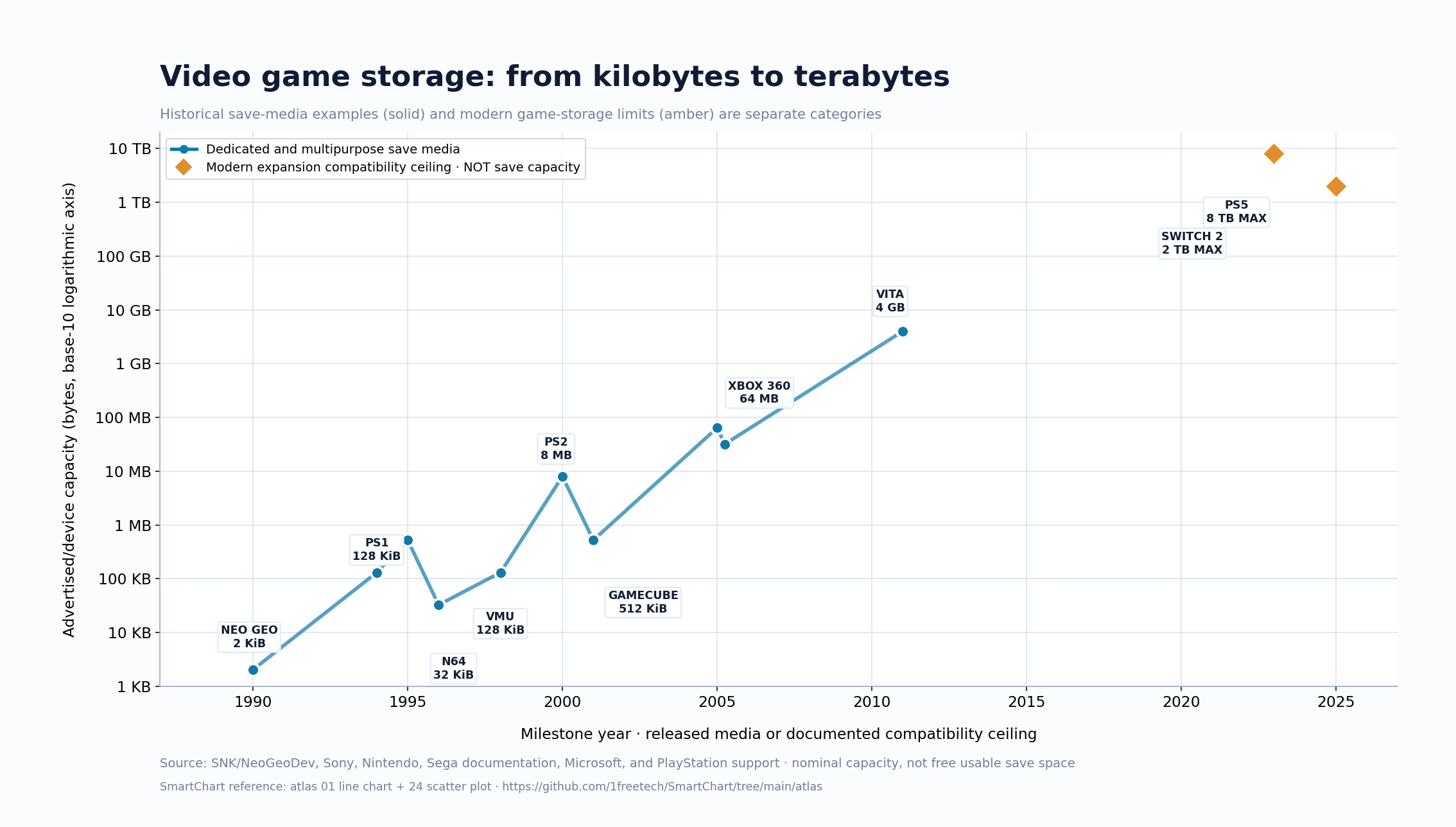
The table is organized by platform and the storage function relevant to saved games or game installations. Figures are examples or approved capacity limits, not estimates of every card ever sold. The chart above uses the stated original or milestone device capacities, not averages across product families.
| System / period | Save or storage medium | Published example capacity |
|---|---|---|
| Famicom + Data Recorder · 1984 | Cassette tape for programs / compatible game data | Variable; no fixed card capacity |
| Famicom Disk System · 1986 | Writable proprietary game disk | Game + save sectors; not a standalone memory card |
| NES / SNES / Genesis · 1980s–90s | Some game cartridges with backup SRAM / EEPROM | Title-dependent; no universal system card |
| Neo Geo AES/MVS · 1990 | Removable JEIDA SRAM card | 2 KiB original |
| Sony PlayStation · 1994 | Removable dedicated memory card | 128 KiB; 15 save blocks |
| Sega Saturn · 1994–95 | Internal backed-up RAM; backup cartridge | 32 KiB internal; 512 KiB example add-on |
| Nintendo 64 · 1996 | Controller Pak / cartridge-specific saves | 32 KiB Pak; 123 usable pages |
| Sega Dreamcast · 1998 | Visual Memory Unit | 128 KiB physical; ~100 KiB after reserved space |
| Sony PlayStation 2 · 2000 | Dedicated MagicGate save card | 8 MB nominal |
| Nintendo GameCube · 2001 | Memory Card 59 / 251 / 1019 | 512 KiB / 2 MiB / 8 MiB |
| Microsoft Xbox · 2001 | Built-in hard disk and portable memory unit | 8 GB internal / 8 MB unit |
| Sony PSP · 2004–05 | Memory Stick Duo; U.S. Value Pack | 32 MB bundled in 2005 |
| Microsoft Xbox 360 · 2005 | HDD and proprietary removable Memory Unit | 64 MB original unit example |
Historical documentation: NeoGeo Development Wiki; PlayStation memory-card technical reference; Nintendo 64 developer manual; Dreamcast VMU developer specification; Sony’s PS2 card announcement; Nintendo’s GameCube accessories; Microsoft Xbox 360 Memory Unit manual.
2005–2012 — Flash memory outgrows save-only cards
Sony’s PSP supported removable Memory Stick Duo media. Its March 2005 North American Value Pack included a 32 MB card, and Sony announced a 1 GB Memory Stick PRO Duo later in 2005. As games became downloadable and portable systems played music and video, removable capacity served multiple functions beyond compact save files.
The Xbox 360 shipped with portable 64 MB memory units while many configurations depended on hard drives. The 2006 PlayStation 3 and Wii shifted emphasis to built-in or general-purpose storage; the Wii’s SD slot was not a direct equivalent of the original PlayStation card. Nintendo DS games commonly kept saves in the game cartridge, while the 3DS used different save destinations for physical and downloadable games.
PlayStation Vita launched in Japan in December 2011 with a proprietary flash-card family of 4, 8, 16 and 32 GB, with a 4 GB entry option. Sony’s archival announcements provide the actual capacities and launch dates rather than an inferred specification. A 4 GB card was vastly larger than a Neo Geo card, but it could also store downloaded games and other files.
2017–2026 — Terabytes arrive, while save files move elsewhere
PlayStation Support, “Add an M.2 SSD to a PS5 (CFI-2000 Slim and CFI-7000 Pro model groups),” December 9, 2024. Genuine manufacturer demonstration of modern high-speed game-installation expansion; save-file storage rules are separately defined by PlayStation Support. Credit: PlayStation Support / YouTube.
Nintendo Switch adopted microSD for downloaded games and captures, but its game-save records reside in system memory. Switch 2, released in 2025, changed the expansion requirement to microSD Express, supporting cards up to 2 TB according to Nintendo. Ordinary older microSD cards cannot be used for Switch 2 game installations, and Nintendo expressly says save-game data cannot be copied to the microSD Express card.
PlayStation 5 supports compatible PCIe Gen4 M.2 NVMe SSDs from 250 GB to 8 TB; the 8 TB compatibility ceiling arrived through a system software update in 2023. Sony’s support table is explicit: PS5 game installations can be moved to M.2 storage, but PS5 saved-game data is not stored on that expansion SSD. Saved data instead uses console storage and authorized cloud or system backup mechanisms.
Xbox Series X|S similarly employs large internal solid-state drives and branded expansion media for installations, with account-linked cloud saving. Compared with the discrete memory card era, the location, ownership controls, synchronization and durability of save data have changed as much as the byte count. For related context see RAM versus flash storage and SSD versus HDD.
How much growth do the numbers actually show?
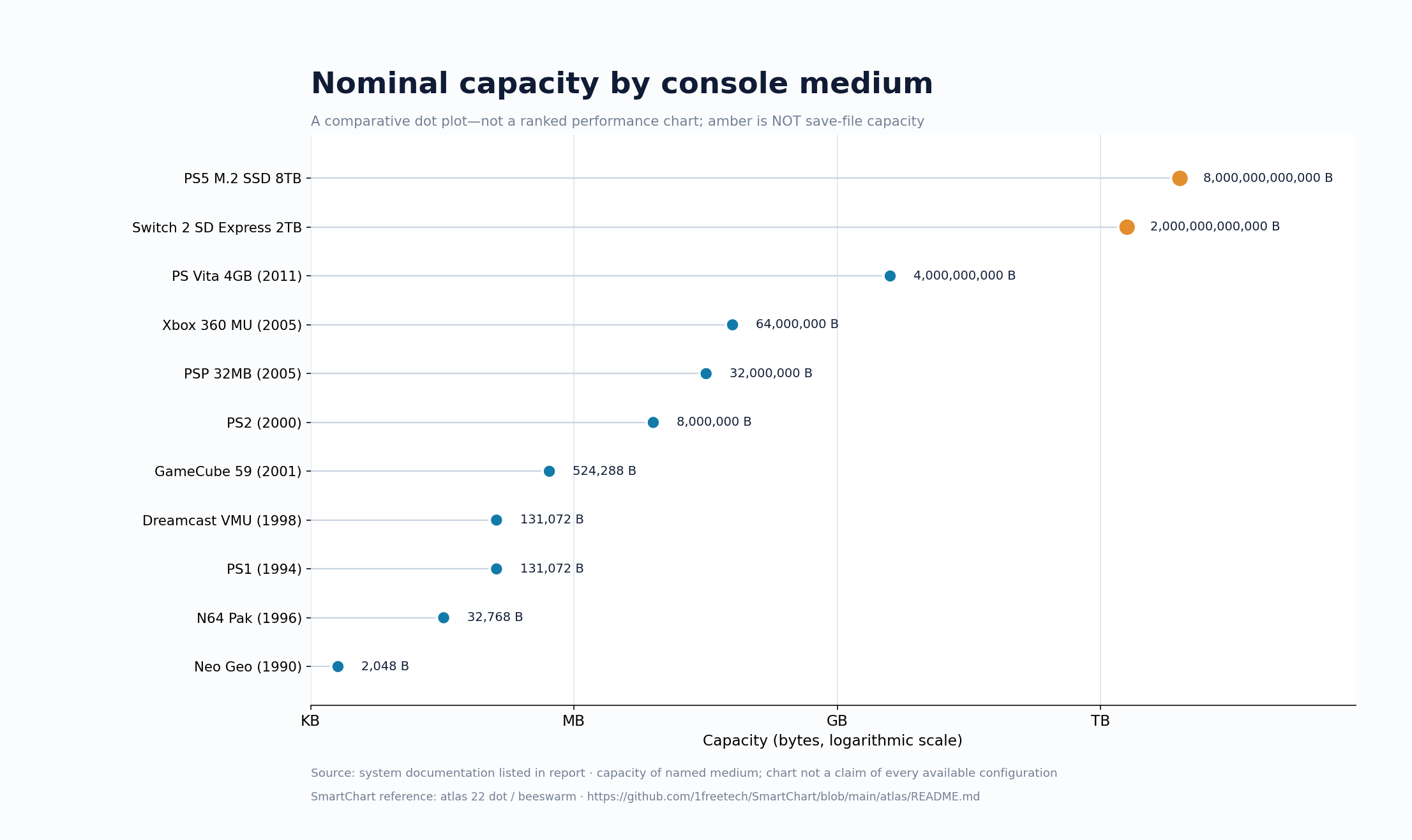
On a nominal-byte basis, the original Neo Geo card held 2,048 bytes. A 4 GB Vita card represents 4,000,000,000 bytes of advertised capacity, approximately 1.95 million times larger. Nintendo’s 2 TB Switch 2 microSD Express compatibility ceiling is 2,000,000,000,000 bytes, approximately 977 million times larger than 2 KiB. The PS5’s 8 TB M.2 compatibility ceiling corresponds to roughly 3.91 billion times the same early card.
Those ratios describe nominal device capacity only. They do not measure the size of a typical save file, the number of games that fit, or effective game progress preserved. A 2 TB expansion card on Switch 2 cannot be presented as a 2 TB detachable save card. Similarly, the 8 TB PS5 SSD is for installed games and applications, not an 8 TB save-management partition.
Why the line chart uses a logarithmic scale
A linear chart from 2 KiB to 8 TB would compress every pre-gigabyte memory card into an almost invisible strip at zero. A base-10 logarithmic vertical axis allocates equal visual space to each tenfold increase, preserving legibility across nine-plus orders of magnitude. The chart connects historical release examples, not a theoretical technology limit; several newer systems deliberately used smaller official cards than older competitors. Orange modern expansion markers remain separate instead of joining save media into a misleading continuous series.
The chart family comes from the site’s 40 Types of Charts visual reference and the SmartChart GitHub atlas. Its 40-chart catalog provides the selection vocabulary, historical methodology and illustrative references. The original PNG charts published here were generated independently from the cited console data; no claim is made that SmartChart itself rendered or validated the values.
Research limitations and preservation implications
A truly exhaustive list of every game system, cartridge save chip, third-party memory card, regional product variant and revised firmware would be a separate archival database; the table instead covers major platforms and verified milestone devices. Some cards used battery-backed SRAM and could lose data after long storage; later flash media eliminated that battery dependency for the stored bits but introduced controller, connector, wear and file-system failure modes.
The modern paradox is that abundant storage does not guarantee portable, recoverable progress. Hardware aging, account requirements, save-game encryption, subscription-linked cloud backups and the shutdown of network services complicate preservation. Capacity alone is therefore a poor proxy for save-data resilience. A separate BitcoinVersus.Tech history of increasing game size also measures a distinct quantity: executable and asset storage, not the few bytes to megabytes needed to remember player progress.
Primary sources and chart provenance
- SNK corporate Neo Geo museum — original portable memory-card feature
- SNK advertisement, Play Meter October 1990 — portable save-game advertising
- NeoGeo development documentation — 2 KiB original SRAM card
- Nintendo Famicom Data Recorder technical history
- Nintendo 64 programming manual — Controller Pak pages and overhead
- Sega Dreamcast VMU technical documentation — flash capacity and allocation
- Sony PS2 8 MB Memory Card press release
- Nintendo GameCube accessory documentation — Memory Card 59
- Microsoft Xbox 360 Memory Unit product manual — 64 MB
- Sony PSP North American launch release — bundled 32 MB Memory Stick Duo
- Sony PS Vita Japan launch release — 4–32 GB proprietary cards
- Nintendo Switch 2 microSD Express FAQ — 2 TB maximum; no game-save data on card
- PlayStation M.2 SSD specification — 250 GB to 8 TB supported
- PlayStation game saves versus M.2 SSD storage matrix
- SmartChart repository and 40-chart atlas methodology
- Neo Geo and GameCube card capacity cross-check, Museum of Obsolete Media
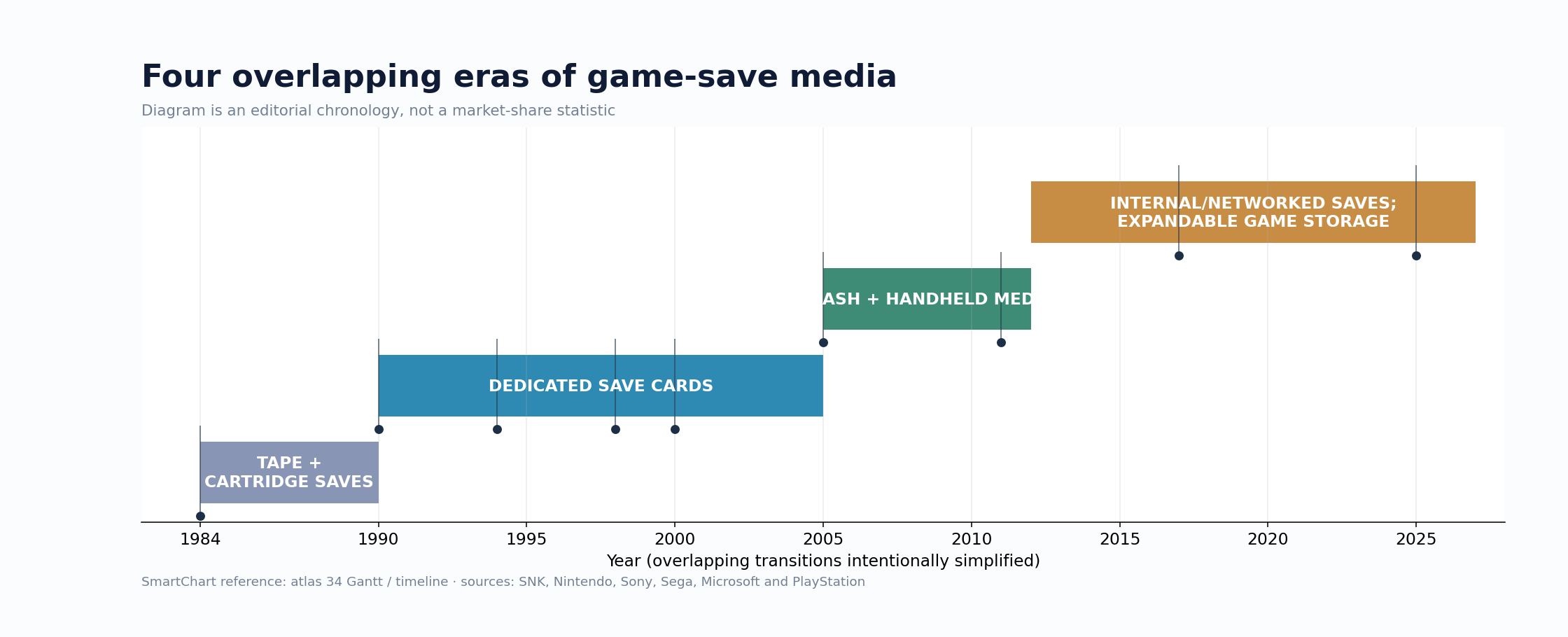
Data method: Source records are dated to the earliest selected product or support-milestone year and use advertised byte counts rather than formatted capacity. Original Neo Geo, N64, PlayStation and VMU figures are shown in binary KiB where design data is specified as kilobits; modern manufacturer GB/TB figures use decimal nameplate bytes. The logarithmic chart combines selected cards, not a census. The dot plot re-expresses the same capacity samples and the era diagram is conceptual. The 40 SmartChart SVG examples are synthetic methods references, not raw data.
Editor’s Note: The report was compiled from manufacturer archives, engineering manuals, historical trade advertising and the BitcoinVersus.Tech SmartChart atlas. The original featured image is a conceptual colored-pencil montage, not documentary product photography; some pictured variants and labels are illustrative. The log-scale line chart, comparative dot plot and era timeline were generated specifically from cited records and separately distinguish modern expansion ceilings from save-card capacities. Nintendo and PlayStation official YouTube videos are authentic manufacturer media, but successful device-level playback or responsive layout requires independent browser testing. The original donation QR and publication footer are preserved. No claim of exhaustive coverage of every gaming system is made.

BitcoinVersus.Tech is volunteer-run and publishes independent research and technical education. An optional donation of 5,000 satoshis supports continued reporting. Scan the original QR code from a second screen using a compatible Bitcoin wallet; on the same phone, import a saved image into a wallet that supports QR-image scanning. Independently confirm the recipient 3C9o19EH5HSiwEPyCTmEKzxhNCbo2X6TTb and 5,000 satoshis before payment. Bitcoin transactions are generally irreversible.
We volunteer daily to ensure the information on BitcoinVersus.Tech is Verifiably True. Editorial coverage is educational and informational and does not constitute investment advice, financial advice, device repair authorization, or a manufacturer’s official compatibility guarantee.


Leave a Reply