Payments infrastructure provider BVNK announced on November 6, 2026, that eligible business customers can mint, redeem, hold, send and receive Open USD (OUSD) through its payment platform. The Mastercard-owned company says the integration connects dollar balances to OUSD on Ethereum, Solana, Base and Tempo, with conversion at a stated one-to-one rate. BVNK is adding access to an existing stablecoin, not issuing a new cryptocurrency.
The development extends the stablecoin capabilities behind Mastercard’s broader payment ambitions. Earlier BitcoinVersus.Tech reporting examined Mastercard’s financial results and BVNK strategy. The new integration focuses on usable treasury and settlement infrastructure rather than a claim that traditional bank transfers have been replaced.
How the dollar-backed token works
A stablecoin represents value on a blockchain while seeking to maintain a reference price, commonly one U.S. dollar. Open Standard launched OUSD on September 30, before BVNK’s November announcement. BitcoinVersus.Tech previously reported on Stripe’s earlier OUSD integration, an existing distribution channel distinct from BVNK’s newly announced access. OUSD is issued by Bridge, a Stripe company, on behalf of the Open Standard network. The consortium’s founding participants include Coinbase, Mastercard, Shopify, Stripe and Visa; its membership now exceeds 200 organizations, according to its launch announcement.
Issuance, or minting, converts approved dollar funds into tokens, while redemption burns tokens in exchange for dollars. Open Standard and BVNK advertise no fee for the one-to-one mint and redemption process. Blockchain transfers can still involve network fees, compliance screening, spreads, intermediary charges or settlement delays. Dollar parity is a redemption design, not a guarantee that every secondary-market trade executes at exactly $1.
OUSD’s proposed economics distribute certain reserve-related revenue to qualifying network partners instead of retaining the entire benefit with one issuer. Partner incentives should not be confused with guaranteed yield for ordinary token holders. Bridge’s issuer explanation and Open Standard’s disclosures describe the architecture; they do not establish a specific return for BVNK customers.
Corporate payments and embedded wallets
BVNK describes three access routes. Its direct business offering handles company treasury balances and payments; an embedded API lets software platforms incorporate wallets and pay-ins or payouts; and a wholesale path offers exchanges, market makers and over-the-counter desks mint-and-burn access. Virtual IBANs and automated rules are intended to make fiat reconciliation practical for high-volume operations.
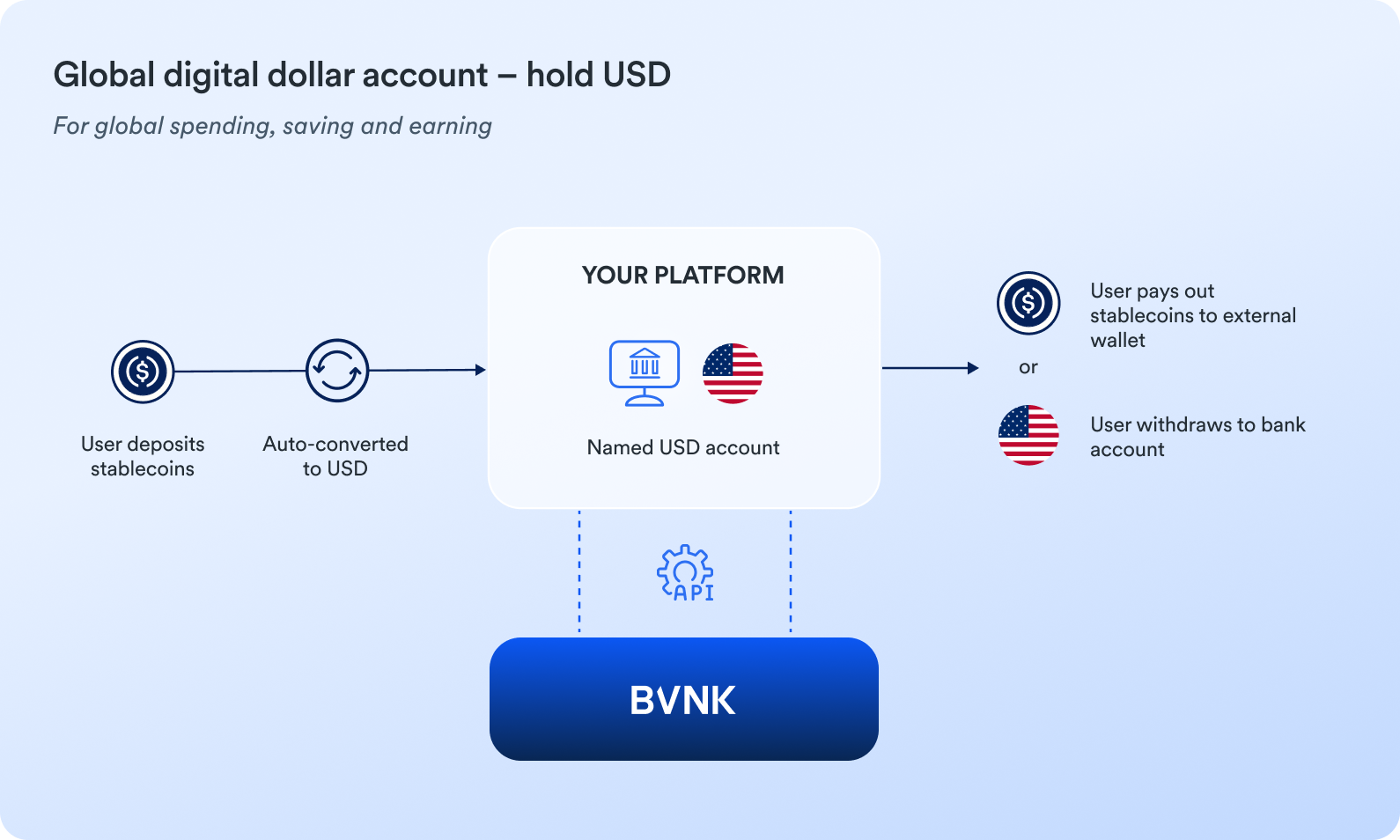
The architecture resembles the embedded account model explored in BitcoinVersus.Tech’s report on Rain’s stablecoin wallets, while Standard Chartered’s RLUSD custody service illustrates a different institutional role. Traditional rails remain relevant: the publication’s ACH explainer describes how domestic bank transfers operate outside public blockchains.
Availability and operational limits
BVNK’s November 6 announcement limits the release to eligible business customers outside the European Economic Area. Its separate U.S. currency documentation describes eligibility by state and lists Tempo support as forthcoming for eligible U.S. users, so the company’s broader four-network announcement should not be interpreted as identical availability in every jurisdiction.
A business must still evaluate custody arrangements, redemption counterparty risk, transaction monitoring, network congestion, liquidity and the possibility of smart-contract failures. OUSD is a stablecoin rather than an insured bank deposit. The issuer and payment platform have different operational responsibilities, making legal claims and reconciliation controls important when something goes wrong.
Neither BVNK’s release nor its changelog provides new OUSD transaction volume, active-customer counts or measurable cost savings attributable to the integration. The immediate result is a newly offered payment route; evidence of scale will depend on subsequent usage disclosures, reliability and independently verifiable settlement performance.
We volunteer daily to ensure the information on this platform is Verifiably True. If you would like to support the research, please scan QR code to donate 5,000 sats.

On mobile, open the article on another screen and use a compatible Bitcoin wallet to scan the original donation QR. Check the destination 3C9o19EH5HSiwEPyCTmEKzxhNCbo2X6TTb before sending 5,000 sats.
Editor’s Note: Reporting was checked against BVNK’s November 6 product announcement, Open Standard’s September 30 launch, Bridge’s issuer statement and BVNK’s currency reference. Company imagery is explicitly illustrative, not documentary evidence of OUSD transaction volume. No video playback was claimed or tested. BitcoinVersus.tech is not a financial advisor. Financial coverage is provided for informational purposes only.


Leave a Reply