
Behind a routine utility bill, insurance premium or bank transfer sits a chain of software systems that must authenticate the payer, route funds, update balances and reconcile records. Cloud-based processors operate across cards, bank accounts and digital channels, making the number of transactions handled a meaningful measure of demand. The harder question is whether growing payment traffic also produces stronger earnings.
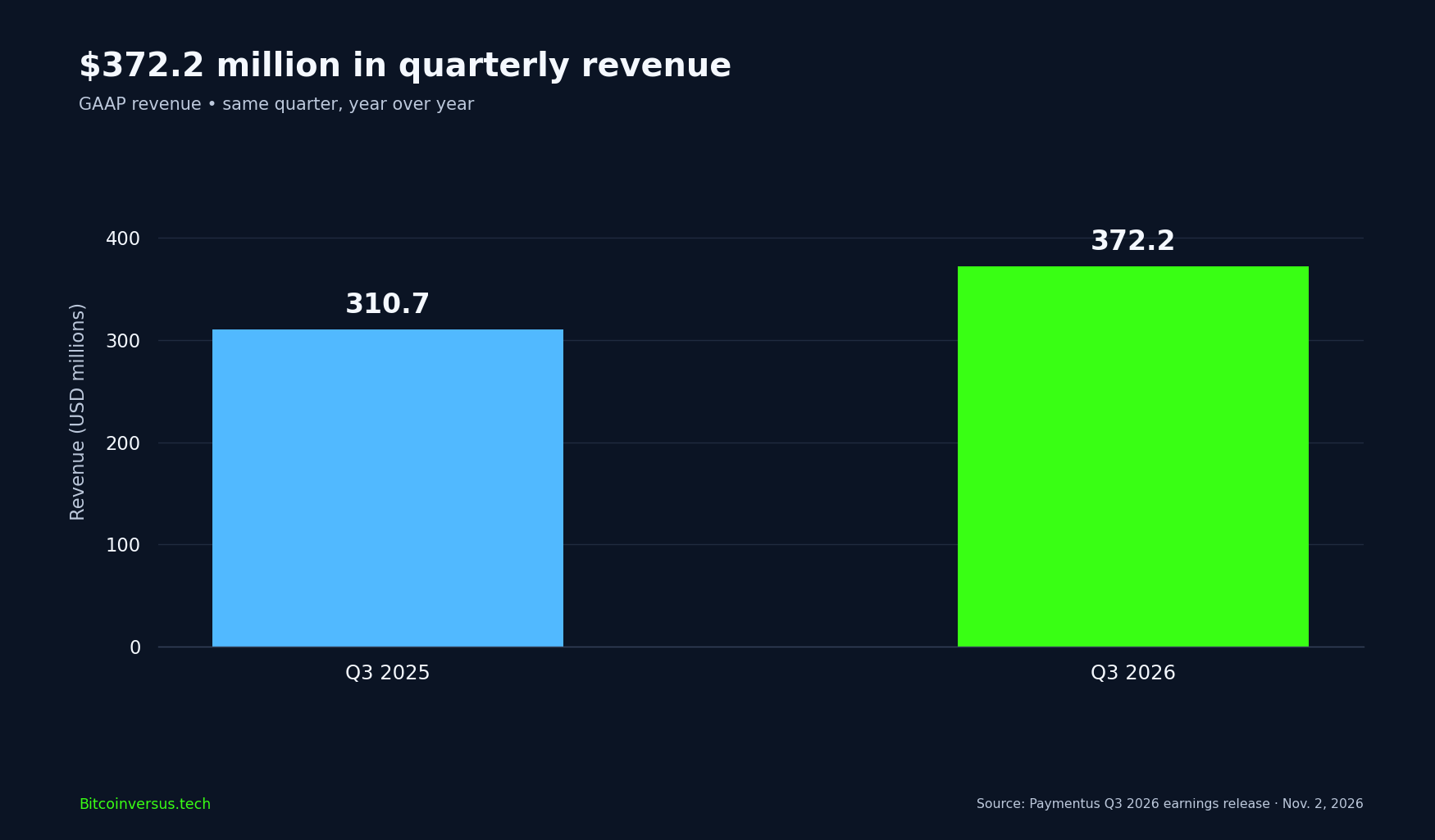
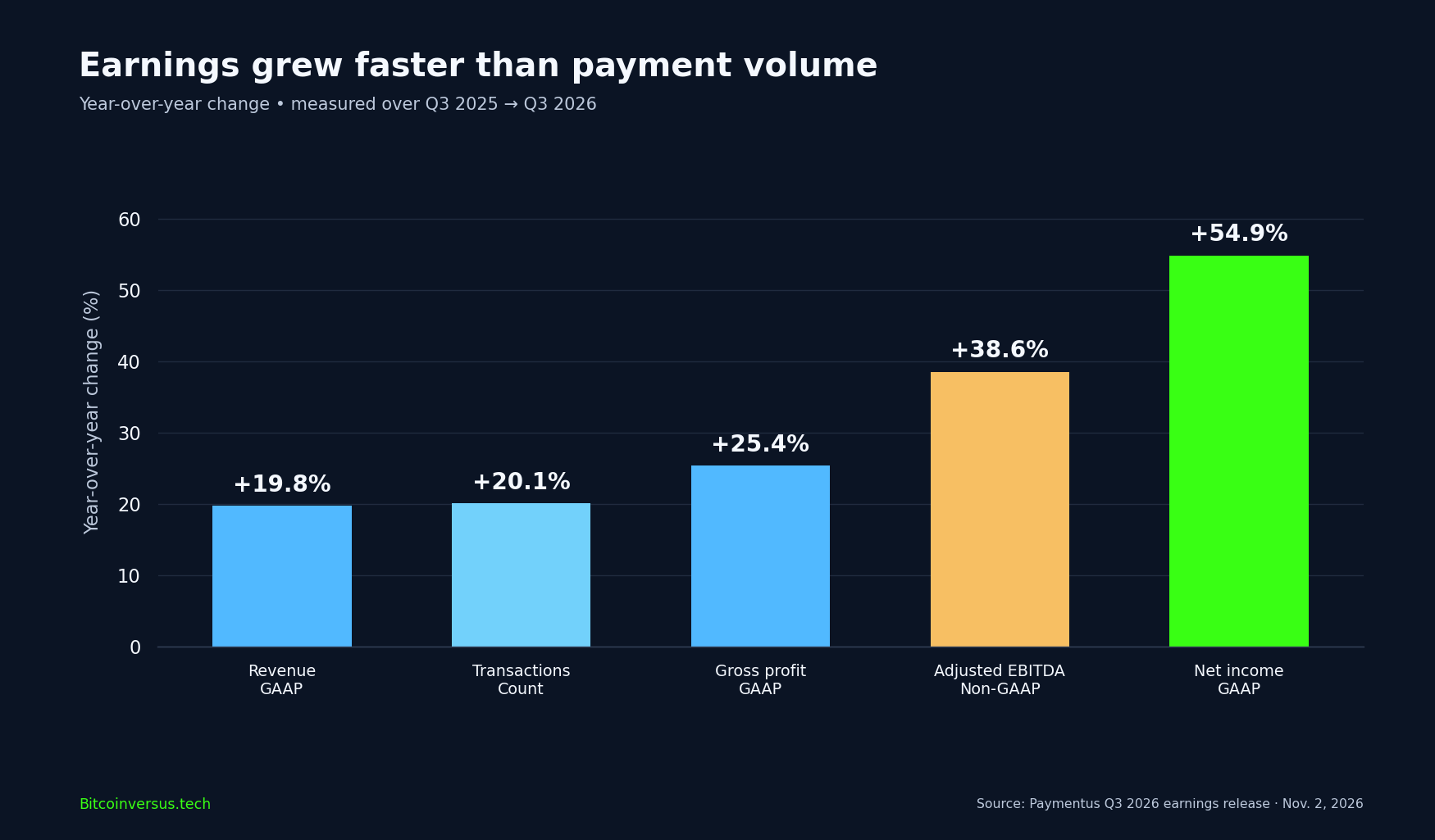
Paymentus Holdings processed a record 219.0 million transactions during the third quarter of 2026, up 20.1% from 182.3 million a year earlier. Its November 2 earnings release reported $372.2 million in revenue, up 19.8%, and $27.5 million in GAAP net income, up approximately 54.9% from $17.7 million. The quarter ended September 30; the figures are financial results, not projections.
Paymentus CEO Dushyant Sharma discusses unified billing and real-time payment experiences with PYMNTS CEO Karen Webster. Official Paymentus Corporation YouTube channel, November 17, 2021. Historical background, not a 2026 earnings video.
Payment volume is growing nearly as fast as revenue
Paymentus counts revenue-generating payment transactions initiated and generally processed through its platform, including cards, checks, automated clearing house items, account-to-account transfers and other payment types. A transaction count is not the dollar value of transferred money. An earlier ACH explainer describes one of the rails capable of moving funds without a card network.
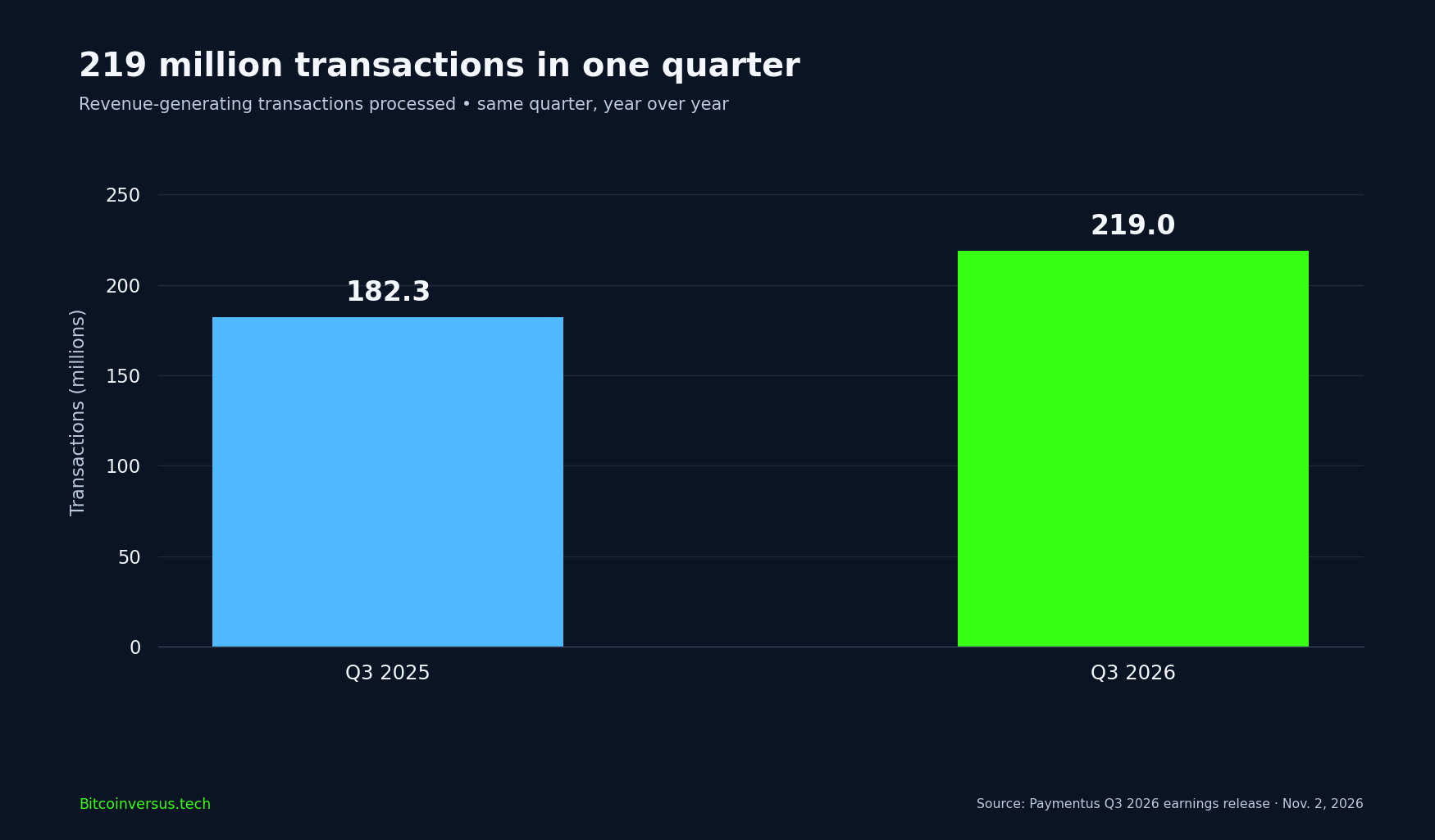
The company processed 36.7 million more transactions than in the year-earlier quarter, according to rounded reported totals. The average quarterly revenue divided by counted transactions remained near $1.70 per transaction in both periods. That ratio is a blended accounting calculation, not a published customer fee: transaction sizes, billing contracts, payment rails and network costs all differ.
Revenue rises, but earnings accelerate
Revenue increased from approximately $310.7 million to $372.2 million. GAAP gross profit climbed 25.4% to $93.8 million, while operating income grew from $19.9 million to $33.5 million. The larger percentage increase in operating income indicates greater earnings growth than the headline revenue percentage, although quarterly mix and costs can change.
Paymentus also reported $118.5 million in contribution profit, up 20.6%, and $49.7 million in adjusted EBITDA, up 38.6%. Both are non-GAAP measures. The company’s record 41.9% adjusted EBITDA margin divides adjusted EBITDA by contribution profit—not total revenue. A reader calculating $49.7 million divided by $372.2 million would obtain about 13.4%, but that is a different denominator and must not be presented as the company’s reported adjusted EBITDA margin.
What the expanding payment network changes
Paymentus sells billing, payment and reconciliation services to utilities, insurers, government agencies, financial institutions and other enterprises. Its Instant Payment Network connects billers and financial partners, helping organizations support different payment methods without building every integration separately. The recent Mastercard earnings report illustrates a larger card-network model, while Broadridge’s repo-volume disclosure measures financial-market transactions of a fundamentally different type.
Modern payment infrastructure also includes experiments beyond conventional accounts. BVNK’s stablecoin integration demonstrates one alternative settlement model; its blockchain throughput cannot be equated with Paymentus transaction counts. Paymentus attributes its Q3 growth principally to new biller implementations and greater activity among existing clients, not a disclosed stablecoin-volume surge.
The outlook remains a forecast
Management guided to $373 million–$378 million in fourth-quarter revenue, with projected adjusted EBITDA of $45 million–$50 million. Those numbers are targets, not observed fourth-quarter performance. Higher transaction loads can increase revenue, but merchant mix, interchange and network expenses, cybersecurity requirements and software investment all influence profitability.
The central finding is measurable: Paymentus handled about one-fifth more transactions while producing considerably faster growth in GAAP net income. Whether the gap can persist depends on customer implementations, payment mix and cost discipline. For investors and payment engineers alike, total transaction counts and carefully defined profitability metrics are more useful together than either headline in isolation.
Primary records: Paymentus SEC Exhibit 99.1, November 2, 2026; official earnings release; Form 10-Q filed November 2026. Official historical video: Paymentus CEO discussion, November 17, 2021.
Editor’s Note: The quarterly figures are drawn from Paymentus’s unaudited November 2 results and SEC filing. Revenue, gross profit, operating income and net income follow GAAP; contribution profit and adjusted EBITDA are company-defined non-GAAP measures. Their reconciliation and limitations appear in the filing. Percentages and per-transaction ratios are calculated from rounded public figures. The featured cover is AI-generated conceptual art, not a photograph of a Paymentus facility. The three graphics are original, source-attributed charts. The YouTube interview predates the quarter and is not evidence of 2026 performance.
Support BitcoinVersus.Tech
To support independent technology reporting, scan the original donation QR below for an optional 5,000-satoshi contribution. On a phone, display the code on another screen and scan with a compatible Bitcoin wallet, or import the saved QR image if supported. Verify the destination and amount before confirming payment.

We volunteer daily to ensure the information on this platform is Verifiably True. If you would like to support the research, please scan QR code.


Leave a Reply