
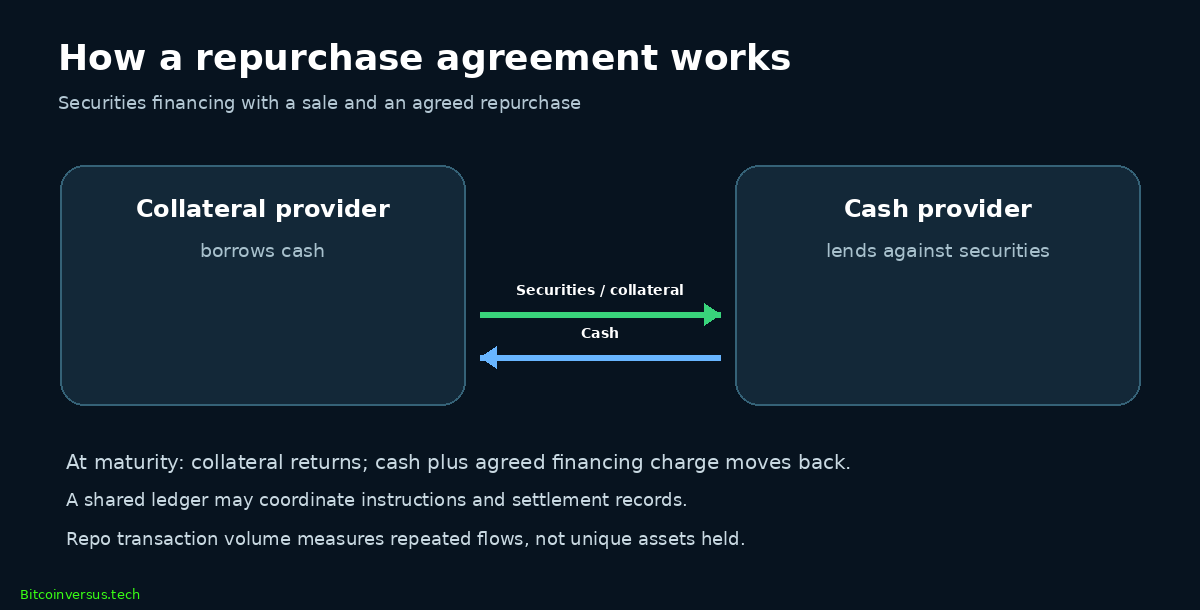
A repurchase agreement, or repo, is a short-term financing transaction in which one party provides securities as collateral in exchange for cash and agrees to reverse the transaction later. Banks and dealers use repo markets to finance securities inventories and manage liquidity. A distributed ledger can coordinate records, collateral transfers and settlement instructions between institutions, but moving repo activity onto a blockchain does not eliminate credit, liquidity or operational risks.
Broadridge Financial Solutions said on November 6, 2026 that its Distributed Ledger Repo (DLR) platform processed $7.6 trillion in October transactions, averaging $345 billion per trading day. The company’s announcement provides a real-world measure of institutional tokenized securities financing, although the total measures transaction flow rather than the value of assets held at one moment.
October grew in total, but not per day
Broadridge’s September release listed $7.5 trillion in monthly repo volume and a $359 billion daily average. October’s monthly volume therefore increased approximately 1.3%, calculated from the published rounded totals. Yet average daily activity fell approximately 3.9%, from $359 billion to $345 billion. A longer settlement month can produce a higher cumulative total even with less activity on a typical trading day.
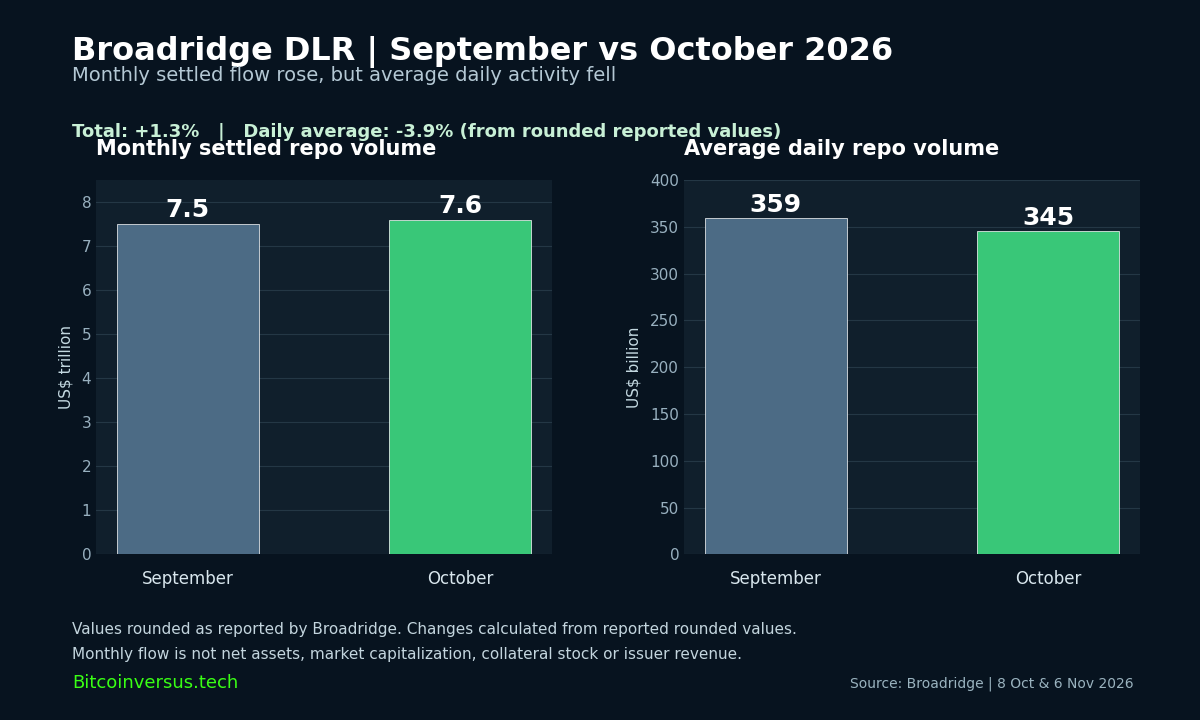
The monthly comparison is useful but incomplete: activity also varies with trading calendars, quarter-end funding needs, collateral demand and customer participation. Broadridge did not provide independently audited profitability, customer counts or a causal explanation for the change in daily volume. Its April announcement had already reported a $368 billion daily average, reinforcing the need to avoid treating every new monthly total as an acceleration.
What actually happens in a tokenized repo
The cash provider advances funding against eligible securities, and the collateral provider later repurchases the securities under agreed terms. Broadridge says DLR can synchronize cash and tokenized collateral movements, support intraday agreements and help institutions manage funding during the trading day. Its September expansion announcement identified additional G7 securities as eligible for broader cross-border collateral use; support for a security type does not mean every institution or jurisdiction is already connected.
The newer DLX platform broadens Broadridge’s services toward token issuance, trading, settlement and servicing. Separate BitcoinVersus.Tech reporting on the NYSE’s planned tokenized-stock transfer agents deals with investor ownership and governance rather than repo turnover. Similar Morgan Stanley tokenization developments concern another part of the emerging market infrastructure. Their reported asset values should not be added to DLR transaction volume.
Broadridge’s Horacio Barakat explains intraday repo and tokenization in a Sibos 2025 interview, predating the October 2026 data. Video: Financial IT, October 6, 2025.
In an October 2025 interview recorded at Sibos, Broadridge executive Horacio Barakat discussed the economics of intraday repo and scaling tokenization beyond pilot deployments. The video provides background, not independent confirmation of the November 2026 totals. Repo volume can reflect repeated borrowing and repayment using the same collateral, making a gross flow figure fundamentally different from holdings, market capitalization or bank revenue.
Institutional scale still has limits
Broadridge has publicized potential benefits such as faster collateral movement and reduced settlement friction, but the October release does not quantify net savings for participating firms or establish that tokenized repo is cheaper under all circumstances. Operational resiliency, interoperability, legal enforceability and access controls remain essential when securities and payment instructions circulate between networks.
Institutions are evaluating related financial-market integrations: an OTC swap recorded on Canton and tokenized sterling deposits among banks illustrate different instruments and settlement arrangements. The new DLR disclosure confirms substantial transaction activity on one live platform, while the drop in its daily average shows why meaningful adoption reporting requires more than a single rising headline number.
Primary sources: Broadridge November 6 figures; Broadridge October 8 comparison; Broadridge September 2 collateral announcement; Federal Reserve repo definition; Financial IT interview (2025).
Editor’s Note: Volumes are company-reported, with percentage differences calculated from rounded figures; BitcoinVersus.Tech has not audited participant transactions or independently operated the DLR service. Featured art is an original AI-assisted conceptual illustration. The chart and explainer are original editorial graphics, not screenshots of proprietary systems. The video is historical background, and its public playback requires separate verification.
Support BitcoinVersus.Tech
To support independent technology reporting, scan the original donation QR below for an optional 5,000-satoshi contribution. On a phone, display the code on another screen and scan with a compatible Bitcoin wallet, or import the saved QR image if supported. Verify the destination and amount before confirming payment.

We volunteer daily to ensure the information on this platform is Verifiably True. If you would like to support the research, please scan QR code.


Leave a Reply