Artificial superintelligence describes a hypothetical class of AI capable of surpassing human performance in nearly every cognitive domain. It is distinct from the narrower tools used to draft emails, generate images or write software. The difference matters after viral social posts claimed Bloomington, Indiana, had banned artificial intelligence citywide and threatened users with jail.
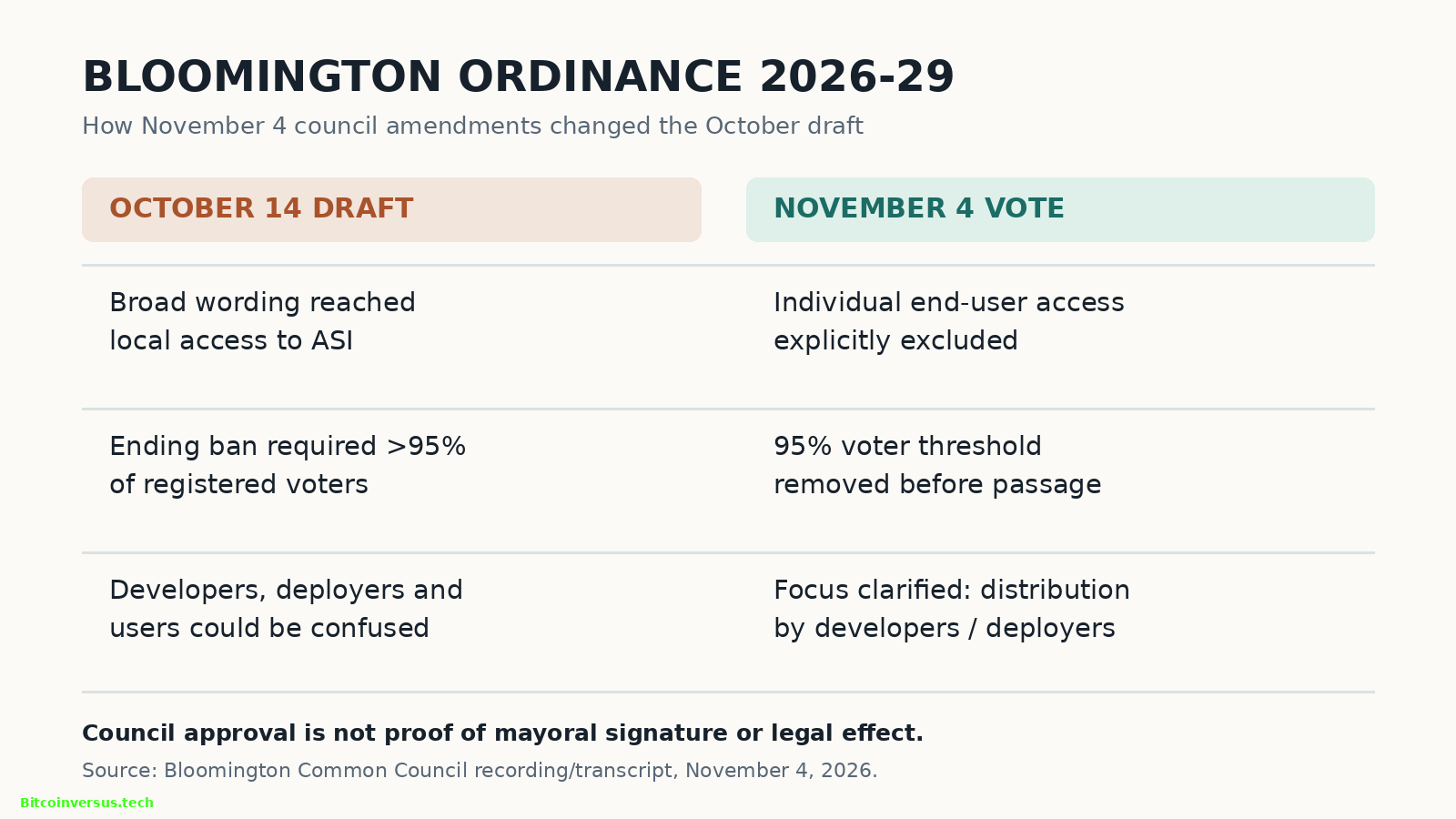
The Bloomington Common Council unanimously approved Ordinance 2026-29 on November 4, 2026. The official meeting transcript establishes that councilmembers adopted four amendments before the final vote, narrowing the measure to distribution and deployment of artificial superintelligence. A publicly circulated October 14 draft did not reflect those final changes.
Verified official Bloomington Common Council recording, November 4, 2026 (4 hours, 45 minutes). Source: Community Access Television Services, Monroe County Public Library. WordPress displays a linked recording rather than an in-page player; watch the complete meeting on CATS.
End users were explicitly excluded
Amendment 4a specifies that distribution and deployment do not include individual end-user access to an artificial superintelligence system. Councilmember Dave Rollo explained that developers and deployers, rather than ordinary Bloomington residents, were the targets. City legal staff confirmed that a resident merely using a system would not be covered, though an individual distributing it could be.
The original draft covered remote execution through browsers, applications and local interfaces even when the server was elsewhere. The B Square Bulletin questioned how a city could regulate software supplied from beyond municipal boundaries. Reporting only the early draft overstates the reach of the version that passed the council.
The proposed 95% referendum was removed
The October draft required approval by more than 95% of all registered city voters before the ban could be lifted, alongside a scientific safety finding. During the November 4 debate, Rollo acknowledged that the voter requirement was impractical. Amendment 2a removed it and moved proposed scientific-consensus language into the preamble, where it was framed as an aspiration rather than an operative repeal condition.
The ordinance addresses systems claimed to pose risks to infrastructure, financial markets and public safety. BitcoinVersus.Tech previously explained the difference between AI and superintelligence and why industrial systems should be isolated from public networks. Neither subject demonstrates that ordinary commercial chatbots qualify under Bloomington’s superintelligence definition.
Possible fines do not mean automatic jail
The draft enforcement provision permits discretionary civil penalties, injunctions and possible referral to the Monroe County prosecutor for separate state-law offenses. Bloomington’s general municipal penalty rule allows fines of up to $2,500, with continuing violations potentially charged again. The adopted user exemption is especially important: a referral does not constitute a conviction, and the council did not create an automatic jail sentence for using everyday AI.
Implementation remains uncertain. Software can be hosted beyond city boundaries, making jurisdiction, proof of deployment and model classification difficult. The October ordinance specified mayoral approval and any required publication before taking legal effect. A signed final text, mayoral approval and effective date were not independently available for verification on November 8.
The larger debate concerns balancing precaution against enforceable and technically meaningful definitions. Earlier BitcoinVersus.Tech reporting examined physical limits on superintelligent computing and legal liability for AI-run companies. Bloomington’s council vote is a real development. A blanket prohibition on AI use with jail for ordinary residents is not what the verified amended record establishes.
Primary documents
November 4 council meeting transcript; official council recording; October 14 ordinance text and staff memo; Indiana Daily Student November 6 coverage; B Square Bulletin local legal analysis. The Polymarket post prompted the fact-check. The signed amended ordinance and mayoral approval were not independently confirmed.
Editor’s Note: The council’s November 4 transcript, rather than the unamended October draft, establishes the individual end-user exemption and deletion of the proposed 95% voter threshold. Council passage is not independently verified as mayoral approval or legal commencement. The featured oil-painting cover is a conceptual illustration of Bloomington City Hall, not a photograph of the council meeting. The official CATS meeting player has not been independently playback-tested.
Support BitcoinVersus.Tech
To contribute an optional 5,000 satoshis, scan the original BitcoinVersus.Tech donation QR below with a compatible wallet. On a phone, display the article on another screen or use a wallet’s supported saved-image scanning feature. Confirm the destination and amount before authorizing payment.

We volunteer daily to ensure the information on this platform is Verifiably True. If you would like to support the research, please scan QR code.


Leave a Reply