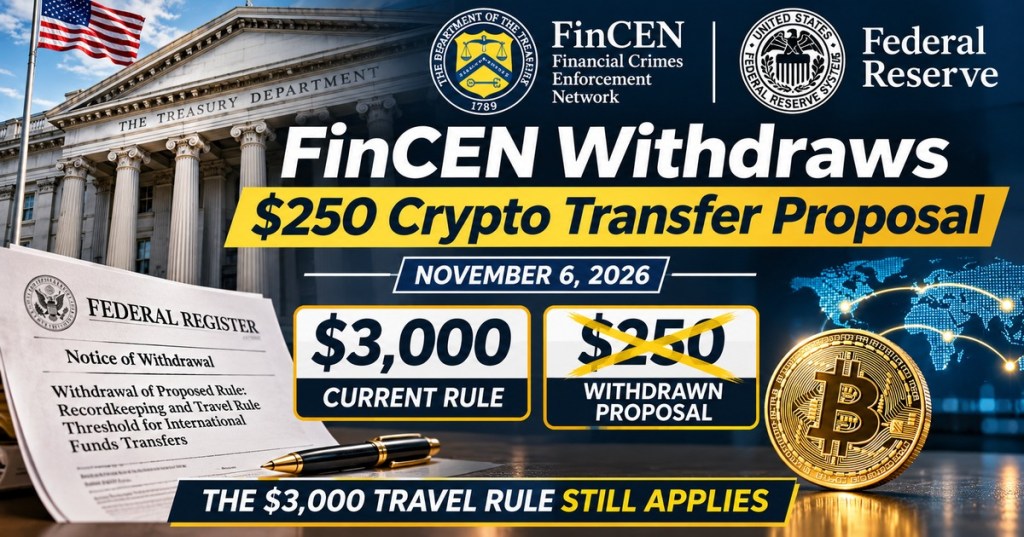
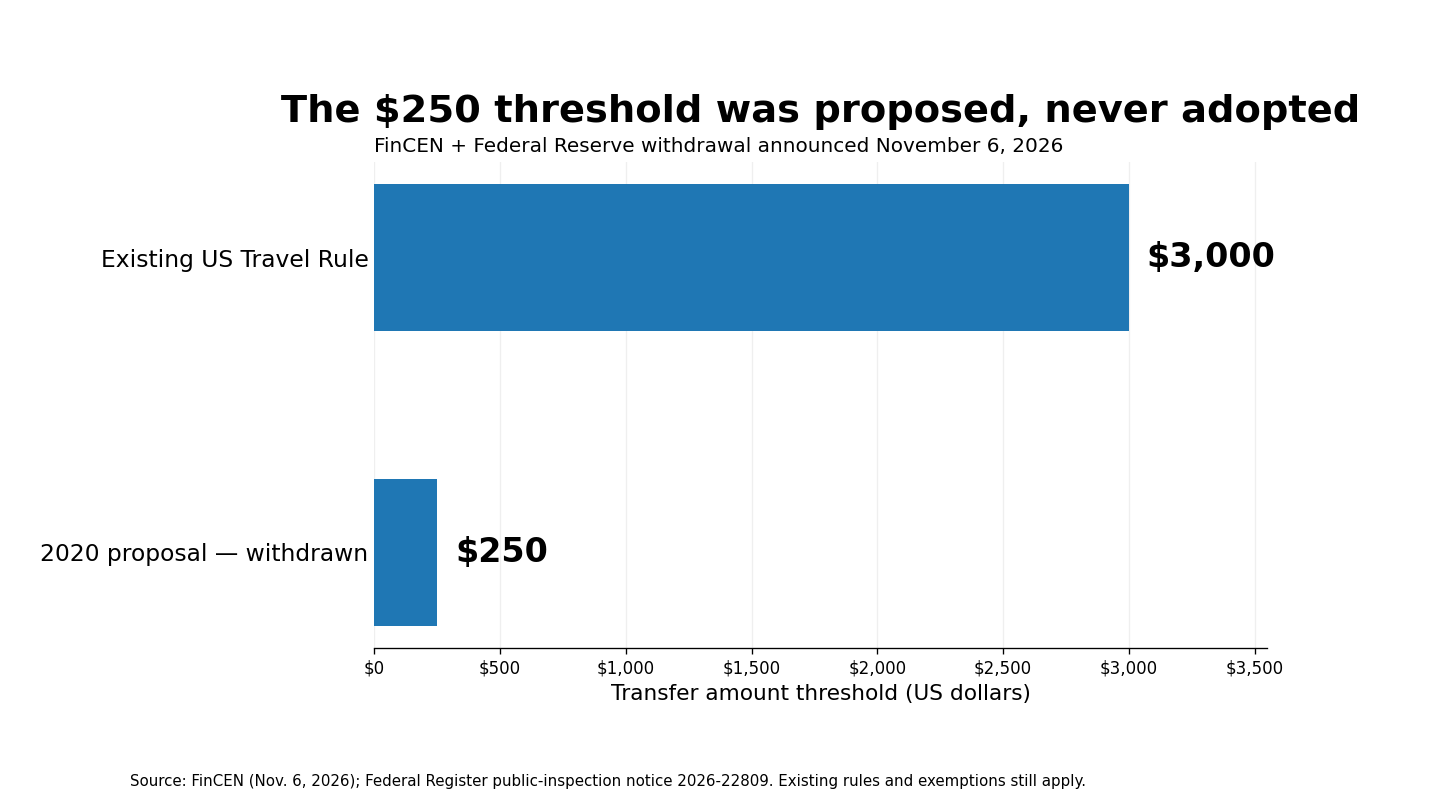
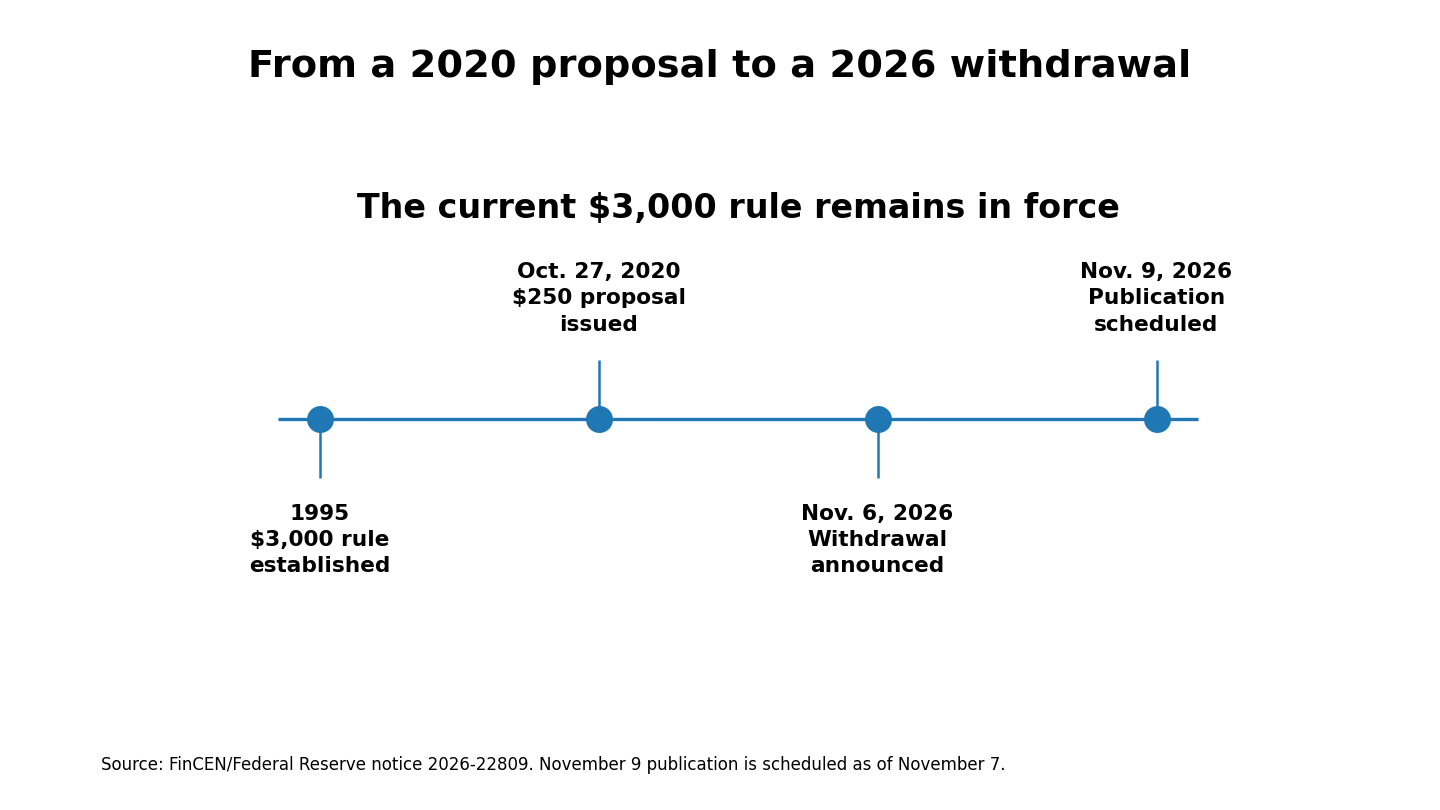
The U.S. Financial Crimes Enforcement Network (FinCEN) and Federal Reserve have withdrawn a six-year-old proposal that would have lowered the threshold for information collected and shared on certain international funds transfers from $3,000 to $250. Announced November 6, 2026, the withdrawal is scheduled for publication in the Federal Register on November 9. The $250 requirement never took effect, and the existing $3,000 threshold remains in place.
The withdrawn 2020 notice also proposed clarifying how the rules cover convertible virtual currencies, including Bitcoin, and digital assets recognized as legal tender. Ending that proposed amendment does not repeal the Bank Secrecy Act, eliminate anti-money-laundering controls or give cryptocurrency exchanges a blanket exemption from recordkeeping.
What the existing Travel Rule requires
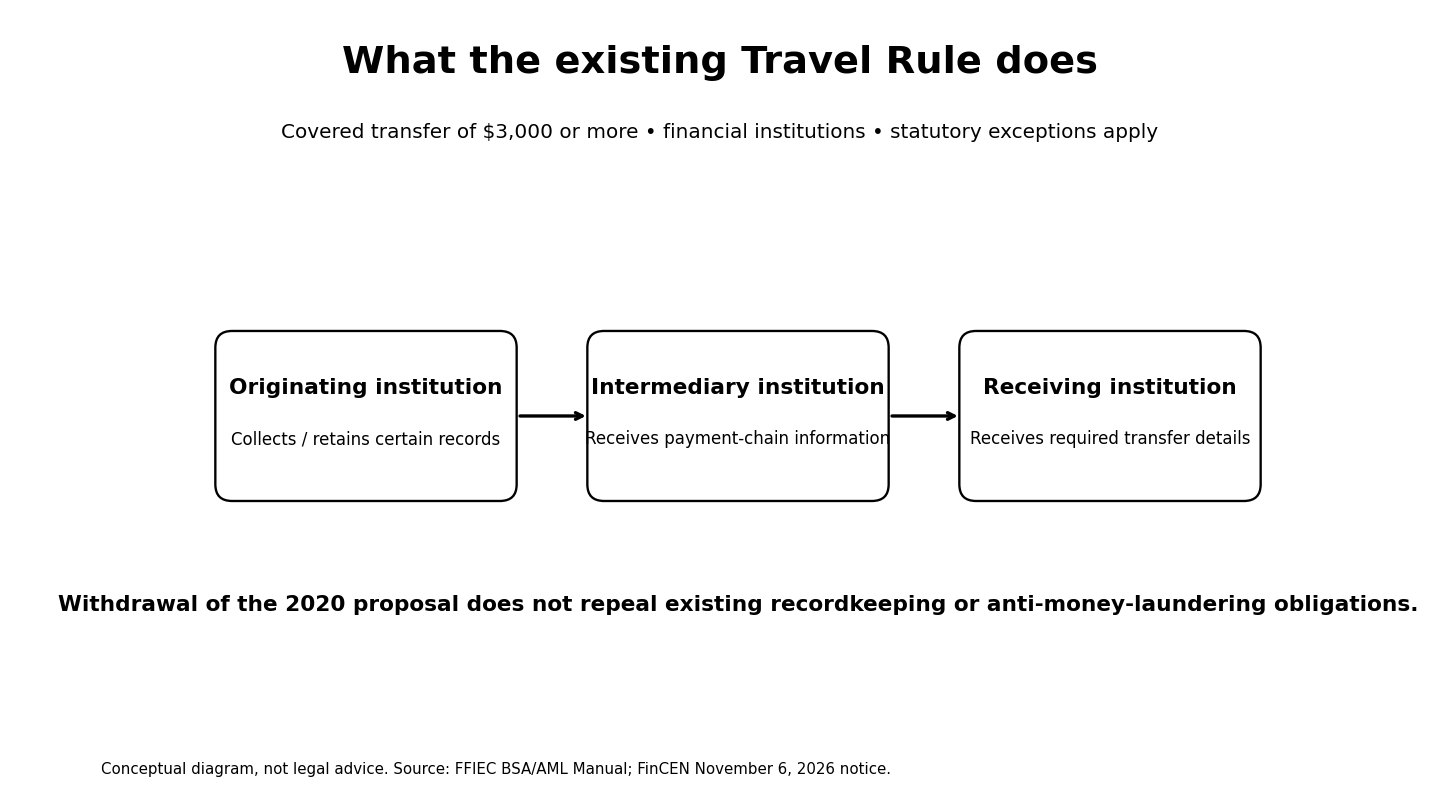
For covered transfers of $3,000 or more, financial institutions generally retain specified transaction records and transmit required originator information through the payment chain. Records can include names, addresses, amounts, dates and identifying information, subject to the applicable rules and exceptions. The Federal Financial Institutions Examination Council’s examination manual distinguishes recordkeeping duties from the separate information-transmission requirement commonly called the Travel Rule.
Those institutional obligations matter for custodians, exchanges and payment intermediaries. BitcoinVersus.Tech recently covered Bitget’s off-exchange custody integrations, where institutional arrangements can involve several entities. A direct peer-to-peer wallet transfer should not automatically be described as an institution-to-institution payment subject to identical duties; applicability depends on the participants and the governing rules.
Regulators cite costs and a changed industry
The joint withdrawal notice records nearly 3,000 comments on the October 27, 2020 proposal, although many were substantially similar form letters. Opponents warned of privacy risks, additional compliance work for smaller institutions and possible disruption to remittances. Some organizations supported clarifying cryptocurrency coverage to strengthen illicit-finance tracing. The agencies said more public input would be needed before pursuing comparable amendments.
They also cited changes since 2020, including the federal stablecoin framework enacted in July 2025. BitcoinVersus.Tech’s coverage of USDC access through Samsung Wallet illustrates how payment interfaces now extend beyond early cryptocurrency exchanges. A fresh rulemaking would have to account for evolving products and legal definitions.
Withdrawal is not deregulation of every transfer
FinCEN can still pursue suspicious activity and enforce other financial-crime rules. On the same date, the bureau announced a separate action against MEXC Global; BitcoinVersus.Tech reported the allegations and associated financial restrictions. Suspicious Activity Reports, customer verification, sanctions controls and other obligations may apply independently of the withdrawn $250 proposal.
A more diverse payments market also complicates compliance design. BitcoinVersus.Tech recently examined stablecoin settlement across four blockchains. The operational question for regulators is how to obtain actionable transaction information without imposing disproportionate cost or collecting unnecessary personal data. Lower thresholds may help trace smaller payments, but increase the number of transfers and records handled by regulated institutions.
The immediate outcome is narrow and concrete: the 2020 $250 threshold proposal is being withdrawn, not the underlying $3,000 rules. Any replacement would require additional policymaking and public input; as of November 7, the November 9 Federal Register publication remains scheduled.
Editor’s Note: The November 6, 2026 decision was checked against FinCEN’s official news release, the joint Federal Register public-inspection notice 2026-22809, and the FFIEC BSA/AML Manual. The $250 threshold was a 2020 proposal, not an active regulation. Publication of the withdrawal was scheduled for November 9, 2026, at the time of reporting. Three original graphics are explanatory, not substitute legal authority; the featured cover is an editorial illustration, not an official agency photograph. No relevant new official video was independently confirmed. Independent public-browser and mobile checks remain separate from WordPress saved/rendered HTML verification.

To donate 5,000 sats, open the article on a separate display and scan the original QR code with a compatible Bitcoin wallet. On mobile, use another screen or your wallet’s supported image-scanning feature. Verify the destination 3C9o19EH5HSiwEPyCTmEKzxhNCbo2X6TTb before sending.
We volunteer daily to ensure the information on this platform is Verifiably True. If you would like to support the research, please scan QR code.


Leave a Reply