
The global semiconductor industry is preparing a large wave of fabrication plants through 2030 as governments and chipmakers seek more manufacturing capacity for artificial intelligence, memory, processors, vehicles and industrial electronics. China leads one published historical forecast of new factory openings, while Taiwan, South Korea, Japan, the United States and European countries pursue different manufacturing strengths. Yet factory counts, construction milestones and actual wafer output are not interchangeable.
A semiconductor fabrication plant, or fab, processes wafers through lithography, deposition, etching, implantation, thermal treatments and inspection. A new building must also establish cleanroom conditions, ultrapure water, reliable electricity, chemical handling, equipment qualification and yield before commercial chips can emerge consistently. The first silicon from a line is an initial manufacturing milestone, not proof of high-volume, profitable production.
96 new fabs in an older 2030 forecast
A January 2025 American Enterprise Institute analysis by Chris Miller reproduced SEMI’s June 2024 World Fab Forecast by expected first-silicon year. Adding its bars gives 96 new fabs originally scheduled across 2023–2030. China represented 38; the Americas, 18; Europe and the Middle East, 14; Japan, 11; Taiwan, seven; Southeast Asia, five; and South Korea, three. The historical schedule placed 52 of those facilities in 2026–2030.
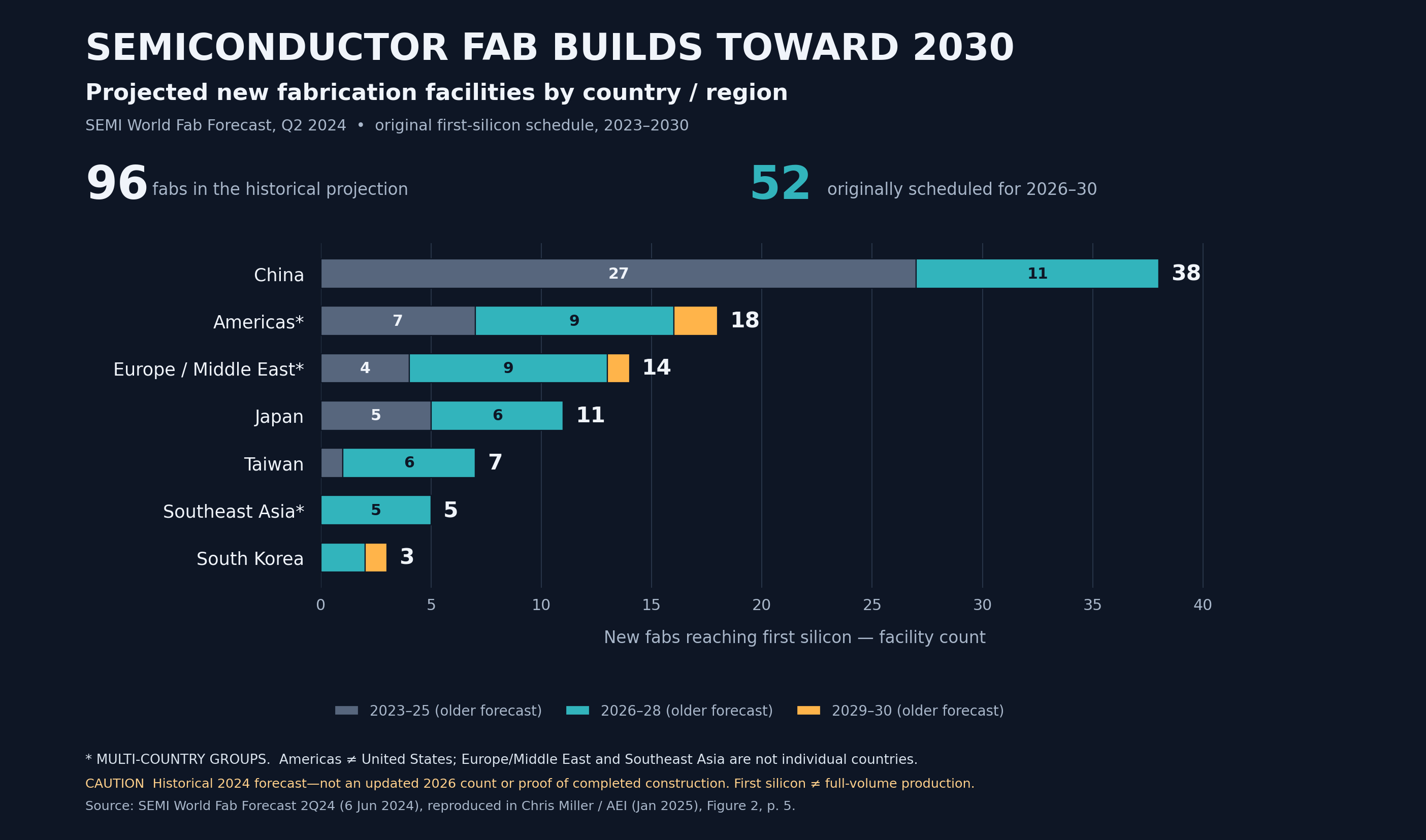
The geography matters. “Americas” includes more than the United States; Europe/Middle East and Southeast Asia each contain multiple countries. Assigning all 18 American-region fabs to the United States would overstate the evidence. The underlying country-level, project-by-project forecast is available in SEMI’s commercial database rather than the public figure.
A charted first-silicon target also can change. The data were assembled in 2024 and include facilities scheduled in years that have already passed. No 2026 audit confirms all 96 projects were built or entered production on time.
Newer SEMI research suggests a bigger pipeline
In a May 13, 2026 statement, SEMI reported 108 planned fabs worldwide expected to become operational during 2024–2028, based on its fourth-quarter 2025 forecast. The accompanying industry map assigned 84 to Asia, 16 to the Americas and eight to Europe/Middle East. SEMI estimated at least 30 additional fabs would be required by 2030 to satisfy projected demand, especially from AI.
The 30 facilities are an estimated future requirement, not announced or financed construction sites. Nor may the newer 108-fab forecast be added to the older 96-fab figure: the periods overlap and the underlying project schedules differ. SEMI’s third-quarter 2026 World Fab Forecast also tracks future facilities and production lines with varying probabilities, another category that should not be mislabeled as confirmed completed factories.
2030 wafer capacity tells a different story
A second measure estimates the share of commercial wafer-manufacturing capacity rather than counting buildings. The Boston Consulting Group and Semiconductor Industry Association’s May 2024 report projects mainland China at 22% of global 2030 capacity, South Korea at 19%, Taiwan at 17%, Japan at 15%, the United States at 13%, Europe at 8%, and other locations at 6%. The chart covers commercial facilities processing 200 mm or larger wafers, normalized for wafer size and excluding very small operations.
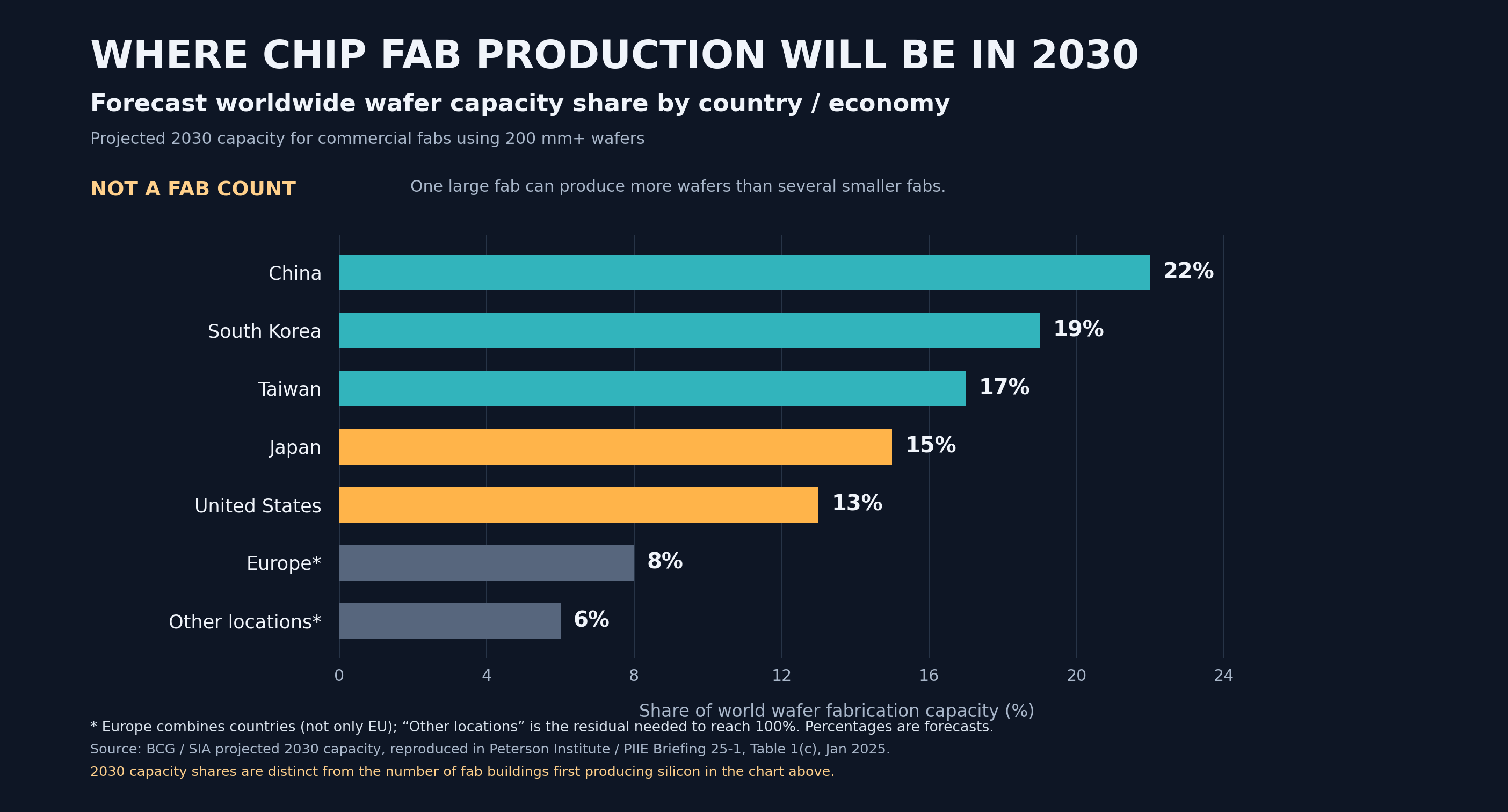
The percentages describe all qualifying commercial capacity expected in 2030, including capacity at existing factories—not merely fabs scheduled to open before the deadline. One advanced memory or logic megafab can add more wafer output than several smaller specialty plants. Production capacity also differs from chip revenue, commercial yield, advanced-node leadership and actual monthly wafer starts.
United States: advanced logic and new DRAM facilities
The United States is gaining major investments from foundries and memory suppliers. On its October 15, 2026 earnings call, TSMC reported that its second Arizona fab had completed building construction and was receiving equipment, with 3-nanometer volume production scheduled for the third quarter of 2027. A third Arizona facility remains part of the longer-term expansion. Such schedules remain company targets until actual production is confirmed.
Micron’s 2026 Form 10-K forecasts initial DRAM wafers from its first Boise, Idaho fab in mid-2027 and from a second Boise fab in late 2028. Micron started construction at Clay, New York in 2026 and expects initial wafer output from the first New York fab during 2030. The broader four-fab New York vision spans more than two decades; all four cannot reasonably be counted as producing by 2030.
Intel’s Ohio One construction update illustrates the schedule risk. The company planned to finish its first Ohio module in 2030 and begin operations between 2030 and 2031; its second module was targeted to begin operations in 2032. A finished building is not equivalent to a full production line. The workforce needed to operate new sites is another constraint, examined in BitcoinVersus.Tech’s coverage of America’s semiconductor technician training gap.
Taiwan and Japan target advanced-node manufacturing
TSMC also expects volume production from a new 3-nanometer fab in Tainan during the first half of 2027 and a further Tainan fab in the first half of 2028, according to the October 2026 earnings call. In Japan, its second Kumamoto fab is scheduled to move to 3-nanometer production during 2028. Equipment conversion inside operating fabs can increase output without adding a new factory to the construction chart.
Japan’s Rapidus IIM-1 project in Hokkaido began a 2-nanometer pilot line in April 2025 and targets mass production in 2027. Early transistor and pilot results do not guarantee mature commercial yields or customer volume. BitcoinVersus.Tech previously reported on Rapidus and its supplier ecosystem.
South Korea, Europe and the importance of chip type
South Korean manufacturers remain central to DRAM, NAND and high-bandwidth memory capacity, while China’s expanding mature-node and other facilities can raise its aggregate wafer share without making it the leading source of every advanced AI chip. Geography and technology mix matter more than a single global ranking.
Europe is investing in automotive, industrial, analog and power semiconductors. Infineon opened its €5 billion Smart Power Fab in Dresden on July 2, 2026, a completed construction milestone for advanced power and mixed-signal technologies. Other planned European projects still face the separate requirements of equipment installation, qualification and commercial ramp. BitcoinVersus.Tech previously distinguished semiconductor samples from verified commercial production.
What the industry should measure through 2030
The strategic race is not settled by architectural renderings, ceremonial groundbreakings or installed nameplate capacity. The decisive measurements are qualified wafer starts per month, manufacturing yield, node capability, utilization, equipment uptime, electricity and water availability, and reliable deliveries. Advanced equipment demand, described in BitcoinVersus.Tech’s Lam Research reporting, underpins the construction pipeline but cannot independently establish how many facilities become profitable.
Historical forecasts point to China leading the number of planned first-silicon milestones, while projected 2030 capacity shares show considerable strength across East Asia and growing U.S. investment. Neither chart is a real-time census. Readers tracking the fab race should revise the country rankings as manufacturers publish actual facility completions, first-wafer announcements and sustained high-volume output.
Editor’s Note: The first chart was reconciled against the year-by-year bars in Chris Miller’s AEI Figure 2, based on the SEMI World Fab Forecast from June 2024. Category totals are 38 + 18 + 14 + 11 + 7 + 5 + 3 = 96, of which 52 were originally forecast for 2026–2030. The second chart’s 2030 capacity percentages were checked against BCG/SIA Exhibit 7 and total 100%. SEMI’s May 2026 industry statement provides a newer, non-additive construction pipeline. Individual manufacturer dates come from official releases and regulatory documents. First silicon, building completion and commercial high-volume production remain distinct milestones. The featured cover is an original conceptual image, not a photograph of an identified fab. No unrelated video was added.

To donate 5,000 sats, open the article on a separate display and scan the original QR code with a compatible Bitcoin wallet. On mobile, use another screen or your wallet’s supported image-scanning feature. Verify the destination 3C9o19EH5HSiwEPyCTmEKzxhNCbo2X6TTb before sending.
We volunteer daily to ensure the information on this platform is Verifiably True. If you would like to support the research, please scan QR code.
BitcoinVersus.tech is not a financial advisor. Manufacturing and industry forecasts are informational and may change as companies revise capacity plans.


Leave a Reply