
ROSEVILLE, Calif. — Bosch’s July 13, 2026 manufacturing update confirmed that its California semiconductor plant had begun sample production of silicon-carbide chips. The company expected commercial production later in 2026, but the primary disclosures reviewed on November 3 do not establish completed customer qualification, full-volume shipments or a sustained factory yield. Those operating milestones matter as Bosch prepares a dedicated semiconductor division for January 2028.
The distinction is substantial: making trial chips proves a process can produce devices; manufacturing customer-qualified chips reliably and at a competitive cost requires repeatable yields, testing, packaging and delivery. Bosch acquired the existing Roseville fab in 2023 and is converting it into a 200-millimeter silicon-carbide power-device facility. The U.S. plant adds geographic diversity alongside Bosch’s established Reutlingen operation in Germany.
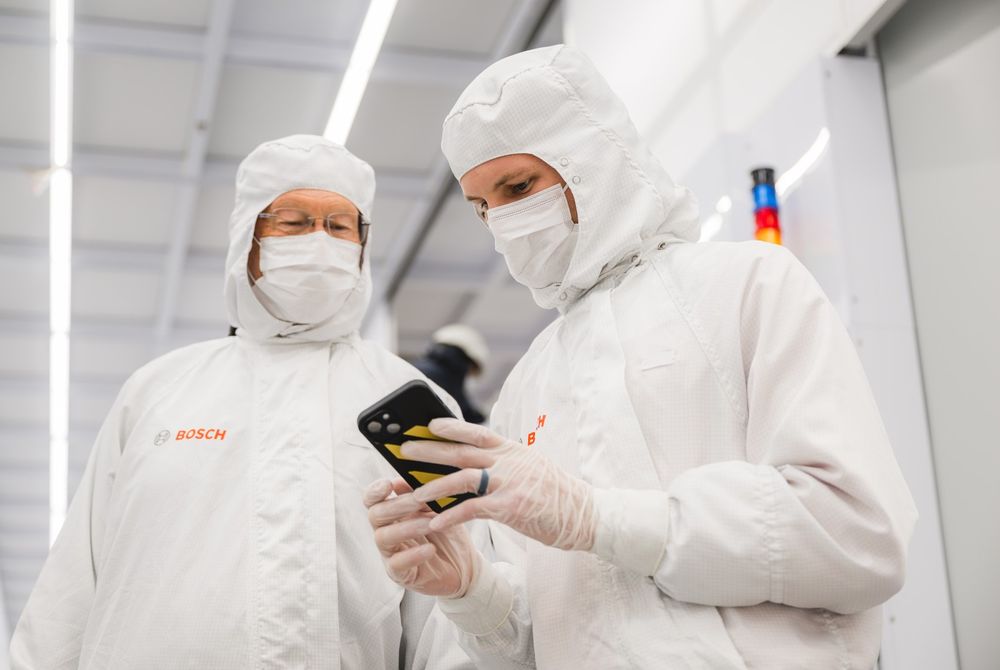
Bosch Global’s historical tour shows automated wafer processing at its Dresden 300-mm factory. Video: Bosch Global, March 2021. The Dresden footage illustrates fab operations; it does not document commercial SiC output at Roseville. Source video.
The investment and the production gap
The U.S. Commerce Department announced a signed direct-funding agreement on July 13 for up to $225 million in CHIPS Act incentives supporting Bosch’s approximately $2 billion Roseville conversion. An authorized maximum is not proof that every dollar has been paid. Federal support can lower project financing pressure, but it does not independently verify wafer throughput, device quality or profitable production.
Bosch says Roseville has new cleanroom infrastructure and specialized equipment for high-voltage silicon-carbide MOSFETs. The devices help regulate and switch electricity in electric vehicles, charging systems and industrial equipment. Unlike a central processor, a SiC power transistor does not run AI models; it may help reduce energy losses in power conversion systems.
Why the 200-mm wafer transition matters
According to Bosch’s manufacturing-network report, Reutlingen stopped producing its older 150-mm SiC wafers in May 2026, moving entirely to 200-mm SiC production. A 200-mm circular wafer has roughly 78% more gross surface area than a 150-mm wafer, before edge losses, die geometry and defects. Greater potential wafer area is not a measured 78% rise in saleable chips or factory output.
The company describes Roseville and Reutlingen as a future two-fab supply strategy, with manufacturing practices shared between German and American engineering teams. Bosch’s two-fab production account also identifies sample chips, product qualification and a planned commercial ramp as separate steps. For chip purchasers, two locations can support regional sourcing, provided both deliver qualified devices on schedule.
Silicon-carbide production is becoming more competitive. BitcoinVersus.Tech has reported on Wolfspeed’s 200-mm SiC wafers and Infineon and Eaton’s SiC work for 800-V data-center power. Meanwhile, Renesas’ GaN server and robotics devices illustrate alternative power-semiconductor approaches; GaN and SiC cannot be treated as interchangeable without considering voltage, frequency, thermal conditions and cost.
The practical scorecard for Roseville is now straightforward: public evidence of commercial start-up, qualification results, repeatable yields, customer shipments and utilization. Bosch’s new division may sharpen sales and foundry strategy by 2028, but manufacturing results will determine whether the California plant adds cost-effective capacity rather than only announced investment.
BitcoinVersus.Tech Editor’s Note: We volunteer daily to ensure the credibility of the information on this platform is Verifiably True. If you would like to support to help further secure the integrity of our research initiatives, please donate using the QR code provided

For best QR-code scanning results, please scan this donation code from a desktop or larger screen. Mobile screens may prevent camera recognition. Verify the receiving address 3C9o19EH5HSiwEPyCTmEKzxhNCbo2X6TTb before sending.
Disclaimer: BitcoinVersus.Tech is not a financial advisor. This media platform reports on financial subjects purely for informational purposes.


Leave a Reply