
Franklin Templeton’s Sandy Kaul argues that blockchain could become essential infrastructure for autonomous AI payments. In a July 21, 2026 essay, the investment firm’s digital-assets executive wrote that “Blockchain will be pivotal in allowing agentic AI to realize its potential.” The thesis remains relevant as Franklin’s October discussion of personal finance agents examines wallets, programmable permissions and machine payments.
Why an AI agent needs payment rails
Unlike a chatbot that drafts responses, an autonomous agent may purchase computing time, call paid APIs or arrange services. Kaul contends that card networks’ fixed fees make very small transactions difficult, while blockchain settlement and programmable wallets could automate authorization and accounting. The proposal intersects with Coinbase’s early AI-to-AI crypto payment demonstration and wallet infrastructure for autonomous agents.

The vision is economic as well as technical: software could pay software for data and services, with credentials and spending limits enforced by payment infrastructure. This does not mean that blockchain alone solves fraud, compromised agent keys or mistaken purchases.
Coinage’s August 4 interview with Sandy Kaul covers agentic AI, tokenization and why AI agents may require access to digital-asset payment networks.
A forecast range, not an adoption count
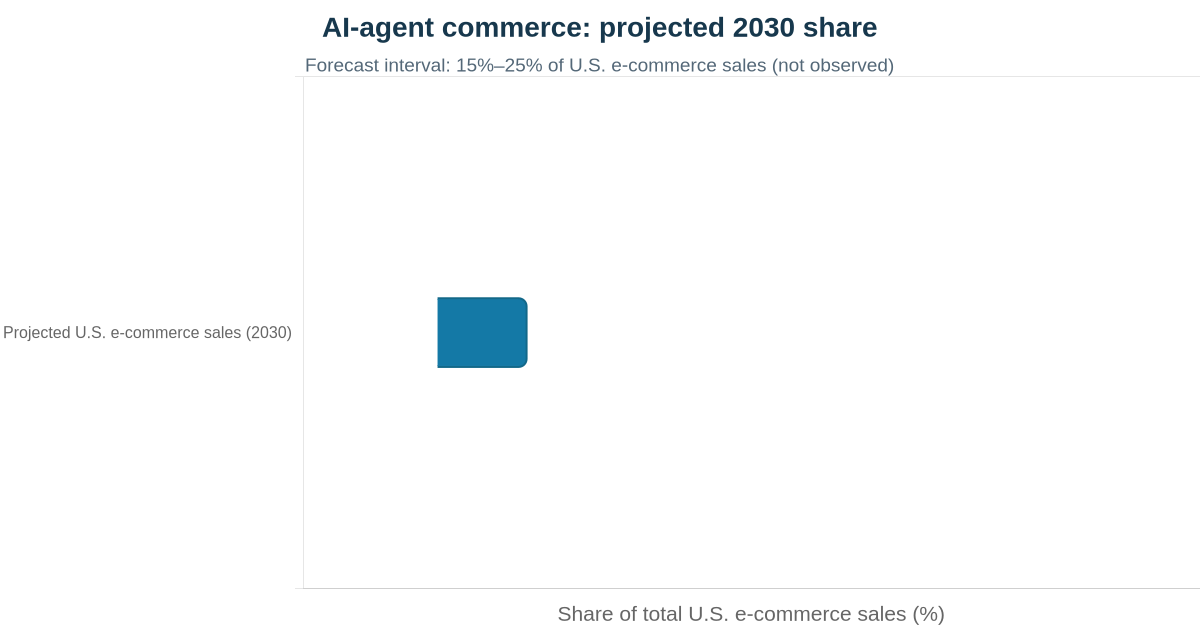
The essay cites an estimate that AI agents may account for 15%–25% of U.S. e-commerce sales by 2030. The figures describe a forecast interval, not a measured market share. They also do not establish that all such purchases would use cryptocurrencies. A range chart accurately communicates the uncertainty without manufacturing a historical series.
For technology readers, the practical mechanism matters more than a token-price forecast. Coinbase’s x402 approach uses HTTP payment instructions so an agent can pay for an online resource; other payment systems can also automate authorized purchases. Our coverage of AI agents using Bitcoin and stablecoins explores that distinction.
DevWorld 2026’s technical presentation demonstrates an HTTP 402 machine-payment flow, including agent authorization and on-chain settlement.
What would prove the prediction?
Evidence would include audited volumes, fees, failed-payment rates, consumer protections and actual usage across agent payment systems. The blockchain thesis is Franklin Templeton’s investment interpretation, not a demonstrated requirement for all AI commerce. As other executives discuss digital money for AI agents, the next question is which rails deliver safe, inexpensive transactions at useful scale.
BitcoinVersus.Tech
BitcoinVersus.Tech Editor’s Note: We volunteer daily to ensure the credibility of the information on this platform is Verifiably True. If you would like to support our work and help further secure the integrity of our research initiatives, please scan the QR code below to donate 5,000 sats. For best results, scan the QR code from a laptop or larger screen.

Bitcoin address: 3C9o19EH5HSiwEPyCTmEKzxhNCbo2X6TTb. On a phone, open the QR image on another screen or copy and verify the address in your wallet before sending.
BitcoinVersus.tech is not a financial advisor. This media platform reports on financial subjects purely for informational purposes.


Leave a Reply