Bitcoin can now pay for the AI computing that keeps a coding agent working. On November 12, 2026, Lightning Labs released pi402, an open-source extension that lets the Pi coding agent purchase model inference over the Bitcoin Lightning Network without a conventional account, credit card or buyer-managed API key. Broad adoption and independent reliability benchmarks remain unproven.
Lightning Labs’ official Wavelength wallet and Model Context Protocol demonstration shows how agents interact with Bitcoin payment tools. Earlier infrastructure footage, not a recording of the November 12 pi402 release.
How an AI agent pays for its own tokens
A model request triggers HTTP 402, meaning payment is required, with a Lightning invoice and authorization credential. The wallet checks its budget, pays, then retries the request. The service streams its answer.
Lightning Labs combines the existing L402 authentication protocol with its Wavelength wallet, Aperture payment gateway and Lightmeter pricing service. Aperture v0.6.0 also supports Machine Payments Protocol (MPP). Under L402, a macaroon credential tied to the invoice becomes usable with the payment preimage.
The extension offers per-request and daily spending limits. Sellers manage the model API and its credentials. Wavelength lets buyers pay without maintaining an always-online Lightning node.
What could the AI bill actually look like?
Rather than charging a flat amount for every prompt, the metering system tracks input and output tokens. Lightning Labs illustrates a rate of 1 millisatoshi per input token and 2 millisatoshis per output token. Since 1,000 millisatoshis equal one satoshi, a hypothetical request consuming 1,000 tokens of each type works out to 3 satoshis before any other charges. A larger request using 100,000 of each type yields 300 satoshis at the same example rates.
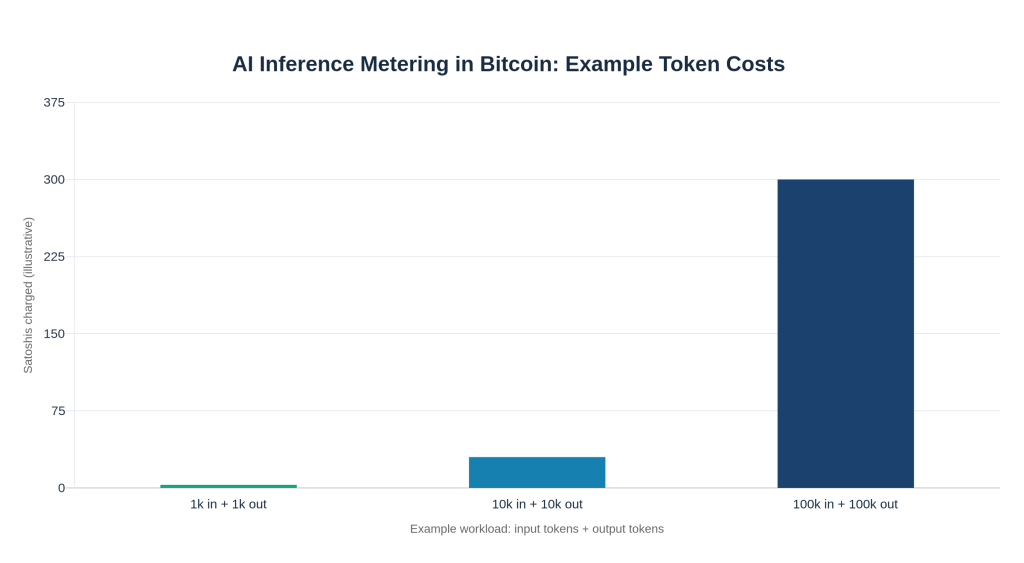
The chart gives arithmetic, not live prices. One payment can fund a token bundle, depleted as requests complete. Providers choose pricing, margins and terms.
Lightning Labs’ earlier official tutorial explains connecting Bitcoin payment capabilities to AI agents. Archival technology background rather than a new pi402 product demonstration.
Why pay GPU providers with Bitcoin?
AI inference uses compute capacity immediately, while conventional card transactions can later face chargebacks. Lightning Labs argues that rapid, final settlement reduces seller exposure and makes very small machine-to-machine purchases feasible. The trade-offs include bitcoin price volatility, possible routing or funding fees, wallet security and the difficulty of reversing mistaken payments.
A compromised agent could exhaust its allowance; faulty metering could overcharge users. Rate caps, scoped credentials and audits matter. Lightning is not necessarily cheaper or safer in every market.
A small launch with a bigger possible market
BitcoinVersus.Tech previously examined blockchain-based AI agent commerce and agent preferences for Bitcoin and stablecoin payments. The new release narrows that concept to a working open-source inference integration rather than claiming an entire autonomous economy already exists.
Developers interested in the underlying software can inspect the pi402 source code and official implementation guide. The buyer installation command is pi install npm:@lightninglabs/pi-402. Operators still need a compatible seller endpoint and funded wallet. For additional risk context, our AI API credential abuse report and LND accounting bug coverage demonstrate why payments and compute systems require ongoing testing.
Sources and methodology
- Lightning Labs, pi402 release announcement, November 12, 2026.
- Official pi402 documentation and sample pricing, accessed November 20, 2026.
- Lightning Labs pi-402 code repository and Aperture gateway repository.
- Wavelength mainnet launch documentation, October 23, 2026.
Reporting note: The featured oil painting is original conceptual artwork, not a screenshot of a live paid inference session. Both official Lightning Labs videos are earlier background demonstrations. The chart is a hypothetical calculation using disclosed demonstration rates, not a tested live billing quote. The underlying code and documentation were identified, but a paid mainnet inference transaction was not independently executed for the article.
We volunteer daily to ensure the credibility of the information on this platform is Verifiably True. If you would like to support to help further secure the integrity of our research initiatives, please scan the QR code below

BitcoinVersus.Tech publishes technology and financial journalism for information purposes only. Donations and Bitcoin transactions are voluntary and irreversible once settled.


Leave a Reply