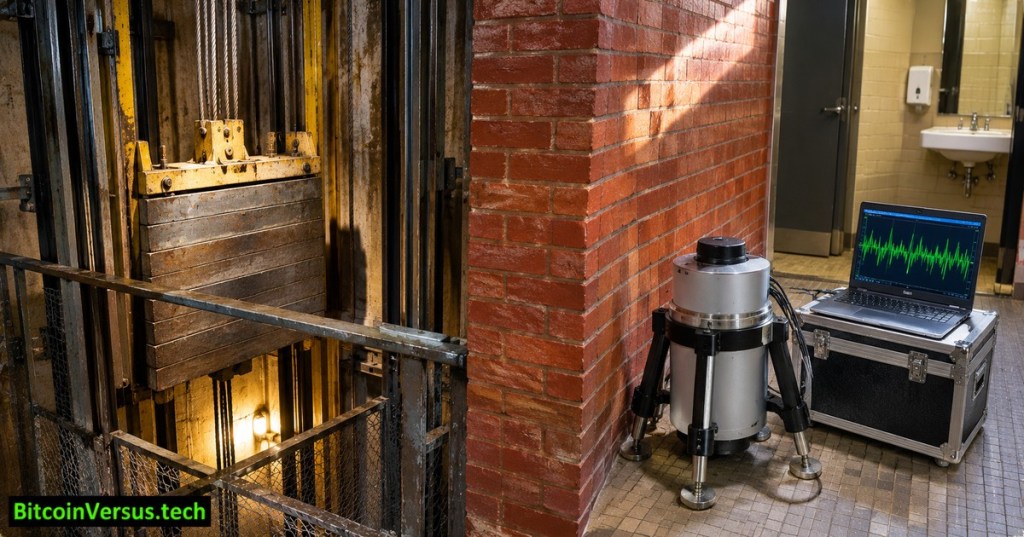
Scientists at the University of Queensland used an old elevator to transmit a word through a brick wall using gravity instead of radio waves. A 1.8-tonne counterweight supplied the signal; a sensitive gravimeter in a nearby bathroom decoded it. The received word was “Gravity.” The work was published in Science Advances in November 2026 and described in a University of Queensland announcement on November 19.
Each elevator trip moved the counterweight between two positions representing binary zero and one. Gravity passes through ordinary materials without the electromagnetic shielding that can stop radio signals. The team demonstrated communication across approximately 0.7 meter through brickwork at one bit per minute, far slower than any practical wireless network.
Original technical talk by UQ researchers Andrew Groszek and Charles Woffinden, delivered to the Australian Society of Exploration Geophysicists in October 2025. The speakers explain the same gravitational communication experiment before its 2026 journal publication.
How an elevator became a transmitter
The word “Gravity” contains seven characters, or 49 bits in seven-bit ASCII. The researchers also sent seven alternating framing bits before and after the message, making 63 transmitted bits, with additional periods used to collect baseline measurements. The elevator movement and sensor settling time dictated the slow pace.
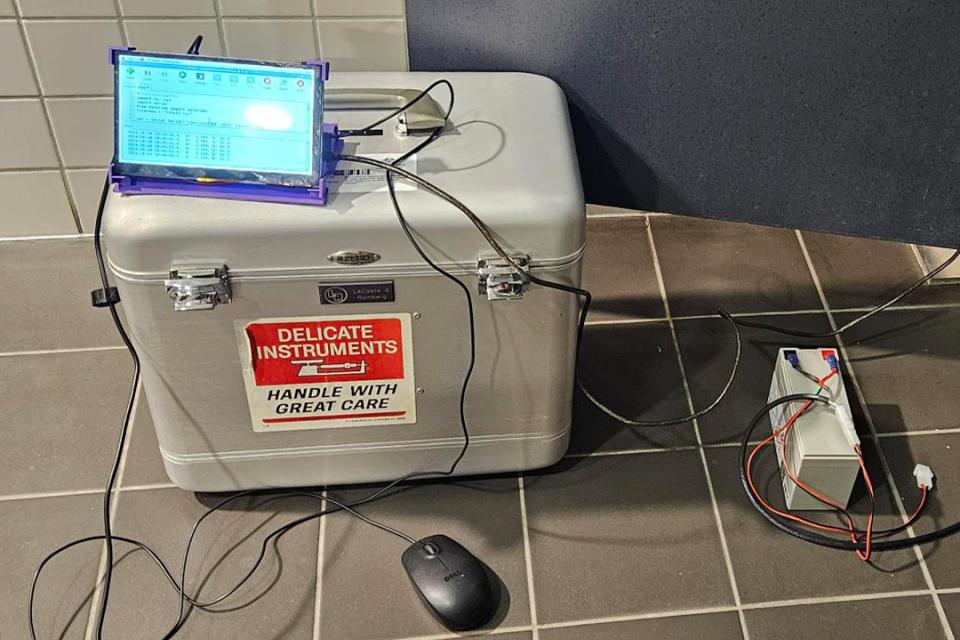
The experiment did not generate gravitational waves or use an exotic quantum transmitter. Moving an ordinary heavy mass changes the local gravitational field according to Newtonian physics. A commercial LaCoste and Romberg Model D spring gravimeter registered tiny changes in the vertical gravitational acceleration, allowing the team to distinguish counterweight positions.
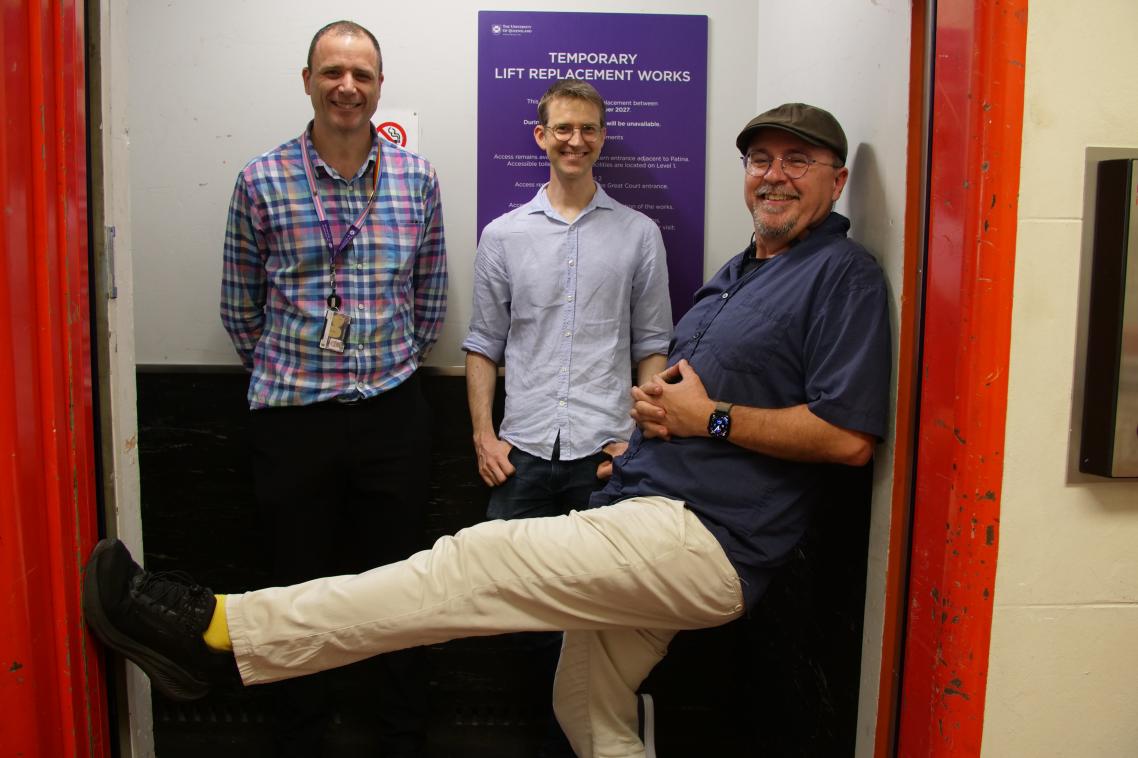
The paper reports a signal difference of roughly 50 nanometers per second squared, with measurements corrected for sensor drift and Earth tides. A gravitational field reaches through the barrier, but its signal becomes rapidly weaker with distance. The researchers therefore positioned the counterweight only about 0.68 meter from the instrument at its closest point.
The underlying idea began as research into measuring truck mass without driving vehicles onto a conventional weighbridge. UQ researchers discovered that carefully recording a vehicle’s gravitational pull could help estimate its mass and distribution. Encoding information through similar gravity measurements became a second experiment.
Why gravity cannot be screened, but signals can fail
A crucial distinction concerns the term “unblockable.” Ordinary shielding cannot cancel gravity in the way a Faraday cage blocks electromagnetic radiation. However, a message can still become unreadable when the signal is too faint, detectors are disturbed or an adversary interferes with measurements. The experiment establishes physical transmission through a wall, not a jam-proof, private or commercially useful network.
UK Quantum Technology Hub gravity-sensing explainer produced by Beeston Media, January 2025. Context for gravimetry, not footage of the Queensland experiment.
Researchers examined larger configurations and more sensitive instruments. A model incorporating a mass around 75,000 kilograms, better geometry and improved gravimetry predicts a possible range approaching 500 meters. A faster elevator with a more advanced classical gravimeter was separately estimated to support around 15 bits per minute. Neither scenario was demonstrated experimentally, and those numbers describe different hypothetical improvements.
What the experiment actually proved
The peer-reviewed publication appeared in November 2026, although an author manuscript was posted in November 2025. Two team members had already discussed the work in an October 2025 technical presentation. The new milestone is the journal publication and public release of the validated experiment, not an elevator suddenly becoming a replacement for broadband.
Gravity communication remains a scientific proof of principle. Its main value lies in revealing another channel for transmitting information under physical constraints. Related BitcoinVersus.Tech coverage explains elevator mechanisms, quantum sensing for GPS-independent navigation, tests of gravitational physics and security upgrades to conventional networks. The technologies operate through different mechanisms and face very different engineering limits.
For now, the strongest result is a seven-letter word received through a wall without light, sound or radio communication doing the work. The experiment demonstrates a real but exceptionally slow gravitational data channel, with many technical hurdles separating the laboratory result from any practical application.
Primary research and original media
- University of Queensland original research announcement, November 19, 2026, with photographs
- Groszek and colleagues, “Unblockable communication with gravity,” Science Advances, November 2026
- Author manuscript, November 2025
- ASEG Videos, Weighing heavy objects and communicating with gravity, October 27, 2025, presented by two UQ researchers
- Beeston Media for UK Quantum Technology Hub, Gravity Sensing, January 2025
Editor’s Note: We volunteer daily to ensure the credibility of the information on this platform is Verifiably True. If you would like to support to help further secure the integrity of our research initiative, please scan the QR code below.

For mobile scanning, open the article on another display and scan the QR code using a Bitcoin wallet. Verify the receiving address 3C9o19EH5HSiwEPyCTmEKzxhNCbo2X6TTb before sending.
BitcoinVersus.Tech publishes science, technology and engineering journalism for informational purposes. Projected sensor capabilities and communication ranges are research estimates, not deployment specifications or engineering advice.


Leave a Reply