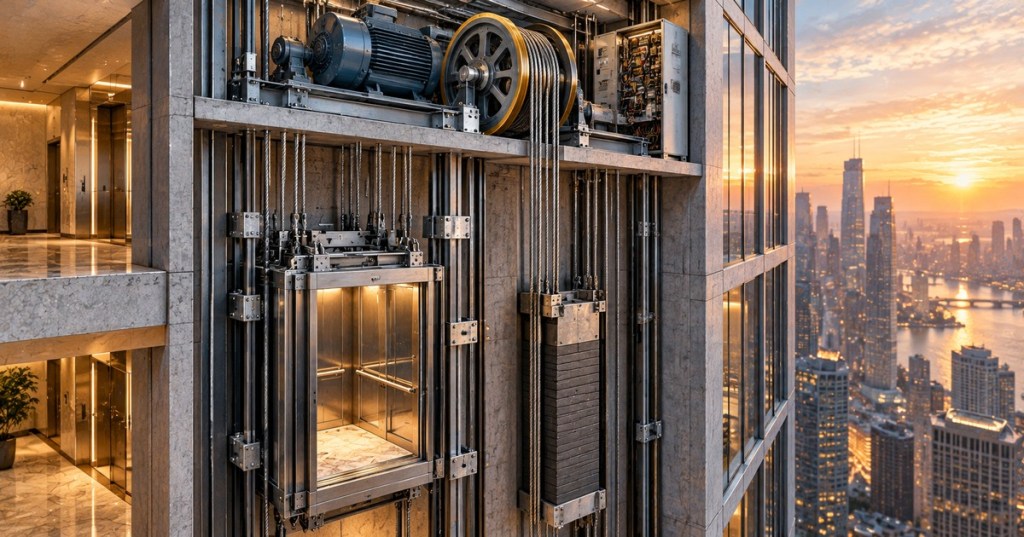
An elevator is a controlled vertical transportation machine that balances mass, manages motion, and layers multiple safety systems around every trip. The basic job sounds simple—move a car up and down a shaft—but a modern elevator has to accelerate smoothly, stop within centimeters of a floor, keep doors locked at the wrong times, handle power loss, detect overspeed, and do all of that while carrying people thousands of times per day.
The most common high-rise design is the traction elevator. It uses an electric motor to turn a traction sheave, while ropes or flat belts connect the elevator car to a counterweight. The car and counterweight move in opposite directions, which dramatically reduces how much work the motor must do.
The Elevator Car Is Only One Part Of The System
Passengers mostly see the car, doors, buttons, display, and maybe a security camera. Hidden behind the walls are guide rails, suspension ropes or belts, a counterweight, drive machine, brakes, sensors, door interlocks, buffers, and a controller that coordinates the system.
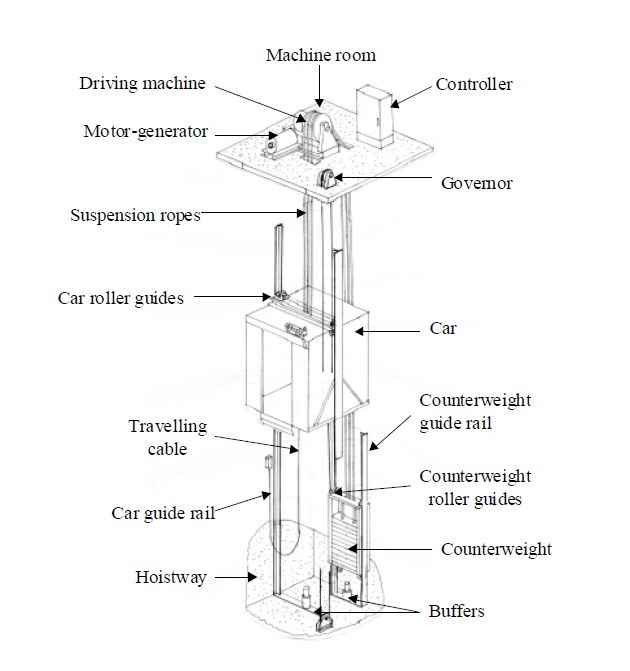
Otis describes the core traction arrangement as a car and counterweight connected by ropes or belts that pass over a machine sheave. As the car rises, the counterweight descends; when the car descends, the counterweight rises. That see-saw relationship is the foundation of the system. Otis explains the same basic arrangement here.
Why Elevators Use A Counterweight
If a motor had to lift the full mass of a loaded elevator car from the bottom of a skyscraper every time, it would need to be much larger and consume much more energy. The counterweight offsets much of the car’s mass so the motor mainly handles the difference between the two sides plus friction and acceleration.
The counterweight is typically sized around the empty car plus a portion of the rated passenger load. That means the system is reasonably balanced during ordinary operation rather than only when the car is empty or completely full.
This is a useful example of energy-efficient engineering: instead of overpowering gravity with a huge motor, the system balances gravity against itself. A related idea appears in regenerative braking, where a motor can reverse its energy flow instead of throwing all motion away as heat.
The Motor Turns A Traction Sheave
At the top of many traction systems is an electric drive machine. The motor turns a grooved wheel called the traction sheave. Suspension ropes or belts wrap around the sheave, and friction between the sheave and those suspension members transmits the motor’s torque into vertical motion.
The elevator car does not simply hang from one cable like a bucket on a crane. Modern systems use multiple ropes or belts, and the suspension arrangement is engineered with substantial redundancy and safety margin.
This engineering walkthrough shows the traction motor, sheave, suspension system, counterweight, brakes, governor, and other safety layers inside a modern elevator.
The Controller Decides When And How The Elevator Moves
The controller is the elevator’s decision-making system. It receives calls from hallway buttons, commands from inside the car, position information from sensors, door status, speed feedback, safety-chain signals, and sometimes instructions from a building-wide destination-control system.
Older elevators used large banks of relays to implement control logic. Modern elevators use microprocessor-based controllers and variable-frequency drives. The controller tells the drive how much torque and speed to command, then continuously watches feedback while the car accelerates, cruises, decelerates, and levels at the destination floor.
That control loop connects directly with broader industrial automation concepts such as power quality, sensors, motor drives, and real-time control systems.
How An Elevator Knows Where To Stop
Elevators do not estimate floors by timing the motor. They use position and speed information so the controller knows where the car is in the hoistway and how quickly it is moving.
As the car approaches a destination, the drive reduces speed according to a planned motion profile. The system then enters a leveling phase so the car floor aligns closely with the landing. Accurate leveling matters for comfort, accessibility, carts, wheelchairs, and safe entry and exit.
Modern systems can use encoders, hoistway sensors, magnetic position references, and other feedback devices. The exact implementation varies, but the principle is consistent: position is measured, not guessed.
The Doors Are Part Of The Safety System
One of the most important rules in elevator operation is that landing doors should not normally open when the car is not safely positioned at that landing. Door interlocks physically and electrically enforce that condition.
The controller also needs confirmation that required doors are closed and locked before normal travel begins. If the safety chain is incomplete, the drive should not simply ignore it and continue the trip.
This is why elevator doors are more than automatic sliding doors. They are integrated safety devices with switches, locks, operators, sensors, and control logic.
What Happens If The Power Goes Out
A power failure does not mean the motor suddenly releases the elevator into free fall. Modern traction elevators use brakes that are typically spring-applied and electrically released. When electrical power disappears, the brake is designed to apply rather than release.
Some buildings also have emergency-power or rescue systems that move the car to a landing so passengers can exit. The exact behavior depends on the elevator and building design.
Why A Broken Rope Does Not Mean Instant Free Fall
The movie version of elevator failure usually shows one cable snapping and the car immediately plummeting. Real elevators use multiple suspension members and independent safety systems.
Otis describes a layered safety chain that includes the controller, machine brake, overspeed governor, car safety gear, and buffers. The governor continuously monitors speed; if the car exceeds its designed speed, the system can initiate braking and mechanically activate safety gear that grips the guide rails. Otis details those high-rise safety layers here.
Buffers at the bottom of the hoistway provide another energy-absorbing layer for extreme conditions. No single component is expected to carry the entire safety burden.
Guide Rails Keep The Car On A Controlled Path
The elevator car and counterweight travel along rigid guide rails mounted vertically inside the hoistway. Roller guides or sliding guide shoes keep both moving along those rails while allowing smooth vertical travel.
The rails do more than keep the car from swinging. They also provide the surfaces that certain emergency safety mechanisms can grip if an overspeed event occurs.
Hydraulic Elevators Work Differently
Not every elevator uses traction and a counterweight. Hydraulic elevators use pressurized fluid and a piston to raise the car. They are common in shorter buildings because the system can be mechanically straightforward, but they typically move more slowly and scale differently than high-rise traction systems.
Traction elevators dominate taller buildings because ropes or belts, counterweights, and efficient drive systems are better suited to long vertical travel.
Elevator technology is not limited to skyscrapers; compact domestic lift systems use the same broader goal of controlled vertical transportation, adapted to much smaller buildings.
Modern Elevators Can Regenerate Energy
When gravity is helping the elevator move—for example, when a heavily loaded car descends or a lightly loaded car rises against a descending counterweight—the drive motor can operate as a generator. Regenerative drives can convert some of that mechanical energy back into electrical energy for the building instead of wasting all of it as heat.
The principle is closely related to regenerative braking in electric vehicles: the motor does not stop being useful when energy flow reverses.
Why Elevators Feel So Smooth
Passenger comfort depends heavily on controlling acceleration and jerk—the rate at which acceleration changes. A car that instantly jumps from zero to full speed would feel terrible even if its maximum speed were perfectly safe.
Modern drives ramp torque and speed through carefully shaped motion profiles. That is why a well-tuned elevator starts gently, accelerates, cruises, decelerates, and settles into the floor without a hard mechanical shock.
The Practical Takeaway
The easiest way to understand a modern traction elevator is as a balanced electromechanical control system:
- The car carries passengers or freight.
- The counterweight balances much of the moving mass.
- The motor and traction sheave move ropes or belts.
- The controller and drive manage speed, direction, leveling, and calls.
- The guide rails keep the car and counterweight on a fixed path.
- The brakes, governor, safeties, interlocks, and buffers provide overlapping protection.
An elevator looks simple from inside because nearly all of its complexity is hidden. Behind the doors is a machine that balances gravity, electric power, mechanical motion, real-time control, and multiple independent safety systems every time someone presses a button.


Leave a Reply