
A research consortium has connected Chicago, Amsterdam and the Bilbao area in Spain through an approximately 8,000-kilometer quantum-safe network demonstration. Presented at the SC26 supercomputing conference on November 18, 2026, the experiment combined quantum key distribution with post-quantum cryptography instead of attempting to send fragile quantum signals beneath the Atlantic Ocean.
The project brought together Luxquanta, the University of the Basque Country, Ciena, GÉANT, Poland’s Poznań Supercomputing and Networking Center, RedIRIS and SURF. Their shared objective was to show that one security framework could protect optical equipment, internet tunnels and even a video call while selecting key technology appropriate for each network segment. The results are a conference demonstration, not a verified production rollout protecting all transatlantic traffic.
Ciena’s official February 11, 2026 demonstration overview of its 1.6 Tb/s quantum-safe optical encryption platform. Background on the hardware, not footage from the November SC26 test.
Why quantum keys did not cross the ocean
Quantum key distribution, or QKD, uses specially prepared light to establish shared secret keys and detect certain forms of interception. In the SC26 design, Luxquanta’s Nova LQ equipment operated across two relatively short fiber links: about 800 meters between exhibition booths in Chicago and 25 kilometers between sites in Bilbao and nearby Zamudio.
The longer legs were fundamentally different. The connection from Spain to Amsterdam, roughly 1,200 kilometers, and the Amsterdam-to-Chicago route, roughly 7,000 kilometers, relied on post-quantum cryptography, including algorithms designed to resist future cryptanalytic quantum computers. No experiment established QKD over the full 8,000 kilometers of fiber. The protection was hybrid by design.
Modern post-quantum systems generally exchange keys through mathematical protocols such as ML-KEM over conventional data networks. Unlike QKD, they do not require quantum optical signals to survive the entire distance. Our earlier post-quantum cryptography explainer covers the distinction.
An optical network can encrypt data at high speed
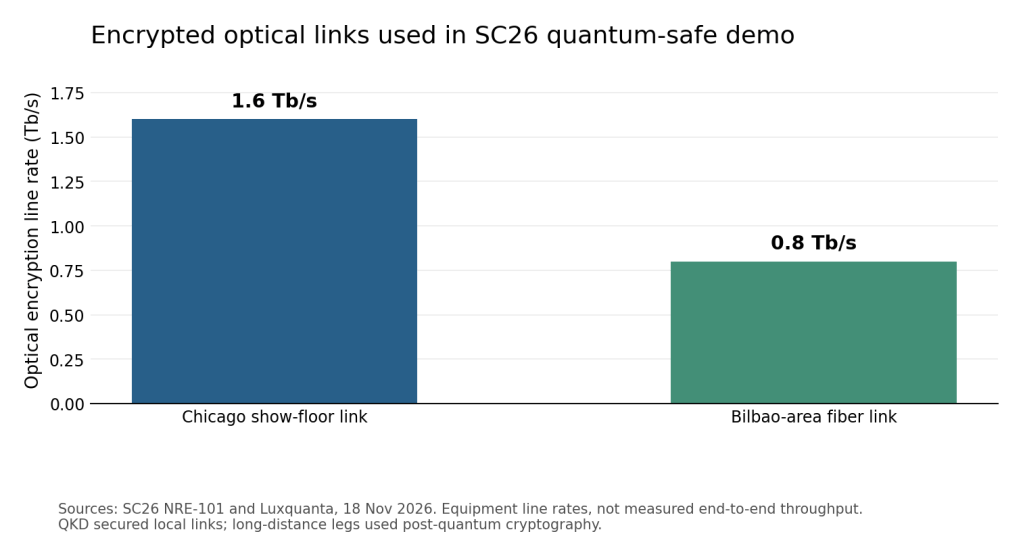
Ciena’s WaveLogic 6 Extreme encrypted optical connection in Chicago operated with a reported 1.6 Tb/s line rate; the WaveLogic 5 Extreme link near Bilbao used 800 Gb/s. Ciena’s platform encrypted ordinary data while supporting keys derived from QKD and post-quantum mechanisms. Those are equipment capabilities, not a claim that encrypted application traffic crossed the Atlantic continuously at 1.6 Tb/s.
The three security layers served different functions. Optical-layer encryption protected traffic on compatible fiber links. IPsec secured network tunnels between sites. A modified open-source video-calling application used the key-management infrastructure to protect audio and video. A functioning call demonstrates integration, not immunity against endpoint compromise.
June 4, 2026 interview with LuxQuanta CEO Vanesa Díaz about practical quantum-key distribution. Original-source executive commentary supplied by Rivela Universe; recorded before the Chicago-Europe demonstration.
The important innovation is key management
The University of the Basque Country developed QuLore to coordinate multiple key-management systems and choose an available quantum-safe method. SURF’s eduKMS and the university’s own service helped relay and deliver keys across administrative boundaries. A standard interface was central to integrating different providers without treating every location as an identical optical link.
The architecture also comes with limitations. QKD equipment is expensive to deploy and has distance, optical-noise and trusted-node constraints. Post-quantum algorithms remain subject to implementation defects and cryptanalysis. The demonstration did not establish that endpoints, key managers or transport equipment were impossible to compromise. Independent, long-duration tests will be necessary to quantify reliability, operating costs and security under attack.
For comparison, BitcoinVersus.Tech previously covered Germany’s QuNET trial, Ciena and Internet2’s separate 800G optical milestone and post-quantum software updates for Linux. Each tackles a different level of the same migration challenge.
What the demonstration proves
The practical achievement is interoperability: existing optical-network hardware, QKD sources and post-quantum key systems worked together across a multinational research setup. The project shows how operators might extend quantum-safe protection without waiting for long-distance quantum repeaters. Its 8,000-kilometer figure describes the geographic hybrid network, not the distance traveled by a single quantum photon or proof of unbreakable communications.
Primary reporting and technical sources
- Luxquanta, November 18, 2026, consortium demonstration announcement
- PSNC, November 19, 2026, QuLore network demonstration
- SC26 Network Research Exhibition, QuLore NRE-101 official listing
- University of the Basque Country, November 19, 2026, participant report
- ITU-T, June 2026, hybrid quantum-safe key-management overview
Editor’s Note: We volunteer daily to ensure the credibility of the information on our platform is Verifiably True. If you would like to support our work and the integrity of our research initiatives, scan the QR code below to donate 5,000 sats.

For mobile scanning, open the article on another display and scan the QR code with a Bitcoin wallet. Verify receiving address 3C9o19EH5HSiwEPyCTmEKzxhNCbo2X6TTb before sending.
BitcoinVersus.Tech provides technology, security and engineering journalism for informational purposes and does not provide financial, investment, legal or cybersecurity consulting advice.


Leave a Reply