
Germany connected experimental quantum-communications networks across Bavaria, Thuringia and Berlin on October 28, 2026, during a demonstration led by federal research minister Dorothee Bär. The QuNET research initiative, backed by €125 million in German government funding since 2019, tested whether different regional systems can exchange security keys across an interconnected network.
Researchers first activated regional nodes in Erlangen, Erfurt and Berlin. Bär then initiated their connection from the Berlin demonstration site. The experiment brought together Fraunhofer IOF and HHI, the Max Planck Institute for the Science of Light, the German Aerospace Center and Friedrich-Alexander University Erlangen-Nürnberg.
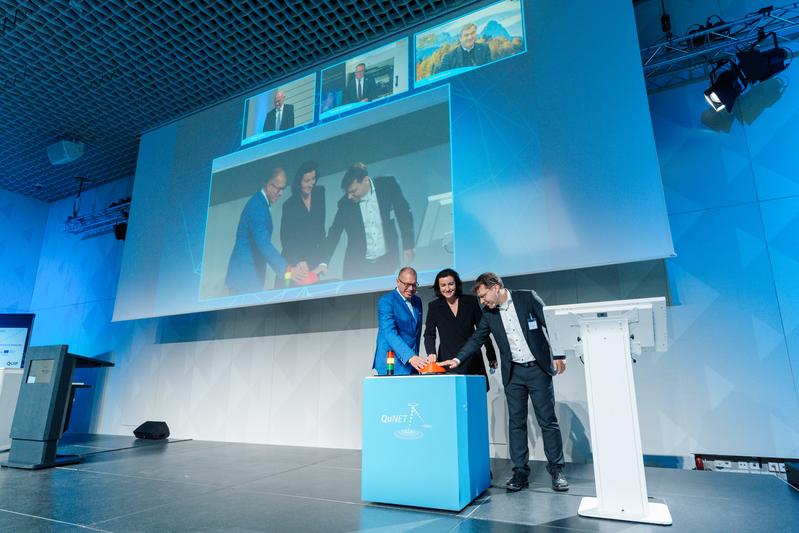
How the quantum network was tested
The live exercise sent fictitious pharmacy invoices from Jena University Hospital through DATEV to the Bundesdruckerei federal printing company. The information traveled over conventional optical-fiber communications infrastructure; quantum key distribution, or QKD, supplied a way to establish encryption keys and detect some forms of interception.
That distinction matters. QKD does not mean documents were transported as quantum particles, and the trial was not evidence that a nationwide commercial service has launched. The network showed interoperability between multiple research installations rather than a finished security product.
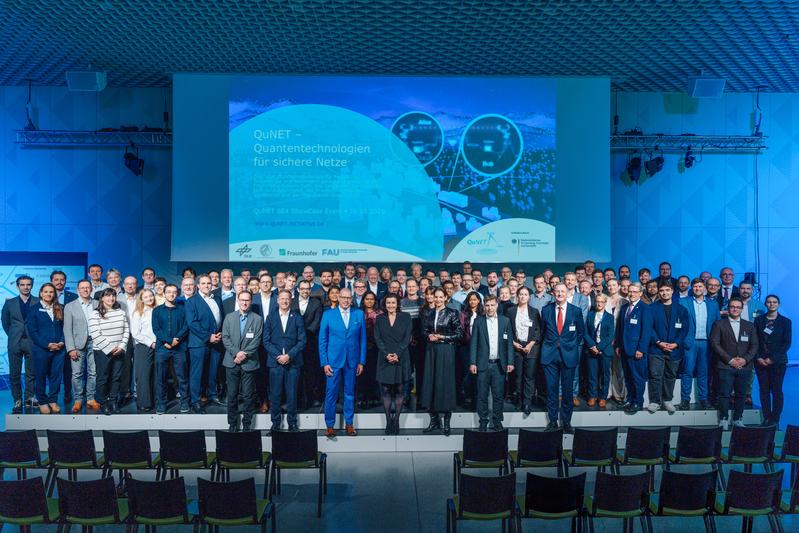
Seven years of communications research
Earlier experiments included a government-district connection in Bonn in 2021, a hybrid free-space and fiber test in Thuringia in 2023, a multinode Berlin network in 2024 and an airborne quantum-network node in Bavaria in 2025. The final demonstration combined elements of that longer engineering program.
For network operators, adoption would depend on specialized optics, key management, trusted equipment and interoperable infrastructure. That creates a different engineering challenge from post-quantum algorithms implemented in conventional chips. Both approaches seek to address future cryptographic threats, but they are not interchangeable.
The work also sits alongside advances in denser optical fiber and optical interconnect technology, although neither automatically supplies QKD security. Reliability, cost, distance and certification still determine whether research systems can become ordinary production networks.
The accompanying QuNET+ program has supported twelve projects developing detectors, lasers, optical routing, security testing and standardized interfaces. Its next challenge is moving those components toward independent evaluation and deployable products. Related quantum-security investments demonstrate growing industry interest, not proof that QuNET equipment is commercially ready.
BitcoinVersus.Tech
BitcoinVersus.Tech Editor’s Note: We volunteer daily to ensure the credibility of the information on this platform is Verifiably True. If you would like to support our work and help further secure the integrity of our research initiatives, please scan the QR code below to donate 5,000 sats. For best results, scan the QR code from a laptop or larger screen.

Bitcoin address: 3C9o19EH5HSiwEPyCTmEKzxhNCbo2X6TTb. On a phone, open the QR image on another screen or copy and verify the address in your wallet before sending.
BitcoinVersus.tech is not a financial advisor. This media platform reports on financial subjects purely for informational purposes.


Leave a Reply