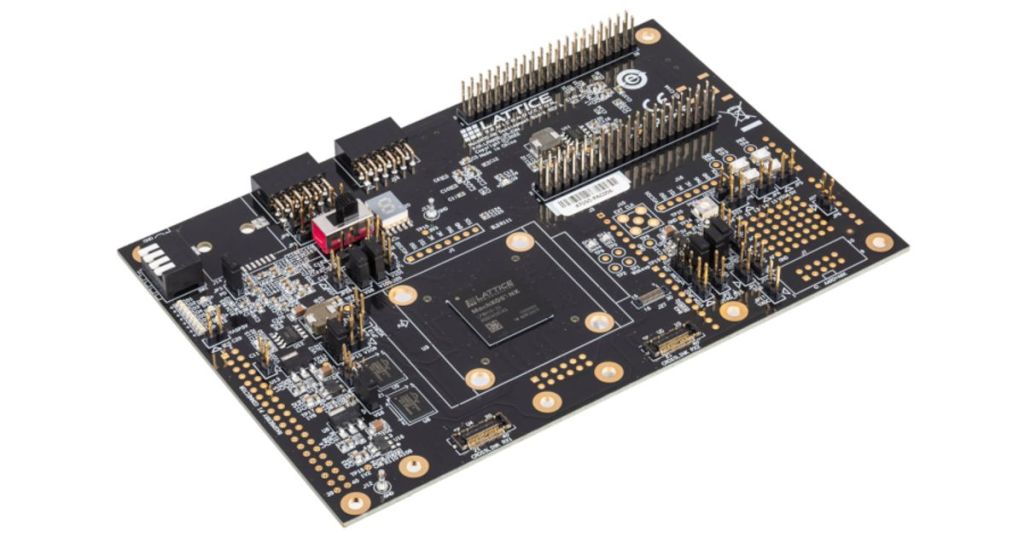
Lattice Semiconductor is pushing post-quantum cryptography down into one of the least glamorous but most important places in a modern computer: the small programmable device that helps control and secure the rest of the board. Its MachXO5-NX TDQ family has just won a 2026 CyberSecurity Breakthrough Award after becoming what Lattice describes as the industry’s first secure-control FPGA family with full CNSA 2.0-compliant post-quantum cryptography.
The award itself is not the most interesting part. The hardware is. MachXO5-NX TDQ combines a field-programmable gate array with a hardware root of trust, classical cryptography, post-quantum algorithms, secure boot, key management and the ability to update cryptographic algorithms in the field. Lattice is targeting compute, communications, industrial and automotive systems where the security component may remain deployed for years.
Lattice originally introduced the family in October 2025 and says the devices are already shipping. The October 8, 2026 award gives the platform another spotlight at a moment when governments and infrastructure operators are trying to move post-quantum security from standards documents into real hardware.
Why an FPGA is part of the security chain
An FPGA is a chip whose logic can be configured after manufacturing. In servers, networking equipment and industrial systems, smaller control FPGAs often handle jobs such as power sequencing, board management, monitoring, configuration and secure startup. That puts them in a privileged position: they can become one of the first components active when a system powers on and one of the last to shut down.
Lattice describes its secure-control devices as “first-on/last-off” components. That makes the FPGA a natural place to anchor a chain of trust before the main processor, operating system or application software begins running. If the control device can verify firmware and configuration before execution, it can help prevent a compromised image from becoming the foundation of the rest of the system.
That concept connects directly to the wider hardware-security problem BitcoinVersus has covered across motherboards, digital hardware and software infrastructure: trust ultimately has to begin somewhere below the application layer.
The post-quantum part is ML-KEM and ML-DSA
The MachXO5-NX TDQ family supports the modern post-quantum algorithms ML-KEM for key establishment and ML-DSA for digital signatures, alongside hash-based signature schemes including LMS and XMSS. Lattice also lists AES-256, SHA-2, SHA-3 and SHAKE among the broader cryptographic functions available in the family.
ML-KEM and ML-DSA are important because they are designed around mathematical problems believed to remain difficult even for sufficiently powerful quantum computers. They are not “quantum encryption” in the sense of needing quantum hardware. They are conventional algorithms intended to run on normal digital systems while resisting the classes of attacks that make large quantum computers threatening to some current public-key cryptography.
For infrastructure with long service lives, migration has to begin well before a cryptographically relevant quantum computer exists. Equipment installed today may still be running years from now, and encrypted data captured today may remain valuable long enough for future decryption attacks to matter.
Crypto-agility may be just as important as the algorithms
The most practical feature may be what Lattice calls crypto-agility. Cryptographic standards change. Algorithms can be weakened, parameters can be revised, and governments can alter approved suites. Hardware that hard-wires a single algorithm for a 10- or 15-year deployment can become a liability.
Lattice says MachXO5-NX TDQ supports in-field algorithm updates with anti-rollback protection. That means a system can move forward to newer cryptographic implementations while preventing an attacker from deliberately forcing the device back to an older vulnerable version.
This is one reason programmable logic makes sense for a security role. The device can still behave like a tightly controlled hardware component, but parts of its cryptographic behavior can evolve as standards change.
Secure boot is where this becomes concrete
A root of trust has to do more than hold algorithms. It needs to establish whether the rest of the system should be trusted. MachXO5-NX TDQ supports authenticated and encrypted configuration bitstreams, integrated nonvolatile memory, unique device secrets, key hierarchies and controls for programming interfaces such as SPI and JTAG.
In practice, that allows the device to participate in secure boot and attestation. The FPGA can verify that firmware or configuration data is signed by an authorized party before allowing the system to proceed. Lattice also supports Device Identifier Composition Engine and SPDM-related functions for device identity, attestation and secure component communication.
The goal is to make compromise harder before the main CPU has even loaded its operating system. That is especially relevant in servers, network appliances and industrial equipment where board-management controllers and firmware have become attractive targets.
The FPGA is small, but its trust domain can be large
Lattice’s MachXO5-NX family is not trying to replace a server CPU or accelerator. The devices sit in a different layer of the system. Current variants span tens of thousands of logic cells and integrate embedded memory, flash, general-purpose I/O and, in some devices, PCIe Gen2 and 5 Gbps SERDES connectivity.
That is enough programmable logic to supervise a much larger platform. A secure-control FPGA can monitor resets, manage sequencing, authenticate firmware, isolate interfaces and act as an independent enforcement point around components that are far more computationally powerful than the FPGA itself.
Post-quantum migration is becoming a hardware problem
Post-quantum cryptography is often discussed as a software-library upgrade: replace one key-exchange algorithm, update certificates, roll out new TLS support and move on. Long-lived infrastructure is more complicated. Keys, identities and trust anchors may exist inside firmware, secure elements, boot ROMs, management controllers and programmable logic.
That means the transition eventually reaches circuit boards. Servers, telecommunications systems, vehicles and industrial controllers need a way to verify that the firmware controlling physical hardware remains authentic even as cryptographic standards evolve.
Lattice’s latest award is therefore less interesting as a trophy than as evidence of where the industry is heading. Post-quantum security is moving from research papers and cloud libraries toward components that can sit on a real motherboard and participate in the system’s boot process.
Quantum-safe does not mean permanently safe
No vendor can guarantee that a cryptographic algorithm will remain secure forever. New mathematics, implementation mistakes, side-channel attacks and future standards changes can all alter the risk. That is why the update path matters so much.
The strongest interpretation of “post-quantum ready” is not that one chip has solved cybersecurity for the quantum era. It is that the platform can authenticate itself with current approved algorithms, protect keys in hardware and still adapt when the approved cryptographic stack changes again.
That is what makes MachXO5-NX TDQ worth watching: the post-quantum transition is becoming something engineers can physically place on a board, power up and build into a chain of trust today.
Editor’s note: Product capabilities and algorithm support are based on Lattice Semiconductor documentation. “Industry-first” and similar positioning are manufacturer claims.
Disclaimer: BitcoinVersus.Tech publishes technology and cybersecurity news for informational and educational purposes.


Leave a Reply