
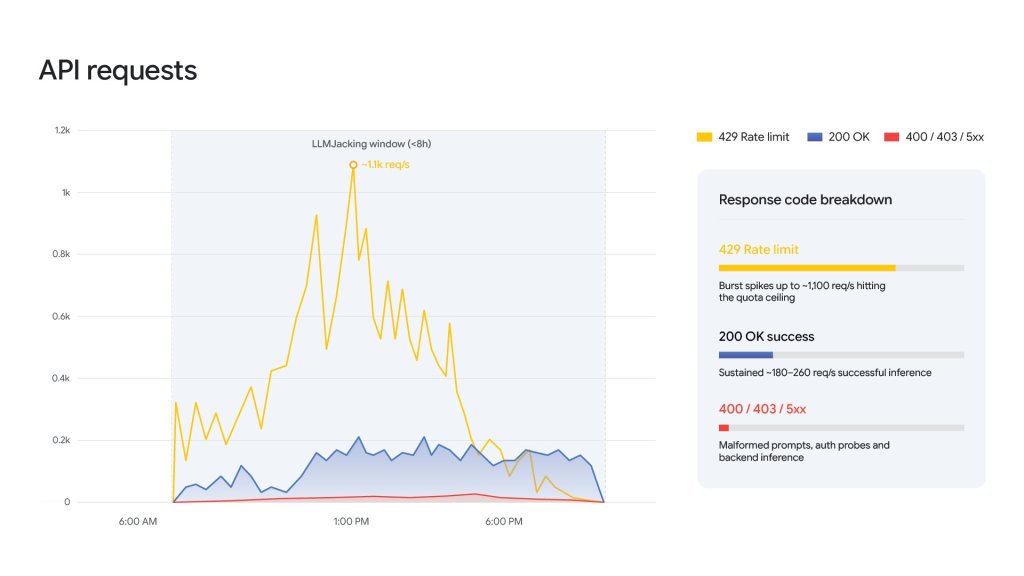
Google investigators observed millions of large language model API calls in approximately 24 hours after attackers gained access to legitimate cloud credentials. The finding appears in the November 16, 2026 Google Threat Intelligence Group and Mandiant report on AI-enabled cybercrime. Google did not disclose an exact call count, so a precise requests-per-second figure cannot be established.
The same report describes separate LLMJacking investigations in which fraudulent AI consumption exceeded $100,000 in one day, with the most severe cumulative resource abuse reaching $1 million before remediation. The financial cases are not identified as the same incident as the 24-hour API surge. Together, the observations renew an important question raised by Jason P. Lowery’s Proof-of-Power Wall concept: can requiring computational effort make automated abuse harder to scale?
Official Mandiant and Google Cloud Security presentation, September 15, 2026, featuring Google Threat Intelligence leadership. Archival context on AI-enabled adversaries.
The 24-hour surge came through valid access
According to Google, at least two separate attackers attempted to exploit a cloud environment using the same legitimate credentials. One inspected available model services, costs and usage. A second set of addresses, apparently operating through a botnet or proxy network, generated millions of model API calls over roughly one day. The compromised credentials were revoked after the noisy activity exposed the account.
Mandiant also documented attackers creating unauthorized service identities, escalating privileges, provisioning GPU instances and requesting expanded cloud quotas in other investigations. Fraudulent inference and compute bills illustrate a distinction often lost in discussions of AI cyberattacks: stealing an existing account can be more effective than overwhelming an anonymous login endpoint.
Where a Proof-of-Power Wall fits
The original BitcoinVersus.Tech Proof-of-Power Wall discussion from March 2025 explored Lowery’s proposal to associate control signals with verifiable physical computation. In a possible web implementation, a gateway could request a fresh cryptographic puzzle before admitting expensive unauthenticated operations. The server would verify the result before committing substantial processing or queue capacity.
The economics scale mathematically. An illustrative puzzle requiring 20 leading zero bits has an expected cost of 220, or 1,048,576 hash attempts. A 24-bit puzzle requires 224, or 16,777,216 expected attempts, sixteen times as much work. Both values describe probabilistic search effort, not tested latency, electricity consumption or an observed success rate against attackers.
Real deployments already demonstrate narrower forms of the principle. The Tor and Cloudflare comparison explains how computational challenges can help prioritize or evaluate requests. The hands-on firewall lesson addresses practical limits, including client device costs and compromised machines.
Mandiant’s official 2026 cybersecurity forecast shared on X in November 2025. Archival industry context, not evidence that computational gates stopped the reported intrusion.
Why proof of work cannot replace access control
A valid credential may already authorize the operation an attacker wishes to perform. A gateway that skips challenges for authenticated users would leave stolen identities unaffected. Applying costly puzzles to every legitimate AI request could also burden customers, mobile devices and victim-owned compute, while attackers distribute work across compromised hosts.
The stronger response combines scoped permissions, phishing-resistant authentication, anomaly detection, short-lived credentials, quota ceilings, spending alerts and immediate revocation. API validation adds another independent layer, as discussed in BitcoinVersus.Tech’s Cloudflare API security analysis. The separate Softwar technical review explains why computational expenditure alone cannot grant permission to issue a command.
Official Mandiant and Google Cloud Security interview, July 27, 2026, examining shadow AI, agent identities and compromised API keys.
For an AI service under attack, the testable measures are abuse attempts denied, legitimate completion time, added energy consumption, unauthorized charges prevented and mean time to revoke credentials. Google’s incident supplies a real-world reason to test those measurements. It does not establish that a Proof-of-Power Wall would have prevented the reported losses.
Primary sources
- Google Threat Intelligence Group and Mandiant, November 16, 2026
- Tor Project, proof-of-work defense for onion services
- Tor protocol documentation on proof-of-work priority queues
- Cloudflare Turnstile challenge documentation
Editor’s Note: We volunteer daily to ensure the credibility of the information on our platform is Verifiably True. If you would like to support our work and the integrity of our research initiatives, scan the QR code below to donate 5,000 sats.

For mobile scanning, open the article on another display and scan the QR code with a Bitcoin wallet. Verify the receiving address 3C9o19EH5HSiwEPyCTmEKzxhNCbo2X6TTb before sending.
BitcoinVersus.tech provides financial and technical journalism for informational purposes and does not provide financial advice.


Leave a Reply